Table of Contents
Pricing Checked: August 16, 2026
Features Checked: August 16, 2026
Last Updated: August 16, 2026
Editorial methodology: This review is based on Hostinger’s current product pages, technical documentation, policies, and independently verified competitor information. It does not claim first hand Hostinger Email testing. Manufacturer specifications and editorial assessments are identified accordingly.
Affiliate disclosure: Include this disclosure if affiliate links are used on the published page: Marjan Services may earn a commission from qualifying purchases made through links on this page. This does not increase the price you pay or determine our editorial conclusions.
Hostinger Email is designed for businesses that want professional email addresses on their own domains without necessarily paying for a complete workplace productivity suite.
That can make it attractive to freelancers, entrepreneurs, small businesses, and existing Hostinger customers, but the cheapest advertised monthly figure does not tell the whole story.
Storage, renewal pricing, mailbox count, migration, aliases, forwarding, security, third-party email client compatibility, AI features, and the cost of adding employees can materially change the value proposition.
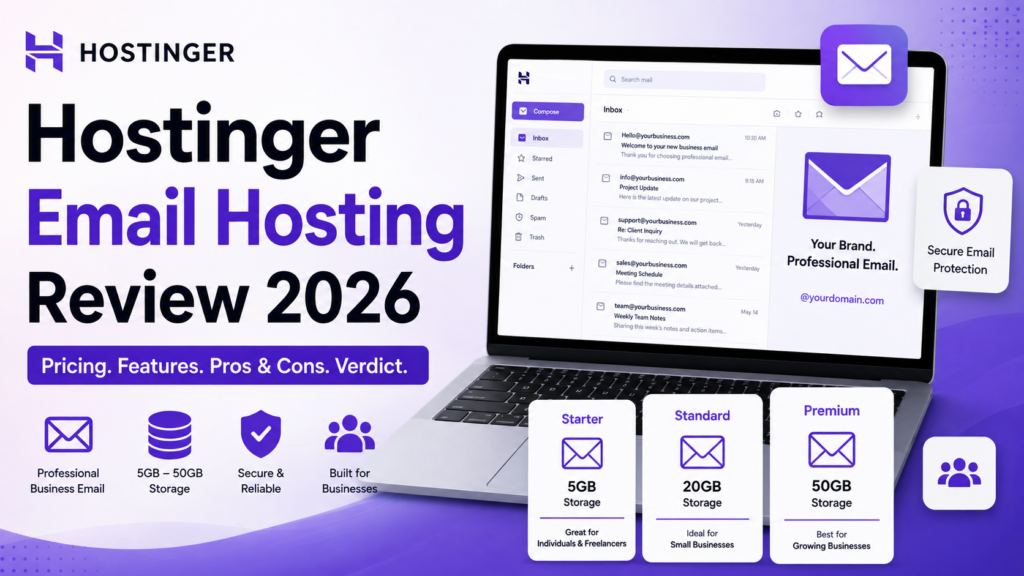
This Hostinger Email Hosting Review 2026 examines those factors using current product information and transparent cost analysis.
Quick answer: Hostinger Email is worth considering when professional custom domain email is the main requirement. Standard appears particularly well-positioned for many small businesses because its 20 GB storage allowance provides considerably more capacity than Starter does without moving directly to Premium.
However, businesses primarily seeking an integrated productivity ecosystem rather than focused business email should compare Google Workspace and Microsoft 365 before purchasing.
Hostinger Email Review: Quick Verdict
Hostinger Email provides a relatively focused business email service built around custom domain mailboxes, webmail, migration, aliases, forwarding, security features, compatibility with standard email clients, and AI-assisted functionality.
Its main strengths are straightforward:
- Low introductory pricing.
- Three storage tiers.
- Professional domain-based addresses.
- Webmail access.
- Third-party email client compatibility.
- Migration functionality.
- Business communication features.
- AI-assisted email tools on applicable plans.
The principal limitations are equally important:
- The lowest advertised rates currently require a 48-month prepaid term.
- Renewal rates are substantially higher.
- Starter provides only 5 GB of mailbox storage.
- Per mailbox pricing becomes more important as the team grows.
- Resource limits apply.
- Hostinger Mail is not a complete replacement for Google Workspace or Microsoft 365 when broader collaboration software is required.
Best for: Freelancers, entrepreneurs, small businesses, and organizations primarily seeking professional email.
Consider an alternative if: Your organization primarily needs integrated document collaboration, enterprise administration, advanced compliance tooling, or a broader workplace productivity environment.
Hostinger Email Plans and Pricing in 2026
As checked on August 16, 2026, Hostinger’s Pakistan-facing Business Email page displays three primary plans.
| Plan | Promotional Monthly Equivalent | Displayed Renewal Rate | Storage | Forwarding Rules | Email Aliases |
|---|---|---|---|---|---|
| Starter | Rs.99 | Rs.299 | 5 GB | 5 | 5 |
| Standard | Rs.199 | Rs.399 | 20 GB | 20 | 10 |
| Premium | Rs.299 | Rs.699 | 50 GB | 50 | 30 |
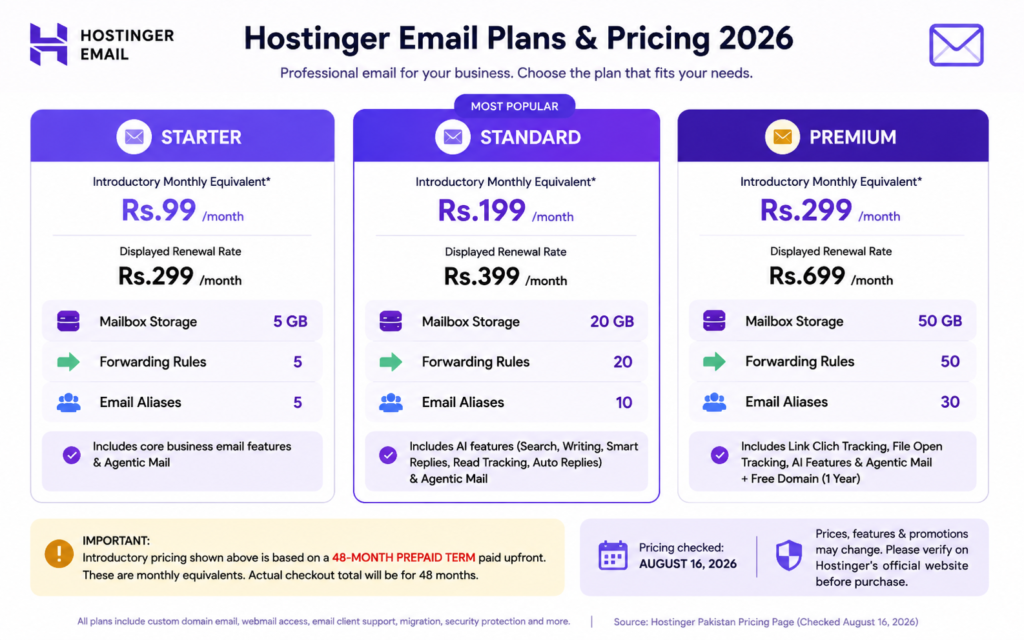
These promotional figures represent monthly equivalents for a longer prepaid subscription rather than ordinary month-to-month billing at those rates.
The lowest advertised prices on the page checked for this review relate to a 48-month commitment paid upfront.
Regional prices, taxes, promotions, currencies, and renewal terms can change. Verify the final checkout amount before purchasing.
What Does Hostinger Email Actually Cost for 48 Months?
Monthly equivalent pricing makes comparison convenient, but the upfront commitment provides a clearer picture of the purchase.
Using the currently advertised promotional monthly equivalents:
| Plan | Monthly Equivalent | Approximate 48 Month Cost Per Mailbox |
|---|---|---|
| Starter | Rs.99 | Rs.4,752 |
| Standard | Rs.199 | Rs.9,552 |
| Premium | Rs.299 | Rs.14,352 |
These figures are calculated by multiplying the displayed monthly equivalent by 48. They are analytical calculations, not separately quoted package totals.
Always use the actual checkout total as the final purchasing figure.
Hostinger Email Cost by Team Size
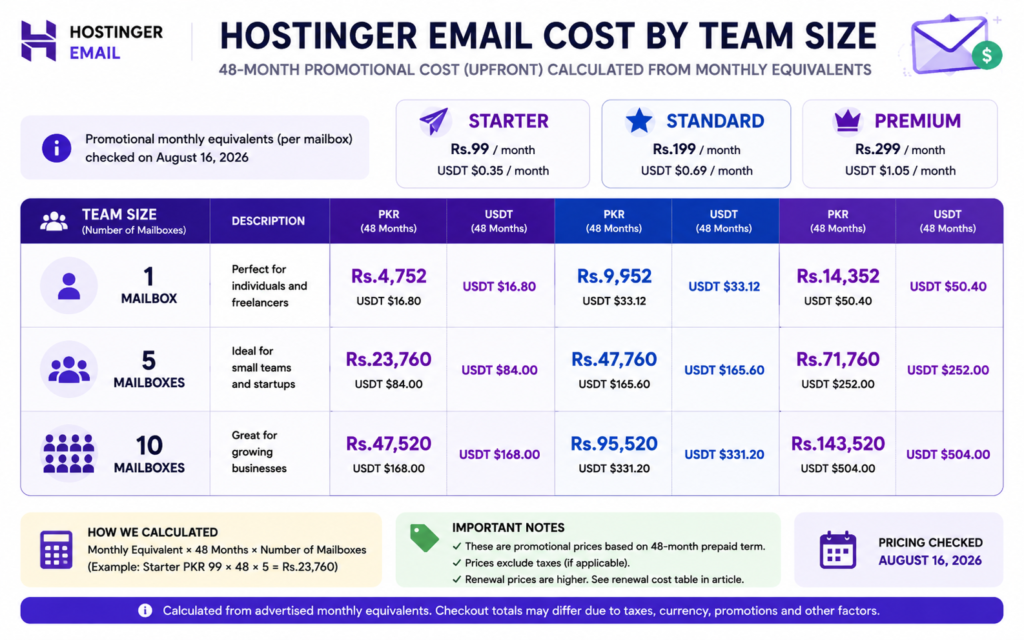
Per mailbox pricing becomes more important as an organization grows.
Promotional 48 Month Cost
| Number of Mailboxes | Starter | Standard | Premium |
|---|---|---|---|
| 1 | Rs.4,752 | Rs.9,552 | Rs.14,352 |
| 5 | Rs.23,760 | Rs.47,760 | Rs.71,760 |
| 10 | Rs.47,520 | Rs.95,520 | Rs.143,520 |
These calculations assume that the published per-mailbox promotional monthly equivalent applies consistently across the number of mailboxes shown.
The important purchasing lesson is simple:
A low price for one mailbox does not necessarily mean a low total email cost for a growing organization.
What Happens at Renewal?
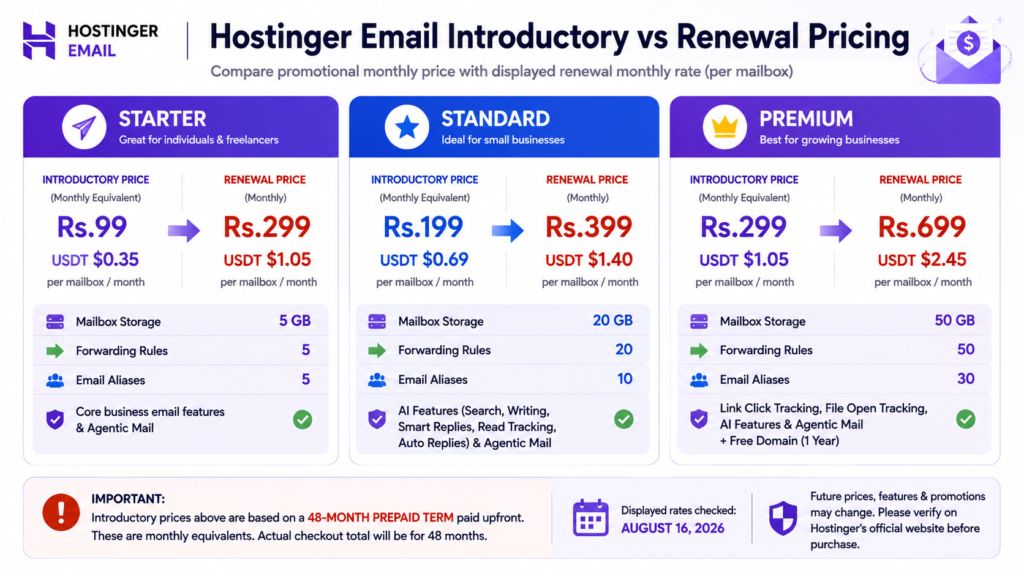
Long-term value should be evaluated using renewal pricing as well as introductory pricing.
Hostinger’s Pakistan page checked for this review displayed:
Starter: Rs.299 per mailbox per month on renewal.
Standard: Rs.399 per mailbox per month on renewal.
Premium: Rs.699 per mailbox per month on renewal.
Using those monthly rates, a simple 48-month renewal scenario would look like this:
| Mailboxes | Starter Renewal Equivalent | Standard Renewal Equivalent | Premium Renewal Equivalent |
|---|---|---|---|
| 1 | Rs.14,352 | Rs.19,152 | Rs.33,552 |
| 5 | Rs.71,760 | Rs.95,760 | Rs.167,760 |
| 10 | Rs.143,520 | Rs.191,520 | Rs.335,520 |
These figures are calculations based on the displayed monthly renewal rates multiplied by 48 and by the stated number of mailboxes. They should not be interpreted as a guarantee that the same renewal pricing will remain available four years from now.
Hostinger may change pricing before renewal.
This analysis demonstrates why a business should not choose an email platform solely because of the initial discount.
For a growing company, renewal cost × number of mailboxes can matter considerably more than the introductory headline price.
Starter vs Standard vs Premium
The correct plan depends primarily on mailbox requirements rather than which tier sounds most impressive.
Hostinger Starter
The current Starter offer includes:
- One mailbox.
- 5 GB storage.
- Five forwarding rules.
- Five email aliases.
- Core business email functionality.
- Agentic Mail as currently advertised.
Starter is most suitable for light users such as freelancers, solo entrepreneurs, personal brands, and very small businesses.
Its principal constraint is 5 GB storage.
That may be sufficient for users whose mailboxes contain mostly text-based correspondence, but attachment-heavy accounts can consume capacity considerably faster.
Hostinger Standard
Standard currently provides:
- One mailbox.
- 20 GB storage.
- 20 forwarding rules.
- 10 aliases.
- AI-assisted search.
- AI writing and summarization.
- Smart replies.
- Read tracking.
- Automatic replies.
- Agentic Mail.
The jump from 5 GB to 20 GB is arguably more important than the additional AI features for many ordinary businesses.
It provides four times Starter’s listed storage while remaining below Premium’s price.
Editorial assessment: Standard is the plan I would examine first for a typical growing small business because its storage allocation creates substantially more room for long-term email usage without automatically paying for Premium.
This is a research-based recommendation, not a result of firsthand performance testing.
Hostinger Premium
Premium currently provides:
- One mailbox.
- 50 GB storage.
- 50 forwarding rules.
- 30 aliases.
- Link click tracking.
- File open tracking.
- AAI-assistedemail functionality.
- Read tracking.
- Automatic replies.
- Agentic Mail.
- A free domain for one year under the current advertised offer.
Premium becomes more compelling when its additional capacity solves a genuine requirement.
It may suit businesses that maintain large email histories, receive many attachments, need substantially more aliases or forwarding rules, or value its additional tracking functionality.
Do not buy Premium simply because it is the highest tier.
If 20 GB already provides sufficient capacity, Standard may represent better value.
A Hostinger Documentation Difference Buyers Should Verify
One issue deserves explicit disclosure.
Hostinger’s current regional commercial page presents a three-tier structure consisting of Starter, Standard, and Premium.
Some Hostinger technical documentation may describe resource limits using product structures that do not map perfectly to the same three current commercial tiers.
That does not automatically mean either source is wrong. Product documentation and commercial pages can be revised on different schedules.
Where a particular technical limit is essential to your decision:
- Check Hostinger’s current regional sales page.
- Review the actual checkout configuration.
- Check the latest technical documentation.
- Ask Hostinger to clarify any material discrepancy before purchasing.
This is more reliable than assuming an older review or support page necessarily describes the exact product currently being sold.
What Is Hostinger Email Hosting?
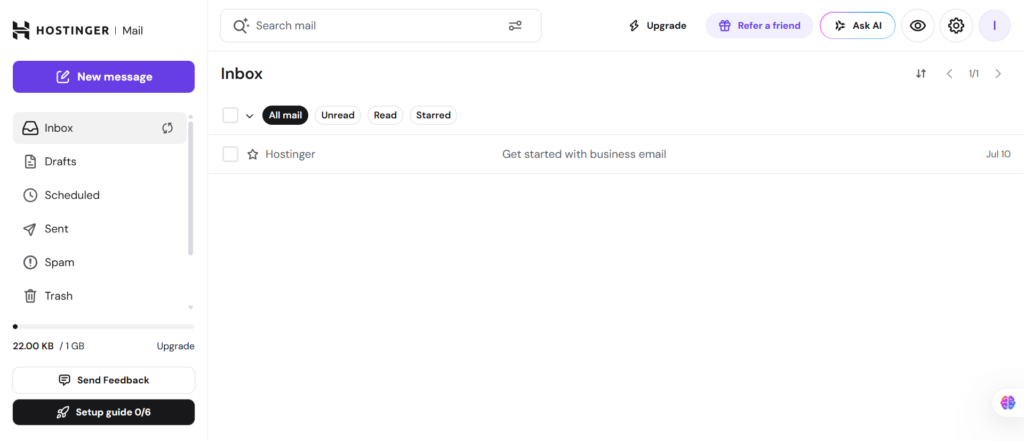
Hostinger Email is a hosted business email service that allows a person or organization to create addresses using its own domain.
For example:
hello@yourbusiness.com
Rather than:
yourbusiness@gmail.com
A custom domain email address creates a consistent organizational identity across a company’s website and communications.
It also separates the business’s public email identity from an individual employee’s personal consumer email account.
Hostinger currently sells its business email service separately from ordinary website hosting, making it relevant even when a company’s website is hosted elsewhere.
Features That Matter in Everyday Business Use
Long feature lists are less useful than understanding how individual capabilities affect real workflows.
Custom Domain Email
Custom domain email is the central product.
Businesses can create addresses associated with functions such as:
sales@company.com
accounts@company.com
support@company.com
This can create a more consistent communication structure and makes the domain, rather than a free consumer email provider, the visible business identity.
Webmail
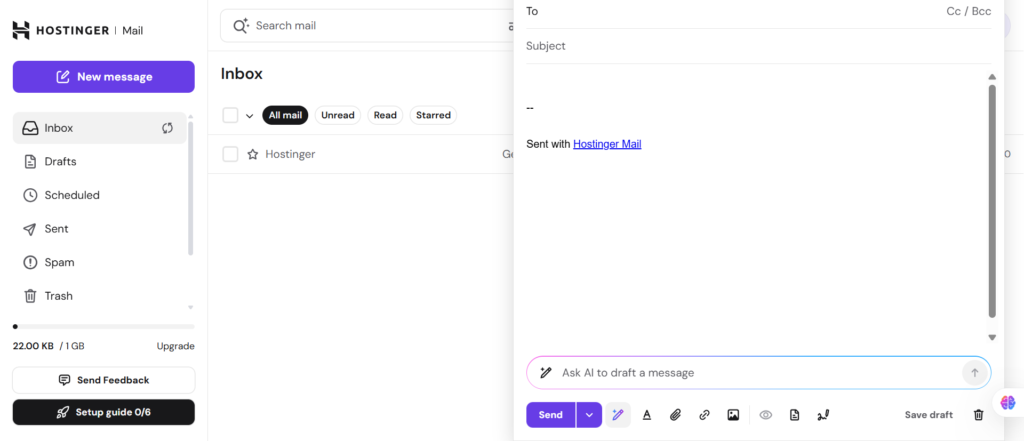
Hostinger provides browser-based webmail.
This means users can access their mailbox without relying entirely on desktop software.
That can simplify access for small businesses that do not want complicated email infrastructure.
Outlook, Gmail, Apple Mail and Other Clients
Hostinger documents support for connecting its mailboxes to popular email clients and compatible applications.
This is important because purchasing Hostinger Mail does not necessarily require users to abandon their preferred email application.
For organizations with existing workflows built around Outlook, Apple Mail, or another compatible client, that flexibility can reduce disruption.
Email Migration
Hostinger provides email migration or import functionality intended to help move existing mail from another service.
Migration difficulty nevertheless depends heavily on the environment.
Moving one relatively small mailbox is fundamentally different from migrating a company with many employees, large historical mailboxes, forwarding arrangements, aliases, and business-critical correspondence.
Larger migrations should therefore be planned and verified rather than assumed to be effortless.
Aliases and Forwarding
Aliases and forwarding can help smaller businesses organize different public email identities without necessarily requiring a completely independent employee mailbox for every function.
For example, a small company may use separate sales, billing, and information addresses while routing messages according to its internal workflow.
The usefulness of this approach depends on the applicable plan allowances and organizational requirements.
Hostinger’s AI Email Features
AI is becoming a more prominent component of Hostinger Mail.
Depending on the current plan, Hostinger advertises capabilities involving:
- Email search.
- Writing assistance.
- Summarization.
- Smart replies.
- Agentic Mail.
These features may reduce repetitive work, but they should not be the first criterion used to choose an email provider.
Before evaluating AI functionality, determine whether:
- Storage is sufficient.
- Renewal pricing is acceptable.
- Required email clients are supported.
- Sending limits fit the workload.
- Security controls meet requirements.
- Existing mail can be migrated.
- The total cost for all employees is sustainable.
AI should be treated as an additional productivity capability rather than a substitute for these fundamentals.
Businesses handling sensitive information should also review the provider’s current privacy, security, and data processing terms before using AI-assisted workflows for confidential correspondence.
Hostinger Email Is Not a Bulk Marketing Platform
Ordinary business email and large-scale email marketing are different services.
A normal business mailbox is intended for activities such as:
- Customer correspondence.
- Supplier communication.
- Invoices.
- Employee messages.
- Support conversations.
- Account-related notifications.
A newsletter sent to thousands of subscribers creates a different technical and reputational workload.
Hostinger applies resource limits to mailboxes and separately offers an email marketing product, Hostinger Reach.
Businesses running substantial subscriber campaigns should use a purpose-built permission-based email marketing service rather than treating an employee mailbox as unlimited marketing infrastructure.
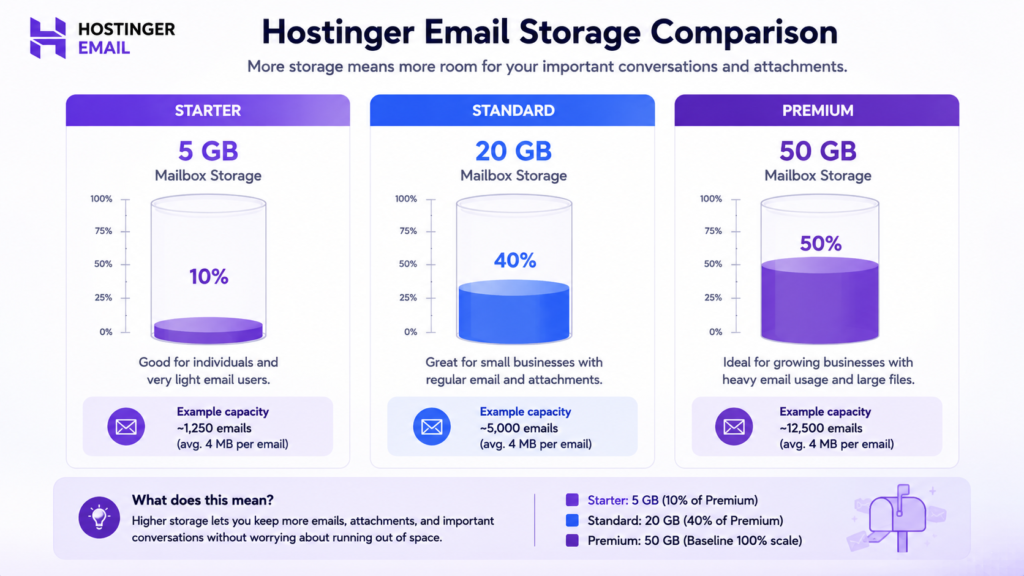
Storage: 5 GB vs 20 GB vs 50 GB
Storage is one of the clearest differences between the current plans.
Starter: 5 GB.
Standard: 20 GB.
Premium: 50 GB.
A text-heavy mailbox may remain relatively small for years.
An account regularly receiving PDFs, photographs, reports, presentations, spreadsheets, and other attachments can grow much faster.
This is why choosing the cheapest plan solely on price can create a false economy if the mailbox later requires more capacity.
For many small businesses, Standard’s 20 GB allocation may provide a more comfortable balance between cost and capacity.
Email Security
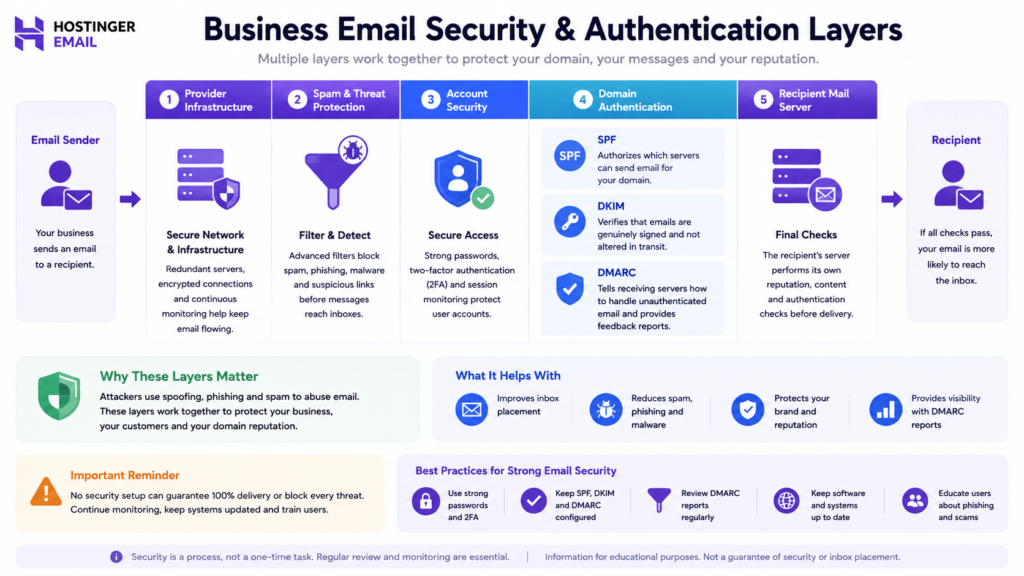
Hostinger advertises spam, virus, and phishing protection as part of its current business email offering.
Provider-level security is only one part of protecting business email.
Organizations should also implement appropriate practices such as:
- Unique passwords.
- Two-factor authentication where available.
- Secure recovery methods.
- Appropriate account permissions.
- Proper employee offboarding.
- Regular review of forwarding rules.
- Domain authentication.
- Sensible retention and backup procedures.
SPF, DKIM and DMARC
Email authentication mechanisms such as SPF, DKIM, and DMARC help receiving systems evaluate messages associated with a domain.
They should not be interpreted as a guarantee that every message will reach the primary inbox.
Deliverability can also be affected by sender reputation, authentication configuration, message content, sending behavior, recipient engagement, complaints, and receiving provider filters.
Be skeptical of any provider claiming guaranteed inbox placement.
Retention and Backups
Important business mail can contain contracts, approvals, invoices, project instructions, and other records.
A Trash folder should therefore not be treated as a permanent archival system.
Organizations with important retention requirements should establish a suitable backup and retention strategy based on their operational requirements and any applicable legal or regulatory obligations.
Ease of Administration
Hostinger’s relatively focused email environment may appeal to small organizations without dedicated IT teams.
Mailboxes can be administered through Hostinger’s management environment, while messages can be accessed through webmail or compatible third-party clients.
This simplicity can be valuable when the company primarily needs email.
The calculation changes when an organization requires advanced identity management, sophisticated retention policies, enterprise compliance controls, device administration, or a tightly integrated productivity environment.
Those requirements justify evaluating broader enterprise platforms.
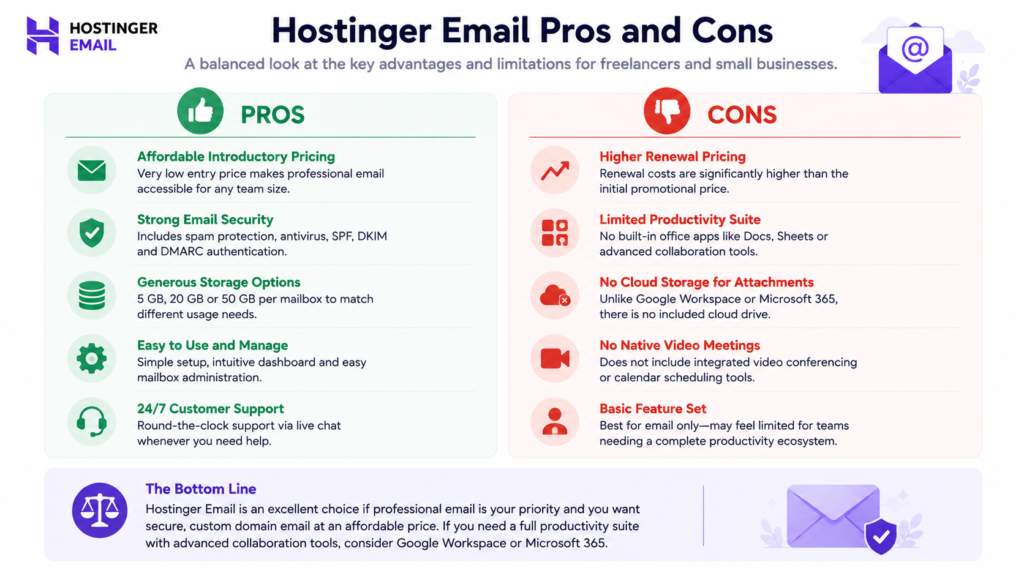
Hostinger Email Pros and Cons
Pros
Low introductory cost. The current promotional pricing creates an accessible entry point.
Professional domain-based email. Businesses can communicate through addresses associated with their own domains.
Three storage tiers. Users can currently choose between 5 GB, 20 GB, and 50 GB allowances.
Email client flexibility. Hostinger supports use with compatible third-party email applications.
Migration functionality. Existing email can be transferred rather than necessarily starting from an empty mailbox.
Aliases and forwarding. These can support practical business communication structures.
Security features. Hostinger advertises spam, virus, and phishing protection.
AI functionality. Applicable plans include increasingly extensive AI-assisted capabilities.
Cons
Lowest pricing requires a long commitment. The cheapest advertised rates checked for this review correspond to a 48-month prepaid term.
Renewal pricing is significantly higher. Long-term budgeting should therefore not use introductory prices alone.
Starter storage is relatively limited. Five gigabytes may be insufficient for attachment-heavy users.
Per mailbox pricing scales with team size. The economics can change substantially as employees are added.
Resource limits apply. Business mailboxes are not unlimited bulk sending infrastructure.
Documentation can differ across Hostinger pages. Exact specifications should be verified when a particular limit is critical.
It is not a complete office suite. Organizations requiring extensive collaborative productivity software should compare broader alternatives.
Hostinger Email vs Google Workspace vs Microsoft 365
The correct comparison is not simply which provider sells the cheapest mailbox.
These services solve different combinations of problems.
| Requirement | Hostinger Mail | Google Workspace | Microsoft 365 |
|---|---|---|---|
| Custom domain business email | Yes | Yes | Yes on applicable business plans |
| Primary proposition | Focused business email | Google productivity ecosystem plus email | Microsoft productivity ecosystem plus email |
| Browser-based email | Yes | Yes | Yes |
| Collaborative documents | More limited | Extensive | Extensive |
| Integrated office tools | Not the primary proposition | Docs, Sheets and related applications | Word, Excel, PowerPoint and related applications depending on plan |
| Best suited to | Organizations primarily needing professional email | Teams working heavily in Google’s ecosystem | Teams working heavily in Microsoft’s ecosystem |
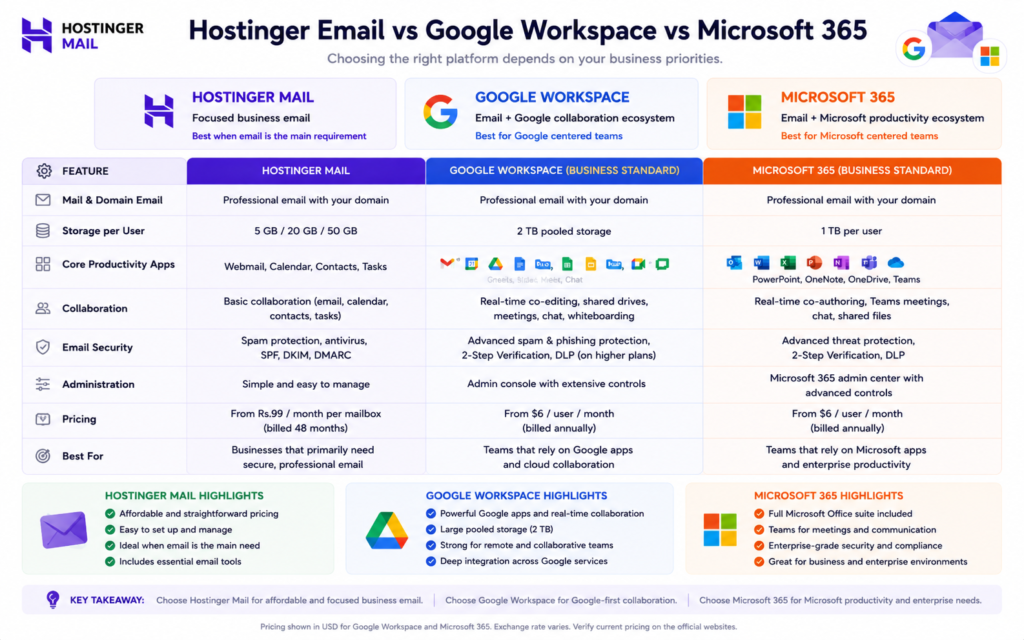
Hostinger vs Google Workspace
Google Workspace combines business Gmail with applications and services such as Drive, Docs, Sheets, Meet, and Calendar.
That makes it fundamentally broader than a focused email hosting service.
Hostinger may therefore be more attractive when the company primarily wants professional email and already has suitable productivity tools.
Google Workspace becomes more compelling when employees actively depend on Google’s collaboration environment throughout the working day.
Hostinger vs Microsoft 365
Microsoft 365 similarly combines business email options with a broader workplace ecosystem involving applications and services such as Outlook, Teams, OneDrive, Word, Excel, and PowerPoint, depending on the subscription.
Hostinger is more directly comparable when email itself is the central requirement.
Microsoft 365 becomes more relevant when email is only one component of a broaderMicrosoft-basedd workplace environment.
Which Should You Choose?
Consider Hostinger Mail when: professional custom domain email is the main requirement, and you want to control email costs without purchasing a much broader software suite.
Consider Google Workspace when: Gmail, Google Drive, Docs, Sheets, Meet, and Google’s collaborative environment are central to the organization.
Consider Microsoft 365 when: Outlook, Teams, OneDrive, Word, Excel, PowerPoint, and Microsoft’s broader business environment are important requirements.
There is no responsible universal winner.
The best choice depends on what the organization actually uses.
Who Is Hostinger Email Best For?
Hostinger Email is particularly relevant to:
- Freelancers.
- Consultants.
- Solo entrepreneurs.
- Small businesses.
- Local businesses.
- Bloggers with professional domains.
- Portfolio website owners.
- Small agencies.
- Existing Hostinger customers.
- Organizations that primarily need professional email rather than a full office suite.
Who Should Avoid Hostinger Email?
Consider another platform first if your organization primarily needs:
- A deeply integrated office productivity environment.
- Enterprise-scale identity administration.
- Advanced compliance tooling.
- Complex device management.
- Specialized archiving.
- Extensive cloud document collaboration.
- Large-scale marketing email infrastructure.
In short: skip Hostinger Mail if email is only a small part of a much broader enterprise collaboration requirement.
Five Questions to Ask Before Buying
1. How many mailboxes do you need?
Calculate both today’s requirement and expected growth.
2. How much storage does each user need?
Choose according to actual mailbox behavior rather than automatically selecting the cheapest or largest plan.
3. What happens to the budget at renewal?
Use renewal pricing when evaluating long-term affordability.
4. Do you need email or an entire productivity ecosystem?
This can determine whether Hostinger, Google Workspace, or Microsoft 365 is the more appropriate category of product.
5. Are any technical requirements non-negotiable?
Verify critical limits and functionality before paying.
These questions provide a more reliable decision framework than choosing whichever plan displays the largest promotional discount.
Is Hostinger Email Good for Small Businesses?
Yes, when the business primarily needs straightforward professional email.
Hostinger’s current offering provides the core capabilities many smaller organizations need, including custom domain addresses, storage choices, aliases, forwarding, webmail, email client compatibility, migration functionality, security features, and AI-assisted tools.
The proposition becomes less compelling when a company needs extensive collaboration and enterprise administration beyond email.
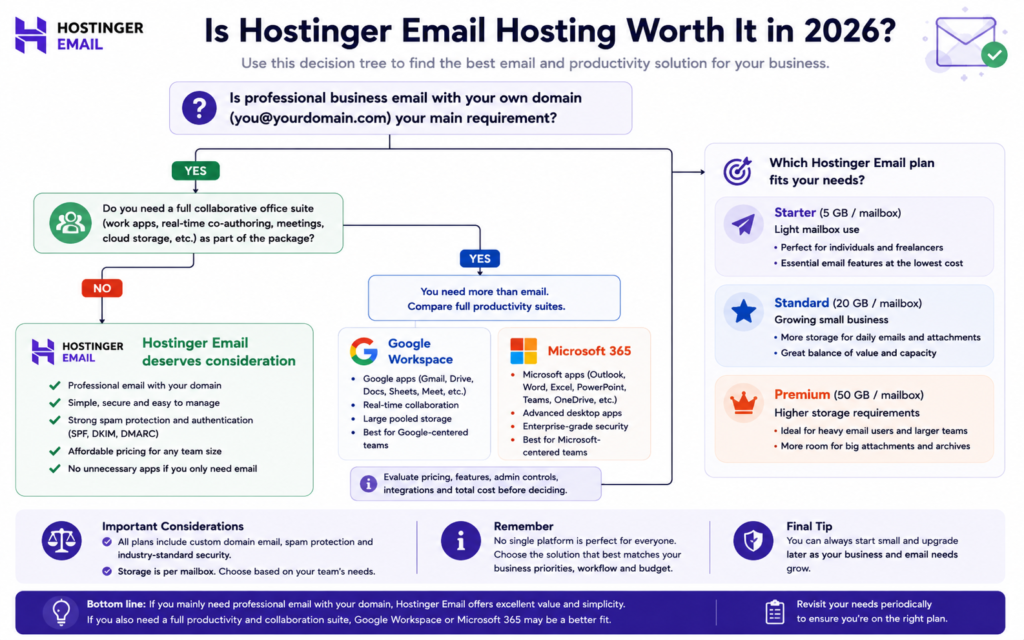
Is Hostinger Email Worth It in 2026?
Hostinger Email is worth considering for cost-conscious businesses whose main requirement is professional domain-based email.
Starter suits relatively light users.
Standard is likely to be the most practical starting point for many growing small businesses because its 20 GB mailbox provides considerably more capacity than Starter.
Premium is more appropriate when 50 GB storage, expanded aliases, forwarding capacity, tracking, or other Premium functionality solves an identifiable requirement.
The correct decision should be based on:
number of mailboxes + storage requirements + required features + renewal cost + broader productivity needs.
That formula is much more useful than judging the service from its promotional price alone.
Hostinger Email Hosting Review: Quick Verdict
Hostinger Mail occupies a useful position between free consumer email and much broader business productivity ecosystems.
It provides professional domain-based email, multiple storage tiers, webmail, migration, aliases, forwarding, security functionality, email client compatibility, and increasingly extensive AI-assisted tools.
Its biggest advantage is focus.
A freelancer or smaller company that primarily needs professional email may avoid paying for a wider productivity ecosystem it does not require.
Its main disadvantages are the long commitment attached to the lowest promotional pricing, materially higher renewal rates, per-mailbox scaling costs, resource limits, and a narrower collaboration ecosystem than Google Workspace or Microsoft 365.
Final recommendation: Hostinger Email is a strong candidate for freelancers, entrepreneurs, and smaller organizations primarily seeking professional custom domain email at a controlled cost. Standard deserves particular consideration for many small businesses because its 20 GB storage allocation creates substantially more capacity than Starter without immediately moving to Premium.
Businesses requiring integrated collaboration, extensive office software, advanced enterprise administration, or specialized compliance functionality should compare Google Workspace and Microsoft 365 before deciding.
Most importantly, evaluate Hostinger using the renewal price and total number of required mailboxes, not only the introductory monthly equivalent.
Frequently Asked Questions
Can I use Hostinger Email without hosting my website with Hostinger?
Hostinger sells business email separately from website hosting. This makes Hostinger Mail relevant even when a website is hosted elsewhere, subject to the current product terms and required domain configuration.
Can Hostinger Email work with Outlook, Gmail or Apple Mail?
Hostinger documents compatibility with popular email clients and applications. Verify the current configuration instructions for the client you intend to use before setup.
Can Hostinger Email be used for newsletters?
Ordinary business email and bulk email marketing should be treated as separate workloads. Hostinger separately offers Hostinger Reach for email marketing. Businesses running significant subscriber campaigns should use appropriate permission-based marketing infrastructure.
Which Hostinger Email plan offers the best value?
There is no universal best plan. Standard appears particularly attractive for many growing small businesses because it increases storage from 5 GB to 20 GB while providing additional business functionality. Premium makes more sense when its 50 GB capacity and additional features solve actual requirements.
Can I upgrade later?
Hostinger provides upgrade options for growing email requirements. Because pricing and upgrade conditions can change, verify the current options inside the account or during purchase before relying on a particular upgrade path.
Affiliate Disclosure
If affiliate links are present, display the affiliate disclosure prominently near the beginning of the page.
Do not allow commission potential to determine the recommendation.
Original Screenshots
If genuine Hostinger Email access is available, add original screenshots showing:
Hands-On Testing
If genuine testing is performed later, document:
- Plan tested.
- Testing date.
- Setup process.
- Email clients used.
- Migration performed, if any.
- Features actually tested.
- Observed limitations.
- Measurements genuinely collected.
- Areas that were not tested.
Never manufacture performance results simply to strengthen the review.
Use only URLs that genuinely exist.
Do not overload ordinary editorial sentences with unnecessary citations.
Structured Data
Use Article structured data where appropriate and consistent with the visible page.
Do not fabricate review ratings, author credentials, aggregate ratings, or other structured data simply to pursue enhanced search presentation.
Page Experience
After publication, verify:
- Mobile responsiveness.
- Table responsiveness.
- HTTPS.
- Core Web Vitals.
- Image compression.
- Image dimensions.
- Cumulative Layout Shift.
- Largest Contentful Paint.
- Readable typography.
- Breadcrumbs.
- Table of contents.
- Author information.
- Clear main content.
- Non-intrusive affiliate elements.
- Non-intrusive popups.
- Accessible image alt text.
Authoritative Internal Resources and Related Expert Guides
- Hostinger Review 2026
- Complete Domain Name Guide 2026
- Technical SEO Guide 2026
- Website Mistakes to Avoid
- Professional Website Development & SEO Services
Authoritative External References and Official Resources
- Hostinger Business Email and Hostinger Mail
- Hostinger Mail Help Center and Technical Documentation
- Hostinger Mailbox Creation and Management Guide
- Hostinger Webmail Access and Usage Guide
- Google Search Central High-Quality Review Guidelines
- Google Search Reviews System Documentation
- Google People First Content Guidelines