Table of Contents
Introduction
Domain Name Guide: A domain name is much more than a web address. It represents your brand, establishes credibility, and serves as the foundation of your online presence. Whether you are launching a personal blog, an online store, a business website, or a professional portfolio, choosing the right domain name is one of the first and most important decisions you will make.
Many people focus only on finding the cheapest domain registration service. While cost is important, factors such as reliability, security, renewal pricing, customer support, and ease of management have a much greater impact over the lifetime of your website.
A carefully selected domain can strengthen your brand, make your website easier to remember, and improve user trust. On the other hand, a poor choice can confuse visitors, weaken your marketing efforts, and create unnecessary challenges if you decide to rebrand later.
This guide walks you through every stage of the domain lifecycle, from understanding how domains work to selecting the right extension, registering your domain, protecting it from security threats, and managing it for long-term success.
Who This Guide Is For
This guide is designed for anyone who wants to choose, register, or manage a domain name with confidence. Whether you are launching your first website or improving an existing online presence, the information in this guide will help you make informed decisions based on current industry best practices.
This guide is especially useful for:
- Small business owners creating a professional online presence.
- Entrepreneurs launching a new brand or startup.
- Bloggers and content creators building a personal website.
- Freelancers and consultants establishing their professional identity.
- eCommerce businesses planning to sell products online.
- Digital marketers and SEO professionals advising clients.
- Students and beginners learning how domain names work.
- Organizations looking to strengthen their online branding.
Regardless of your experience level, understanding how domain names, domain extensions, DNS, security, and domain management work can help you avoid common mistakes and build a stronger foundation for long-term online success.
Why You Can Trust This Guide
This guide is based on practical experience working with domain registration, website development, WordPress, Shopify, business websites, and SEO projects. Instead of recommending a registrar simply because it offers the lowest introductory price, this guide focuses on long-term ownership costs, domain security, renewal policies, ease of management, and branding considerations. The recommendations are intended to help beginners and business owners make informed decisions that support sustainable online growth.
What Is a Domain Name?
A domain name is the human-readable address people type into a browser to access your website. Instead of remembering a complex IP address such as 192.168.1.1 users enter a memorable name like yourbusiness.com.
Think of your domain name as the street address of your digital property. Just as customers need an address to locate a physical store, internet users need a domain name to find your website.
A typical domain consists of two primary parts:
- The domain name itself, such as “example.”
- The domain extension, such as “.com.”
Together, they create a unique online identity that directs visitors to your website.
Why Is a Domain Name Important?
Real World Example
Imagine two local businesses offering the same service. One uses a branded domain such as BrightHomeSolutions.com, while the other relies on a free website address. Most customers instinctively trust the branded website because it appears more established and professional. That initial impression often influences whether visitors stay on the site, contact the business, or move on to a competitor.
A professional domain name provides several business advantages.
Builds Trust
Customers are more likely to trust a website with its own branded domain than one using a free subdomain.
For example:
- yourbusiness.com
appears significantly more professional than
- yourbusiness.freewebsite.com
A custom domain demonstrates commitment, professionalism, and long-term investment in your business.
Strengthens Brand Identity
Your domain often becomes the first impression of your business. A short, memorable, and brandable name helps customers remember your company and return to your website.
Consistent branding across your website, email addresses, and social media profiles reinforces recognition and credibility.
Supports Marketing
Your domain appears in:
- Search results.
- Business cards.
- Email signatures.
- Advertisements.
- Social media profiles.
- Printed brochures.
Choosing an easy-to-spell and easy-to-pronounce domain improves brand recall and reduces the likelihood of users mistyping your address.
Professional Email Addresses
Owning a domain allows you to create branded email addresses such as:
These look more trustworthy than free email accounts and help build confidence with customers.
How Domain Names Work
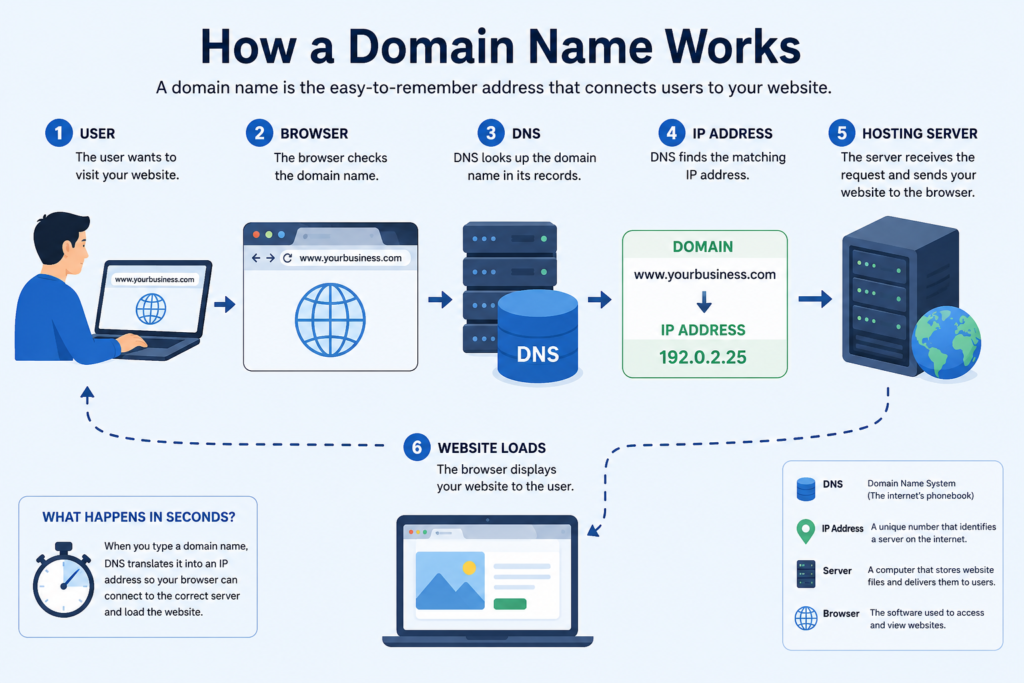
Every website is hosted on a server with a numerical IP address. Since these numbers are difficult for humans to remember, the Domain Name System (DNS) acts like the internet’s phonebook.
When someone enters your domain into a browser, DNS translates that domain into the correct IP address, allowing the browser to connect to your website’s server and load the requested content.
The process happens in seconds and is invisible to the user.
The Main Components of a Domain Name
Top-Level Domain (TLD)
The TLD is the extension at the end of your domain.
Examples include:
- .com
- .net
- .org
- .info
- .biz
Among these, .com remains the most widely recognized and trusted option for many commercial websites.
Country Code Top-Level Domains (ccTLDs)
Country-specific extensions target users in a particular region.
Examples include:
- .uk
- .ca
- .pk
- .au
- .de
Businesses serving a local audience often benefit from using their country’s domain extension alongside or instead of a global extension.
Generic Top-Level Domains (gTLDs)
Modern gTLDs offer industry-specific branding opportunities.
Examples include:
- .shop
- .store
- .tech
- .online
- .agency
- .blog
- .design
While these extensions can be memorable, businesses should evaluate customer familiarity and long-term branding before choosing them.
Domain Name vs Web Hosting
Common Beginner Mistakes
Many first-time website owners assume that buying a domain automatically includes web hosting, email services, and website creation tools. In reality, these are separate services. Understanding the difference before making a purchase helps avoid unnecessary expenses and confusion during website setup.
Many beginners confuse domain names with web hosting, but they serve different purposes.
| Feature | Domain Name | Web Hosting |
|---|---|---|
| Purpose | Website address | Stores website files |
| Required | Yes | Yes |
| Renewal | Annual | Monthly or annual |
| Example | example.com | Hosting account |
| Ownership | Registered through a registrar | Purchased from a hosting provider |
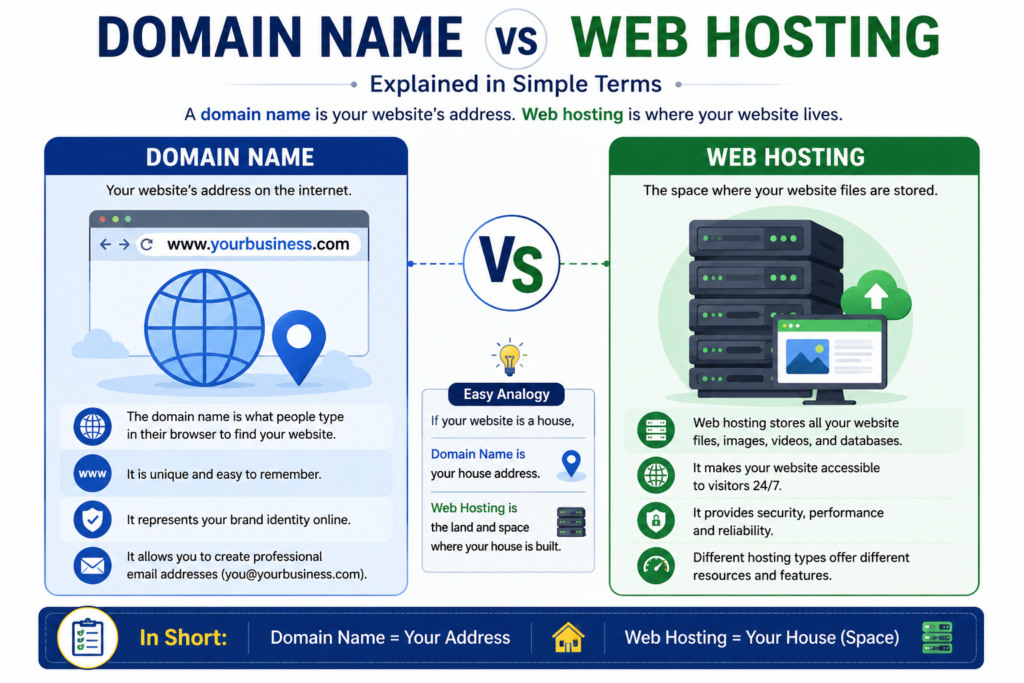
An easy way to remember the difference is to think of your website as a house. The domain name is the address people use to find it, while web hosting is the land where the house is built.
Understanding Domain Extensions
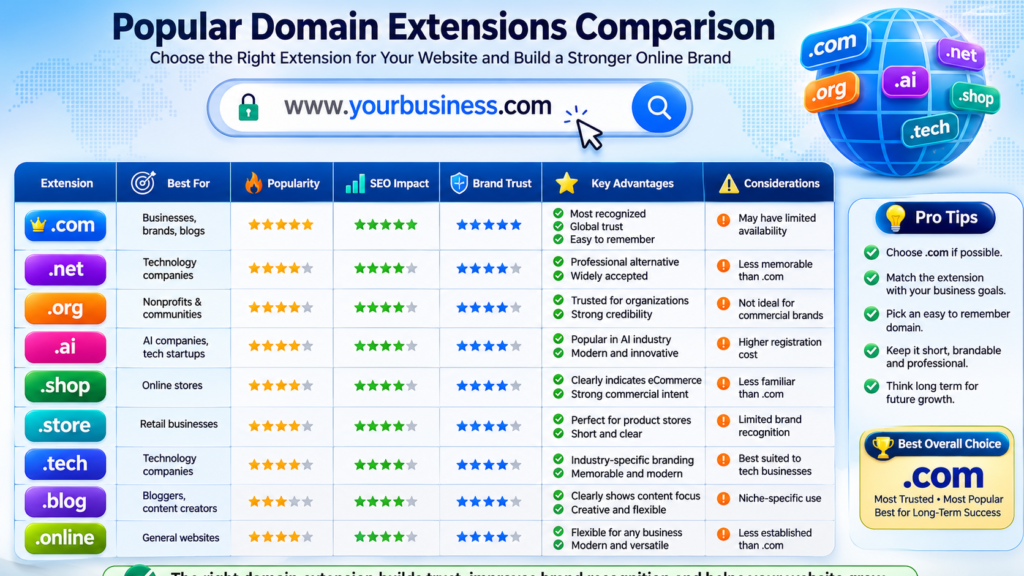
Choosing the right domain extension is just as important as selecting the domain name itself. While your domain name reflects your brand, the extension helps visitors understand the purpose, location, or nature of your website.
Years ago, businesses had only a handful of choices, such as .com, .net, and .org. Today, hundreds of extensions are available, including industry-specific and country-specific options. Although search engines can index most extensions equally, user trust, brand recognition, and audience expectations still influence the best choice.
Common Domain Extensions
| Extension | Best For | Advantages | Considerations |
|---|---|---|---|
| .com | Businesses, brands, blogs | Most recognized and trusted | May have limited availability |
| .net | Technology companies | Professional alternative | Less memorable than .com |
| .org | Nonprofits and communities | Trusted for organizations | Not ideal for commercial brands |
| .co | Startups and businesses | Short and modern | Can be confused with .com |
| .ai | AI companies | Popular in artificial intelligence | Higher registration cost |
| .shop | Online stores | Clearly indicates eCommerce | Less familiar than .com |
| .store | Retail businesses | Strong commercial intent | Limited brand recognition |
| .tech | Technology companies | Industry-specific branding | Best suited to tech businesses |
| .online | General websites | Flexible | Less established |
Should You Always Choose .com?
For most businesses, .com remains the preferred choice because it is widely recognized and trusted. Customers often type “.com” instinctively when searching for a business online.
However, a different extension may be appropriate if:
- Your target audience is local, and a country-specific extension aligns with your market.
- Your preferred
.comdomain is unavailable. - Your business operates in a niche where an industry-specific extension strengthens branding.
The most important consideration is selecting a domain that customers can easily remember and trust.
When Another Extension Is the Better Choice
Although .com remains the most recognized and trusted domain extension for many businesses, it is not always the best choice. The ideal extension depends on your target audience, industry, branding goals, and geographic focus. Choosing an extension that aligns with your business can improve brand recognition and help visitors immediately understand the purpose of your website.
Local Businesses
Businesses that primarily serve customers in a specific country or region often benefit from using a country code top-level domain (ccTLD). Extensions such as .pk, .uk, .ca, or .au can strengthen your local identity and make your business appear more relevant to regional customers. For example, a company that operates exclusively in Pakistan may find that a .pk domain resonates better with local users than a generic extension.
Nonprofit Organizations
Nonprofit organizations, charities, and community initiatives often use the .org extension because it has long been associated with educational, charitable, and public interest organizations. While nonprofits can certainly use .com, many visitors naturally associate .org with organizations that focus on public service rather than commercial activities.
AI and Technology Startups
Technology companies and artificial intelligence startups increasingly choose extensions such as .ai, .tech, or .io to reinforce their industry focus. These extensions can help create a modern brand image and immediately communicate the type of products or services a company provides. However, businesses should also consider long-term branding, customer familiarity, and registration costs before selecting a specialized extension.
Country Focused Businesses
Companies that primarily operate within one country often benefit from using a local extension that reflects their target market. A Canadian business may choose .ca, while an Australian company may prefer .au. Using a country-specific extension can help build trust among local customers who prefer doing business with organizations that have a strong regional presence.
Government Organizations
Government agencies typically use official extensions such as .gov or country-specific government domains where available. These extensions provide a high level of credibility because they are generally restricted to authorized public institutions. Businesses and individuals should never attempt to imitate government domain naming conventions, as doing so may violate legal or registration requirements.
Educational Institutions
Universities, colleges, schools, and academic organizations frequently use .edu or country-specific educational domains where permitted. These extensions immediately signal that the website represents an educational institution, making them highly trusted among students, educators, and researchers.
Comparing Popular Domain Extensions
The following comparison can help you determine which extension may best suit your goals:
| Domain Extension | Best For | Primary Advantage | Considerations |
|---|---|---|---|
| .com | Businesses, brands, blogs | Most recognized and trusted | May have limited availability |
| .org | Nonprofits and communities | High credibility for nonprofit organizations | Less suitable for commercial businesses |
| .net | Technology and network services | Professional alternative to .com | Lower brand recognition than .com |
| .pk | Businesses targeting Pakistan | Strong local identity | Less suitable for international audiences |
| .co | Startups and modern businesses | Short and memorable | Can sometimes be confused with .com |
| .tech | Technology companies | Clearly communicates industry focus | Best suited to technology-related businesses |
| .ai | Artificial intelligence companies | Popular within the AI industry | Higher registration and renewal costs |
| .shop | Online stores | Instantly communicates eCommerce | Less familiar than .com |
Rather than choosing an extension based solely on popularity, focus on selecting one that supports your brand, aligns with your audience, and remains suitable as your business grows. In many cases, securing both your primary extension and relevant alternatives can also help protect your brand identity over the long term.
How to Choose the Perfect Domain Name
A domain name is a long-term investment in your brand. Changing it later can affect branding, marketing materials, customer recognition, and search visibility. Spending extra time choosing the right name now can save significant effort in the future.
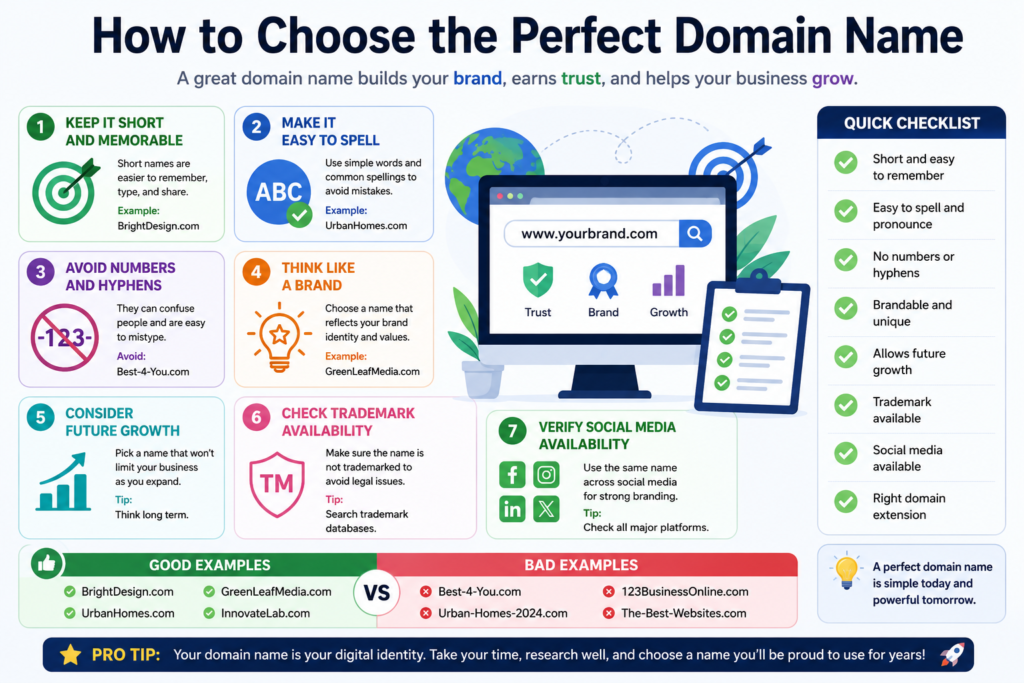
1. Keep It Short and Memorable
Short domain names are easier to type, share, and remember.
Good examples:
- brightdesign.com
- urbanhomes.com
- greenleafmedia.com
Less effective examples:
- bestaffordablewebsitedesignservicesonline.com
Long names increase the chance of typing errors and reduce memorability.
2. Make It Easy to Spell
If people struggle to spell your domain after hearing it once, they may never reach your website.
Avoid:
- Difficult spellings.
- Uncommon words.
- Repeated letters.
- Ambiguous pronunciations.
A simple, intuitive domain improves user experience and supports word-of-mouth marketing.
3. Avoid Numbers and Hyphens
Numbers and hyphens often create confusion.
For example:
- best-4-you.com
A customer may not know whether to type “4” or “four,” or may forget the hyphen entirely.
Whenever possible, choose a clean domain consisting only of letters.
4. Think Like a Brand
Your domain should represent your business beyond today’s products or services.
Instead of focusing solely on keywords, consider whether the name:
- Reflects your business identity.
- Is easy to pronounce.
- Is distinctive.
- Can grow with your company.
Strong branding creates long-term value that extends beyond search engine optimization.
5. Consider Future Growth
Many businesses begin with one product but expand over time.
For example, a domain like:
- bestlaptopshop.com
may become restrictive if the company later sells phones, tablets, or accessories.
A broader brand name offers greater flexibility.
6. Check Trademark Availability
Before purchasing a domain, ensure it does not infringe on another company’s trademark.
Using an existing trademarked brand could lead to legal disputes, forced domain transfers, or rebranding costs.
Research trademarks in the countries where you intend to operate and seek legal advice if necessary.
7. Verify Social Media Availability
Consistency across digital platforms strengthens brand recognition.
Before registering your domain, check whether the same business name is available on major social media platforms.
Using identical branding across your website and social channels makes it easier for customers to find and trust your business.
Does a Domain Name Affect SEO?
This is one of the most common questions among website owners.
The short answer is not in the way many people believe.
Modern search engines prioritize:
- Helpful content.
- Relevant information.
- Website quality.
- User experience.
- Expertise and trustworthiness.
Having an exact-match keyword in your domain does not guarantee higher rankings.
However, a good domain can indirectly support SEO by:
- Improving click-through rates.
- Increasing brand recognition.
- Encouraging repeat visitors.
- Building trust.
- Supporting marketing campaigns.
A memorable brand often performs better over the long term than a keyword-stuffed domain.
Common SEO Myths About Domains
Many website owners believe that simply choosing the “right” domain name will automatically improve their Google rankings. While your domain name plays an important role in branding and user trust, several common misconceptions continue to circulate. Understanding these myths can help you make better decisions and avoid investing time or money in strategies that provide little or no SEO benefit.
Myth 1. Exact Match Domains Guarantee Higher Rankings
Years ago, websites with exact-match domains, such as bestlaptops.com, sometimes gained an advantage simply because their domain matched popular search queries. Today, Google’s ranking systems are far more sophisticated. An exact-match domain alone does not improve rankings if the website lacks helpful, high-quality content.
A brandable domain supported by valuable content, strong user experience, and topical authority will generally outperform a keyword-stuffed domain over the long term.
Myth 2. Older Domains Automatically Rank Higher
Many people assume that buying an older domain guarantees better rankings. While an aged domain may have an existing backlink profile or established reputation, age itself is not a direct Google ranking factor.
A newly registered domain with excellent content, strong technical SEO, and a positive user experience can outperform an older domain that has outdated information, poor content quality, or spam-related issues.
Myth 3. A .com Domain Always Ranks Better Than .net or Other Extensions
Google has repeatedly stated that it does not give preferential treatment to .com domains simply because of the extension. Search engines can index and rank many different domain extensions equally.
However, .com often performs well from a marketing perspective because users recognize it, remember it more easily, and tend to trust it. This improved brand recognition may indirectly support SEO by increasing click-through rates, repeat visitors, and direct traffic.
Myth 4. Expensive Domains Improve SEO
Purchasing a premium or expensive domain does not automatically increase your rankings. A high-priced domain may have branding advantages or memorable characteristics, but Google does not rank websites based on how much was paid for the domain.
A standard domain with exceptional content, reliable performance, and a strong user experience can achieve better search visibility than an expensive domain with weak content.
What Actually Influences Google Rankings?
Instead of focusing on domain myths, invest your time in the factors that genuinely affect search performance. Google primarily evaluates the overall quality and usefulness of your website rather than the price or age of your domain.
Some of the most important ranking factors include:
- Publishing original, accurate, and helpful content that satisfies search intent.
- Demonstrating experience, expertise, authoritativeness, and trustworthiness (E.E.A.T.).
- Maintaining fast page loading speeds and a mobile-friendly website.
- Building a logical site structure with effective internal linking.
- Earning relevant, high-quality backlinks from reputable websites.
- Keeping content accurate, up to date, and regularly reviewed.
- Providing a secure browsing experience through HTTPS and strong website security.
- Creating a positive user experience with clear navigation and accessible design.
A memorable domain name supports your overall digital strategy, but long-term SEO success comes from consistently delivering valuable content, maintaining a technically sound website, and building trust with both users and search engines. By focusing on these fundamentals, your website is far more likely to achieve sustainable rankings than by relying on outdated SEO myths alone.
How to Check Domain Availability
Once you have selected a potential domain name, the next step is confirming that it is available for registration.
Most registrars provide a search tool where you can:
- Enter your preferred domain.
- Check whether it is available.
- Explore alternative extensions if necessary.
- Review pricing and renewal costs.
- Complete the registration process.
If your preferred domain is unavailable, consider:
- Adding a relevant brand word.
- Using an appropriate alternative extension.
- Choosing a shorter variation.
- Contacting the current owner if acquiring the domain is commercially valuable.
Avoid making unnecessary spelling changes that could confuse users.
Domain Name Ideas for Different Businesses
| Business Type | Domain Strategy |
|---|---|
| Local Business | Include your brand and, if appropriate, your service area |
| eCommerce Store | Use a memorable brand name rather than product keywords alone |
| Personal Portfolio | Use your own name where practical |
| Startup | Choose a unique, scalable brand |
| Agency | Brand-focused, professional, and easy to pronounce |
| SaaS Company | Short, innovative, and globally recognizable |
| Blog | Niche-focused while allowing future expansion |
Professional Domain Selection Checklist
Before purchasing your domain, ask yourself:
- ✔ Is it easy to remember?
- ✔ Is it easy to spell?
- ✔ Is it easy to pronounce?
- ✔ Does it reflect my brand?
- ✔ Can customers type it without mistakes?
- ✔ Does it allow future business growth?
- ✔ Is it legally safe?
- ✔ Is the matching social media username available?
- ✔ Does it look professional on business cards and email signatures?
- ✔ Would I still be happy using this domain five years from now?
If you answer “yes” to all of these questions, you have likely chosen a strong domain name.
Expert Tips Before Registering
- Register your domain for multiple years if you plan to use it long term.
- Enable automatic renewal to reduce the risk of accidental expiration.
- Activate domain privacy if it is available and appropriate for your registration.
- Keep your registrar account secured with a strong password and multi-factor authentication.
- Maintain accurate registration contact details to avoid issues with renewal or ownership verification.
- If your brand is valuable, consider registering common variations or relevant extensions to reduce the risk of impersonation.
How to Register a Domain Name
Registering a domain name is a straightforward process, but making informed decisions at each step can save you money, improve security, and support your business over the long term. Before completing your purchase, take time to compare registrars, understand renewal costs, and review optional services.
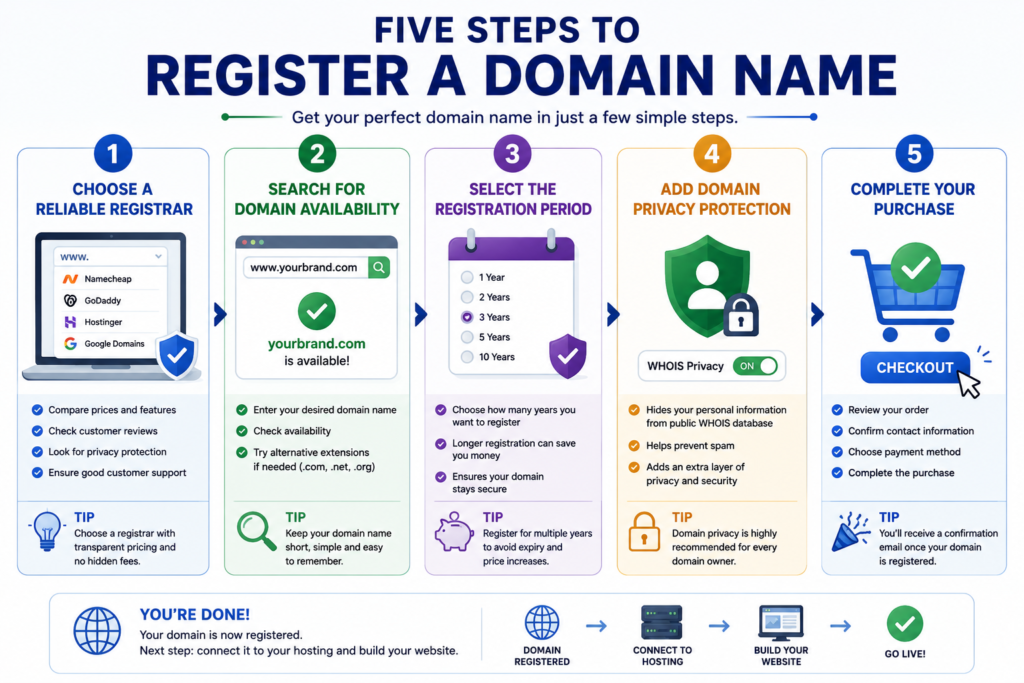
Step 1. Choose a Reliable Domain Registrar
A domain registrar is an accredited company authorized to register and manage domain names. While many registrars offer similar services, they differ in pricing, customer support, security features, user experience, and additional tools.
When evaluating a registrar, consider the following:
- Transparent registration and renewal pricing.
- Strong reputation and customer support.
- Free or affordable WHOIS privacy.
- Domain transfer flexibility.
- DNS management tools.
- Multi-factor authentication.
- Domain locking and security features.
- Integration with hosting, email, and SSL certificates.
Step 2. Search for Domain Availability
Use the registrar’s search tool to check whether your desired domain name is available.
If your preferred domain is already registered:
- Try another extension.
- Consider a shorter variation.
- Add a relevant brand word.
- Contact the current owner if the domain has significant business value.
Avoid choosing confusing spellings or unnecessary hyphens simply because your first choice is unavailable.
Step 3. Select the Registration Period
Most registrars allow registrations from one to ten years.
For long-term businesses, registering for multiple years can:
- Reduce the chance of accidental expiration.
- Simplify long-term management.
- Provide pricing stability if renewal rates increase.
Remember that domain registration length is not a direct Google ranking factor.
Step 4. Add Domain Privacy Protection
Many registrars offer WHOIS privacy protection.
Benefits include:
- Hiding personal contact information.
- Reducing spam emails.
- Limiting unwanted phone calls.
- Protecting business identity.
Depending on the extension and registrar, privacy protection may be included or available as an optional service.
Step 5. Complete Your Purchase
After reviewing your order:
- Confirm the domain spelling.
- Review renewal pricing.
- Check included services.
- Verify your contact information.
- Enable automatic renewal if appropriate.
Once payment is completed, the registrar will register the domain in your name.
Before You Buy. Ask Yourself These Questions
Choosing a domain name is a long-term business decision rather than a quick purchase. While it is easy to focus on whether a domain is available, it is equally important to think about how that name will represent your business in the years ahead. A domain that works well today should continue supporting your brand as your products, services, and audience grow.
Before completing your registration, take a few moments to answer the following questions. These practical considerations can help you avoid costly rebranding, customer confusion, and unnecessary marketing challenges in the future.
Will I Still Like This Domain Five Years From Now?
Businesses often evolve over time. You may expand your services, enter new markets, or introduce new products. A domain that feels too specific today could become restrictive tomorrow.
For example, a business using bestlaptopshop.com may later decide to sell smartphones, tablets, gaming accessories, and office equipment. In this situation, the original domain no longer accurately represents the business.
Choosing a broader, brand-focused domain provides greater flexibility for future growth.
Could My Business Expand Internationally?
If you hope to serve customers beyond your local market, consider whether your domain will still make sense internationally.
Ask yourself:
- Is the name easy to understand in different countries?
- Could it be misunderstood in another language?
- Does it rely too heavily on one specific city or region?
- Would an international customer feel comfortable visiting this website?
A globally recognizable brand name often provides more opportunities for long-term expansion.
Can Customers Easily Pronounce It?
Many people first hear about a business through conversations, podcasts, advertisements, or recommendations from friends.
If someone cannot pronounce your domain correctly, they may struggle to remember it or share it with others.
A good domain should:
- Sound natural when spoken aloud.
- Be easy to repeat over the phone.
- Require little or no explanation.
- Leave little room for misunderstanding.
Simple names encourage word-of-mouth marketing and improve brand recall.
Could Someone Easily Misspell It?
Even an excellent business name can become a problem if customers frequently type it incorrectly.
Avoid domains that contain:
- Unusual spellings.
- Silent letters.
- Repeated characters.
- Difficult combinations of words.
- Numbers that could be written as words.
For example, visitors may not know whether to type 4, four, or for, increasing the risk of losing traffic.
Whenever possible, choose a name that is straightforward, intuitive, and easy to type the first time correctly.
Would I Feel Comfortable Printing It on Thousands of Business Cards?
Imagine seeing your domain on:
- Business cards.
- Company vehicles.
- Product packaging.
- Email signatures.
- Billboards.
- Social media profiles.
- Promotional merchandise.
Would you still feel proud of the name?
A professional domain should look clean, inspire confidence, and represent your business consistently across every marketing channel.
Does the Domain Reflect My Brand Rather Than Just My Current Products?
Many successful companies grow beyond their original products or services.
Instead of selecting a domain based entirely on today’s offerings, think about the long-term identity of your business.
For example:
Future-friendly
- BrightPixel.com
- NovaWorks.com
- GreenBridge.com
Potentially limiting
- CheapLaptopDealsOnline.com
- BestPrinterShopToday.com
A strong brand name creates opportunities for expansion without requiring a complete rebrand later.
Is the Matching Social Media Username Available?
Consistency across digital platforms makes your business easier to recognize.
Before registering your domain, check whether the same business name is available on major social media platforms.
Using a consistent brand name across your website, Facebook, Instagram, LinkedIn, YouTube, and X (formerly Twitter) helps customers find your business more easily and strengthens brand recognition.
Will Customers Trust This Name?
Your domain often creates the first impression of your business.
Ask yourself:
- Does it sound professional?
- Would you confidently share it with a client?
- Does it inspire credibility?
- Does it accurately represent your business?
If the answer is yes, your domain is likely supporting your brand rather than creating unnecessary doubt.
Final Decision Checklist
Before registering your domain, confirm that you can confidently answer Yes to most of the following questions:
- Is it short and easy to remember?
- Is it simple to spell and pronounce?
- Does it reflect my brand rather than just keywords?
- Can my business grow without outgrowing this domain?
- Is it suitable for both local and international audiences?
- Will it look professional on marketing materials?
- Are matching social media usernames available?
- Could a customer remember it after hearing it only once?
- Would I still be happy using this domain several years from now?
If you can answer “Yes” to these questions, you are far more likely to choose a domain that supports your business well into the future rather than one that requires expensive changes later.
Choosing the Best Domain Registrar
Not every registrar offers the same value. Some focus on affordability, while others prioritize security, customer support, or integrated hosting services.
Key Evaluation Factors
| Feature | Why It Matters |
|---|---|
| Registration Price | Initial purchase cost |
| Renewal Price | Long-term ownership cost |
| WHOIS Privacy | Protects personal information |
| DNS Management | Simplifies website configuration |
| Customer Support | Helps resolve technical issues |
| Domain Lock | Prevents unauthorized transfers |
| Security Features | Protects against domain theft |
| Transfer Process | Makes future migration easier |
| User Dashboard | Simplifies domain management |
Questions to Ask Before Choosing a Registrar
- Are renewal prices clearly displayed?
- Is WHOIS privacy included?
- Can I easily transfer my domain later?
- Does the registrar provide responsive customer support?
- Are security features available by default?
- Does the registrar have a positive industry reputation?
The cheapest option is not always the most cost-effective if renewal fees, limited support, or poor security create problems later.
How I Personally Compare Registrars
Instead of listing only features, explain a practical evaluation process, for example:
I first compare renewal pricing because introductory discounts can be misleading. Next, I review domain security features such as two-factor authentication and domain locking. Finally, I test the registrar’s dashboard, DNS management tools, and customer support to determine how easy the platform is to manage over time.
Domain Registrar Comparison
Selecting the right registrar involves more than comparing introductory prices. Renewal costs, security features, customer support, and ease of management are equally important when evaluating long-term value.
| Feature | Budget Registrars | Premium Registrars |
|---|---|---|
| Initial Registration Price | Usually lower | Usually higher |
| Renewal Pricing | May increase after promotional period | Often more consistent |
| Customer Support | Basic support options | Faster and more comprehensive support |
| WHOIS Privacy | May require an additional fee | Frequently included |
| DNS Management | Standard tools | Advanced management features |
| Security Features | Basic protection | Enhanced security and account protection |
| Domain Lock | Usually available | Usually available with additional safeguards |
| User Dashboard | Varies by provider | Often more intuitive and feature-rich |
| Best For | Personal websites and small projects | Businesses managing long-term online assets |
Instead of choosing a registrar solely because it offers the lowest introductory price, compare the total value offered over several years of ownership.
Understanding Domain Pricing
Domain pricing varies depending on several factors, including the extension, registrar, registration period, and whether the domain is considered premium.
Typical costs may include:
- Initial registration.
- Annual renewal.
- Domain transfer.
- WHOIS privacy (if not included).
- Premium domain pricing.
- Optional email or hosting services.
Before purchasing, compare both the first-year promotional price and the regular renewal price to understand the true long-term cost.
Factors That Influence Domain Pricing
| Factor | Impact |
|---|---|
| Domain Extension | Some extensions cost more than others |
| Registrar Pricing | Prices vary between providers |
| Premium Status | High-demand domains command higher prices |
| Promotional Discounts | Lower initial cost but different renewal rates |
| Optional Services | Privacy, email, SSL, and hosting may increase total cost |
Premium Domains
A premium domain is a short, memorable, or highly desirable name that is typically sold at a higher price than a standard registration.
Examples of characteristics commonly associated with premium domains include:
- Single-word names.
- Short brandable names.
- Industry-specific keywords.
- High marketing value.
- Strong memorability.
Advantages of Premium Domains
- Strong brand recognition.
- Easier to remember.
- Increased customer trust.
- Better marketing opportunities.
- Potential long-term business value.
Potential Drawbacks
- Higher purchase price.
- Premium renewal costs in some cases.
- Greater upfront investment.
Premium domains are not necessary for every business, but they can be valuable assets when aligned with branding and long-term growth strategies.
Domain Transfers
You are not permanently tied to your original registrar. If another provider offers better pricing, support, or services, you can usually transfer your domain.
Common reasons to transfer include:
- Better renewal pricing.
- Improved customer support.
- Consolidating multiple domains.
- Enhanced security features.
- Better management tools.
Before initiating a transfer:
- Ensure the domain is unlocked.
- Verify your contact information.
- Obtain the authorization code from your current registrar.
- Review any transfer requirements or waiting periods.
Planning the transfer carefully helps minimize disruption to your website and email services.
When Buying a Premium Domain Makes Sense
Premium domains are often shorter, easier to remember, and highly desirable because of their branding potential. While they usually cost significantly more than standard domain registrations, they can provide substantial long-term value in the right circumstances.
However, purchasing a premium domain is not the best choice for every business. Understanding when the investment makes sense can help you allocate your budget more effectively.
Large Businesses Building a Long-Term Brand
Established companies often view a premium domain as a strategic business asset rather than simply a website address.
A memorable domain can strengthen brand recognition, improve customer trust, and support long-term marketing efforts across multiple channels.
For businesses investing heavily in advertising, public relations, and national or international expansion, a premium domain may become an important part of their overall brand strategy.
Businesses in Highly Competitive Industries
Industries such as finance, insurance, legal services, healthcare, real estate, and technology often face intense online competition.
In these markets, a short and memorable domain can improve brand recall, make advertising campaigns more effective, and increase the likelihood that customers return directly to the website.
Although a premium domain alone will not improve Google rankings, it can contribute to stronger brand awareness and repeat traffic.
Investors Purchasing Valuable Digital Assets
Some investors purchase premium domains because they believe those names will increase in value over time.
Just as physical property can appreciate, certain domains may become more desirable as industries evolve or demand increases.
Successful domain investing requires research, patience, and an understanding of market trends, making it more suitable for experienced investors than beginners.
Companies Focused on Long-Term Branding
Businesses planning to operate for many years often benefit from choosing a domain that remains relevant as the company grows.
A strong premium domain may:
- Be easier for customers to remember.
- Look more professional in advertising.
- Support offline and online marketing.
- Reduce confusion with competing brands.
- Increase perceived credibility.
For organizations building a long-term reputation, these branding advantages may justify the higher purchase price.
When a Premium Domain May Not Be Worth the Investment
Although premium domains offer advantages, they are not essential for every website.
A standard domain may be the better choice if:
- You are launching a new business with a limited budget.
- Your priority is investing in high-quality content and website development.
- The premium domain price exceeds your marketing budget.
- A standard domain accurately represents your brand.
- You expect to validate your business idea before making larger investments.
In many cases, investing in professional website design, valuable content, technical SEO, and customer experience will provide a greater return than purchasing an expensive domain.
The Bottom Line
A premium domain should be viewed as a branding investment rather than an SEO shortcut. If it aligns with your long-term business strategy and budget, it can become a valuable digital asset. However, if purchasing a premium domain limits your ability to invest in content, marketing, security, or customer experience, a well-chosen standard domain is often the more practical decision.
Ultimately, the success of your website depends far more on the quality of your content, user experience, and overall business strategy than on the price of your domain name.
WHOIS Privacy Protection
When you register a domain, certain ownership details may be recorded in registration databases, depending on the domain extension and applicable regulations.
WHOIS privacy helps protect personal information by replacing publicly displayed contact details with proxy information where supported.
Benefits
- Reduces spam.
- Protects privacy.
- Helps prevent unwanted solicitations.
- Adds a layer of personal security.
Businesses handling customer data or operating under privacy regulations should understand the registrar’s privacy policies before registering a domain.
Understanding DNS
The Domain Name System (DNS) connects your domain name to the server hosting your website.
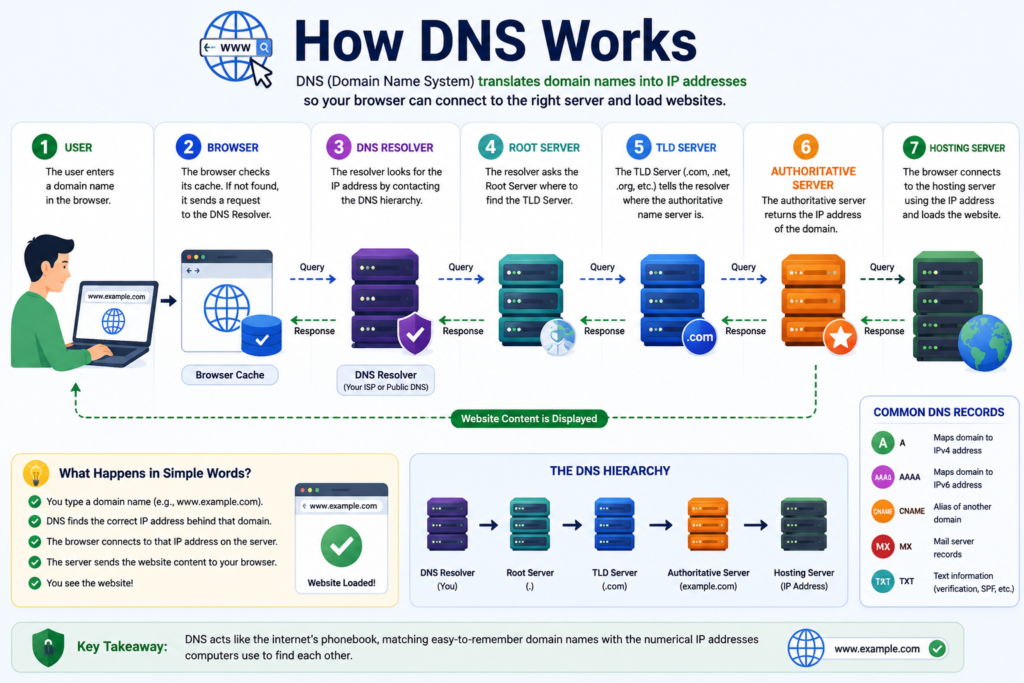
Without DNS, visitors would need to remember numerical IP addresses instead of easy-to-read domain names.
Common DNS records include:
| Record | Purpose |
|---|---|
| A Record | Points a domain to an IPv4 address |
| AAAA Record | Points a domain to an IPv6 address |
| CNAME | Creates an alias for another hostname |
| MX Record | Routes email to the correct mail server |
| TXT Record | Stores verification and security information |
| NS Record | Identifies the authoritative name servers |
Understanding basic DNS management makes it easier to connect your domain to hosting, email platforms, and third-party services.
Simple Example of DNS
Understanding the Domain Name System (DNS) becomes much easier when you look at what happens behind the scenes every time someone visits a website. Although the entire process usually takes only a fraction of a second, several important steps work together to connect a visitor with your website.
Imagine someone opens their web browser and types www.yourbusiness.com into the address bar. Instead of searching the internet randomly, the browser follows a structured process to locate the correct web server and display your website.
Step 1. The Visitor Enters Your Domain Name
The process begins when a user types your domain name, such as www.yourbusiness.com, into a web browser and presses Enter.
At this point, the browser knows the website’s name but does not yet know the numerical IP address where the website is hosted.
Step 2. DNS Looks Up the IP Address
The browser sends a request to the Domain Name System (DNS), which functions like the internet’s global directory.
DNS searches its records to find the IP address associated with the domain name.
For example:
www.yourbusiness.com → 203.0.113.15
The visitor never sees this IP address because DNS performs the lookup automatically in the background.
Step 3. The Browser Connects to the Hosting Server
After receiving the correct IP address, the browser contacts the web hosting server where your website’s files are stored.
The hosting server contains everything needed to display your website, including:
- Web pages.
- Images.
- CSS files.
- JavaScript files.
- Databases.
- Videos and downloadable resources.
The server prepares these files and sends them back to the visitor’s browser.
Step 4. Your Website Loads
Once the browser receives the requested files, it assembles the page and displays your website on the visitor’s screen.
From the user’s perspective, the process feels almost instant. Behind the scenes, however, DNS has successfully translated a memorable domain name into a numerical IP address and connected the visitor to the correct server.
DNS Lookup Process at a Glance
- A visitor types www.yourbusiness.com into their browser.
- The browser requests the website’s IP address from the Domain Name System (DNS).
- DNS identifies the correct IP address associated with the domain.
- The browser connects to the web hosting server using that IP address.
- The hosting server sends the website files to the browser.
- The browser displays the fully loaded website to the visitor.
Why DNS Matters
Although visitors rarely think about DNS, it plays a critical role in making the internet easy to use. Without DNS, every website visitor would need to remember long numerical IP addresses instead of simple domain names.
Proper DNS configuration also affects several important aspects of website management, including:
- Connecting your domain to a web hosting provider.
- Setting up professional email services.
- Verifying domain ownership with third-party platforms.
- Configuring subdomains.
- Improving website reliability through correctly managed DNS records.
Understanding the basics of DNS helps website owners troubleshoot connection issues, manage their domains more confidently, and work more effectively with hosting providers when changes are required.
SSL Certificates and Domain Security
Registering a domain is only the first step. Protecting it is equally important.
An SSL certificate encrypts communication between your website and visitors, helping safeguard sensitive information and build trust.
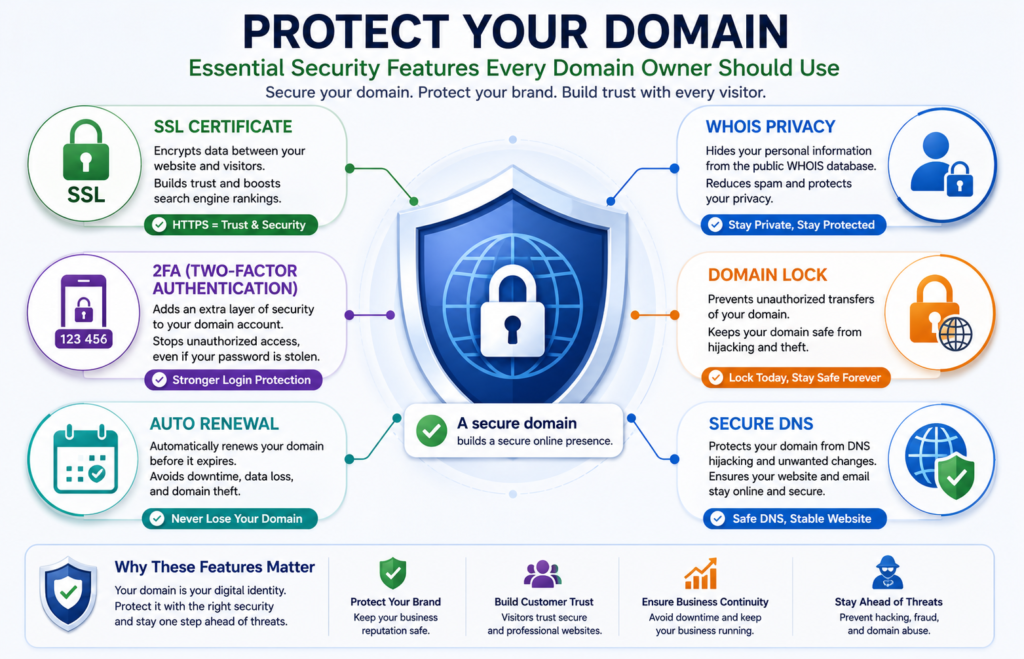
In addition to SSL, consider these security best practices:
- Enable multi-factor authentication on your registrar account.
- Use strong, unique passwords.
- Activate domain locking to reduce the risk of unauthorized transfers.
- Keep registration contact information up to date.
- Monitor renewal dates and enable automatic renewal where appropriate.
Strong domain security protects your online presence and helps maintain customer confidence.
Common Domain Name Buying Mistakes
Choosing a domain name may seem simple, but many businesses make costly mistakes that affect branding, marketing, and long-term growth. Avoiding these common pitfalls can save both time and money.
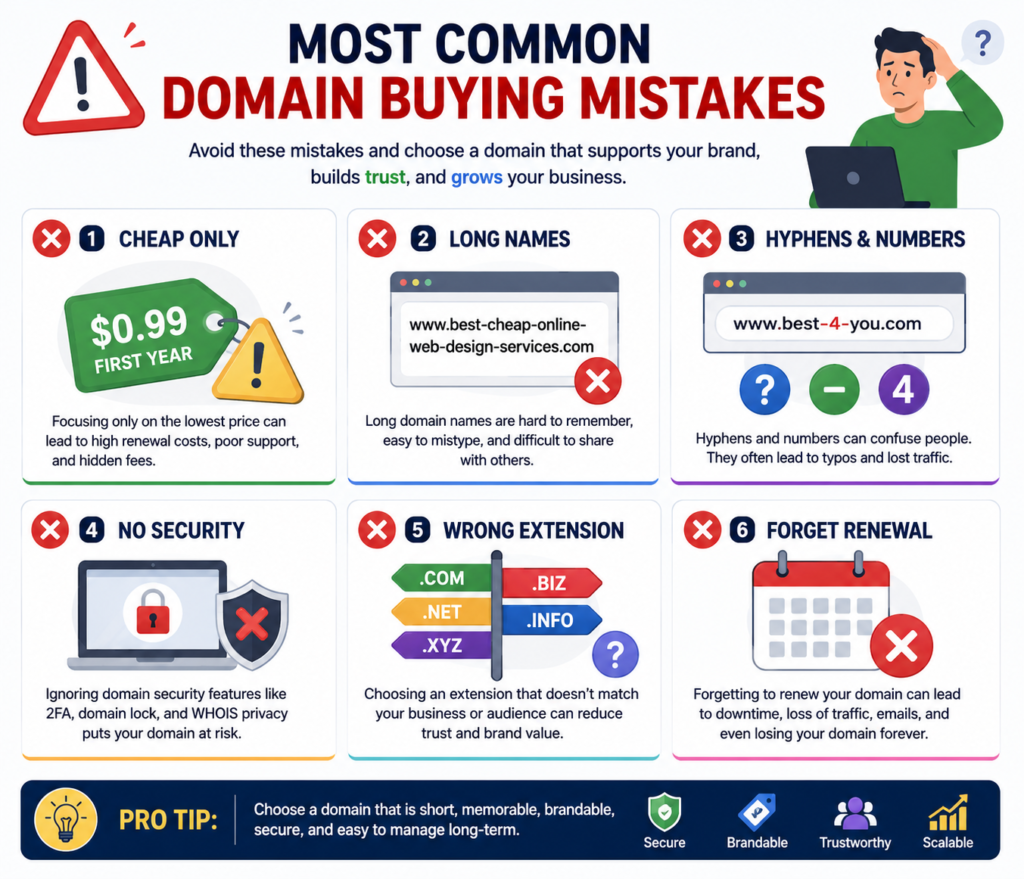
1. Choosing a Domain Based Only on Price
A low registration price may look attractive, but promotional offers often hide higher renewal fees. Always compare both the initial registration cost and the renewal cost before purchasing.
Professional Tip: Focus on the total cost of ownership rather than just the first-year discount.
2. Ignoring Brand Identity
Some buyers choose keyword-heavy domains that sound unnatural.
Example:
- bestcheapwebsitedesigncompanyonline.com
A branded name is usually easier to remember and more effective for long-term marketing.
Better example:
- BrightPixel.com
- NovaStudio.com
3. Selecting Difficult Names
Avoid domain names that:
- Are difficult to spell.
- Have multiple meanings.
- Include repeated letters.
- Are hard to pronounce.
Simple names improve user experience and reduce typing errors.
4. Forgetting Renewal Dates
Thousands of valuable domains expire every year because owners forget to renew them.
When a domain expires:
- Your website may become unavailable.
- Business emails may stop working.
- Customers lose access.
- Competitors or domain investors may purchase your domain.
Always enable automatic renewal and maintain updated payment information.
5. Not Registering Similar Domains
If your business is growing, consider registering:
- Common misspellings.
- Relevant country-code extensions.
- Important alternative extensions.
- Brand variations.
This helps protect your brand from impersonation and customer confusion.
6. Ignoring Domain Security
A domain is one of your most valuable digital assets.
Failing to secure your registrar account can expose your business to domain theft or unauthorized changes.
Always:
- Enable multi-factor authentication.
- Use strong passwords.
- Lock your domain.
- Monitor account activity.
7. Choosing the Wrong Extension
Using an extension that does not match your audience or business goals may reduce trust.
Examples:
- A nonprofit organization often benefits from
.org. - A local business may benefit from a country-specific extension.
- An international business often prefers
.com.
Advanced Domain Strategies
Domain Strategy for Small Businesses
A small business should prioritize:
- Brand recognition.
- Easy pronunciation.
- Professional appearance.
- Customer trust.
- Long-term flexibility.
Avoid limiting your future by selecting a domain based on one product if you expect your business to expand.
Domain Strategy for eCommerce
An online store should choose a domain that is:
- Easy to remember.
- Suitable for advertising.
- Professional on packaging.
- Compatible with future product expansion.
A strong domain supports marketing campaigns, repeat purchases, and customer loyalty.
Domain Strategy for Local Businesses
If your customers are concentrated in a specific city or country, your domain should reinforce your local presence.
Examples include:
- Brand-focused domains with local landing pages.
- Country-code extensions when serving a national audience.
Combine your domain strategy with a well-optimized Google Business Profile and location-specific website content.
Domain Strategy for Affiliate Websites
Affiliate marketers should prioritize brandable domains instead of relying solely on exact-match keywords.
Benefits include:
- Easier expansion into multiple niches.
- Better brand recognition.
- Greater flexibility for future content.
- Stronger long-term authority.
Domain Strategy for Startups
Startups benefit from domains that are:
- Short.
- Memorable.
- Easy to pronounce.
- Globally recognizable.
- Available across social media platforms.
A unique brand often becomes more valuable than descriptive keywords over time.
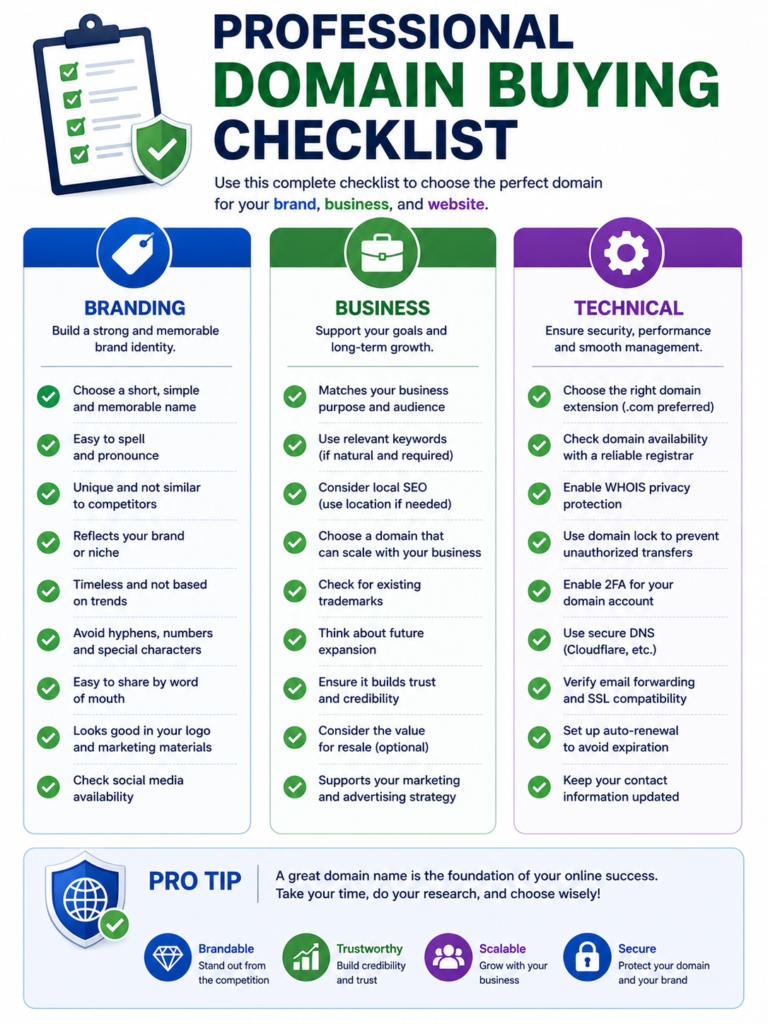
Professional Domain Buying Checklist
Before purchasing your domain, complete this checklist.
Branding
- ✔ Short and memorable.
- ✔ Easy to pronounce.
- ✔ Easy to spell.
- ✔ Unique.
- ✔ Professional.
Business
- ✔ Supports future growth.
- ✔ Suitable for marketing.
- ✔ Matches your business identity.
- ✔ Available on social media.
- ✔ Legally safe.
Technical
- ✔ Reliable registrar selected.
- ✔ Transparent renewal pricing.
- ✔ WHOIS privacy available.
- ✔ SSL compatible.
- ✔ DNS management included.
- ✔ Auto-renewal enabled.
- ✔ Multi-factor authentication activated.
Written by: Syed Abdul Quddus
CEO: Marjan Online Digital Services
This guide was prepared by professionals experienced in website development, WordPress, domain registration, technical SEO, website security, and digital marketing. The recommendations are based on industry best practices, practical experience, and research from authoritative sources to help website owners make informed decisions when selecting and managing domain names.
Domain Registration Process at a Glance
The following workflow summarizes the complete domain registration process:
- Choose a memorable and brandable domain name.
- Check domain availability using a trusted registrar.
- Compare registration and renewal pricing.
- Select the appropriate domain extension.
- Register the domain.
- Enable WHOIS privacy if available.
- Activate domain lock and multi-factor authentication.
- Connect the domain to your web hosting provider.
- Configure DNS records.
- Install an SSL certificate.
- Enable automatic renewal.
- Monitor and manage your domain regularly.
Following these steps helps reduce common registration mistakes and provides a strong foundation for your website.
Frequently Asked Questions
How long can I register a domain?
Most registrars allow registrations from one to ten years, depending on the extension and applicable policies.
Can I transfer my domain later?
Yes. You can transfer a domain to another registrar after meeting the registrar’s transfer requirements and any applicable waiting periods.
Should I buy hosting and a domain together?
Buying them together can simplify setup and management, but purchasing them separately may provide greater flexibility. Compare pricing, features, and support before deciding.
Is domain privacy necessary?
For many individuals and businesses, privacy protection can help reduce spam and protect personal information where supported.
Can I own multiple domains?
Yes. Many businesses register multiple domains to protect their brand, target different markets, or support specific marketing campaigns.
What happens if my domain expires?
If a domain is not renewed, your website and associated services may stop functioning. Depending on the registrar and registry policies, there may be a grace period before the domain becomes available for others to register.
How to Maintain Your Domain After Registration
Include practical maintenance advice:
- Check renewals monthly.
- Review contact details annually.
- Update nameservers carefully.
- Monitor DNS changes.
- Enable registrar security features.
- Keep recovery email addresses up to date.
- This is highly useful and demonstrates ongoing expertise.
Editorial Review Process
To ensure the information remains accurate, helpful, and aligned with current industry standards, this guide follows a structured editorial review process. Each section is reviewed for factual accuracy, clarity, readability, and compliance with current domain registration practices before publication.
Our review process includes:
- Verifying technical information using authoritative industry resources.
- Reviewing domain registration, DNS, and security recommendations for accuracy.
- Updating outdated information when industry standards or best practices change.
- Checking examples and explanations to ensure they remain relevant for beginners and business owners.
- Improving the content regularly to reflect changes in domain extensions, security practices, and website management.
Our goal is to provide practical, trustworthy, and easy-to-understand information that helps readers make informed decisions with confidence.
Last Updated
Last Updated: 18 July 2026
This guide is reviewed periodically to ensure that domain registration practices, DNS management, security recommendations, and industry standards remain current. As technology evolves, we update this article to reflect significant changes that may affect website owners and businesses.
Conclusion
Choosing the right domain name is one of the earliest and most important decisions you will make when building an online presence. A carefully selected domain strengthens your brand, supports customer trust, and provides a solid foundation for future marketing and SEO efforts. Rather than focusing only on the lowest registration price, think about long-term value, security, scalability, and brand recognition. Taking the time to choose wisely today can save significant time, money, and effort as your website grows.
Who Should Not Rely Solely on This Guide
While this guide provides comprehensive information for most website owners, some situations may require additional professional advice or specialized research.
You should consider consulting qualified professionals if:
- You are purchasing high-value premium domains worth thousands of dollars.
- Your business involves complex trademark or intellectual property considerations.
- You are managing domains for large international enterprises with multiple country-specific websites.
- Your organization has advanced cybersecurity or compliance requirements.
- You require legal advice regarding domain ownership disputes or trademark conflicts.
This guide is intended to provide educational information and practical best practices. It should not replace legal, financial, or technical advice for situations involving specialized requirements or regulatory obligations.
Suggested Internal Links
- Proven On-Page SEO 2026
- Website Development Services
- Technical SEO Guide 2026
- Website Mistakes to Avoid
- Website Planning Checklist
- Why Is My Website Not Getting Customers?
- Professional Website Development Services
5 Comments