Table of Contents
What Are AEO Basics?
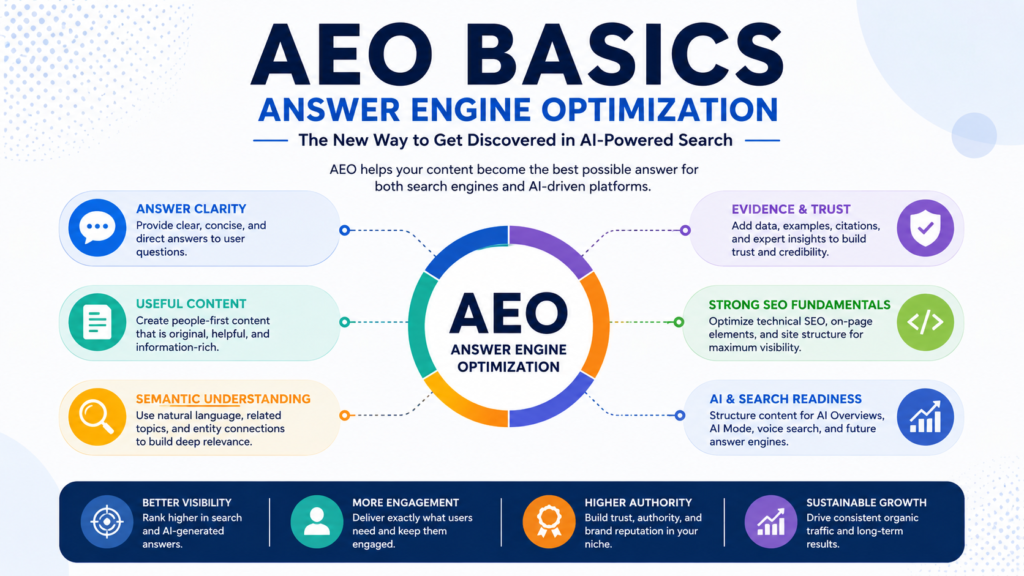
AEO basics are the fundamental practices used to make website content clear, useful, trustworthy, and easy for search and AI powered systems to understand and surface when answering users’ questions.
AEO stands for Answer Engine Optimization. The term is commonly used to describe optimization for search experiences that can provide direct or generated answers rather than only a traditional list of blue links.
However, there is an important distinction that every beginner should understand.
For Google specifically, AEO is not a separate ranking system that replaces SEO. Google’s current guidance says that its generative AI features in Search continue to rely on Google’s core Search ranking and quality systems. Google explicitly treats optimization for these experiences as part of good SEO rather than requiring a completely separate collection of AEO or GEO techniques.
That changes how website owners should approach AEO.
The objective is not to discover a secret formula for getting quoted by AI. The objective is to publish pages that are sufficiently useful, accessible, specific, well supported, and technically discoverable that search systems can confidently retrieve them when they are relevant.
This guide explains exactly how to build that foundation.
AEO Basics at a Glance
| Area | What You Should Do |
|---|---|
| Search intent | Identify the actual question or task behind the query |
| Direct answers | Answer important questions clearly and early |
| Content quality | Provide original, useful, non commodity information |
| Semantic coverage | Explain the concepts and entities necessary to understand the subject |
| Evidence | Support important factual claims with reliable sources |
| Page structure | Use descriptive headings and logical sections |
| SEO | Maintain conventional technical and on page SEO |
| Crawlability | Make important content accessible to search engines |
| Internal linking | Connect related pages contextually |
| Multimedia | Use useful original images, screenshots, charts, or video when appropriate |
| Structured data | Use supported markup only when the page genuinely qualifies |
| AI optimization | Avoid supposed hacks and concentrate on Search fundamentals |
| Measurement | Evaluate actual Search Console data after publication |
The key principle is simple:
Optimize for the person asking the question first. Make the answer exceptionally understandable to machines second.
These goals frequently reinforce each other.
What Is AEO in Digital Marketing?
Answer Engine Optimization is a digital content optimization approach focused on helping systems understand which information on a page is relevant to a particular question, problem, comparison, or decision.
Traditional search behavior often looks like this:
Query → Search results → Website → Answer
Answer oriented search can sometimes look more like:
Question → Search or AI system → Synthesized answer → Supporting sources → Website
That does not mean websites have become irrelevant.
Google’s generative AI Search experiences can retrieve information from its Search index and provide links to relevant web pages as supporting sources. Google describes technologies including retrieval augmented generation and query fan out as parts of these experiences.
Consequently, the quality of the underlying website remains important.
A page still needs to be discovered, crawled, indexed where appropriate, understood, considered relevant, and useful enough to compete with other available information.
Is AEO Different From SEO?
Yes conceptually, but the distinction should not be exaggerated.
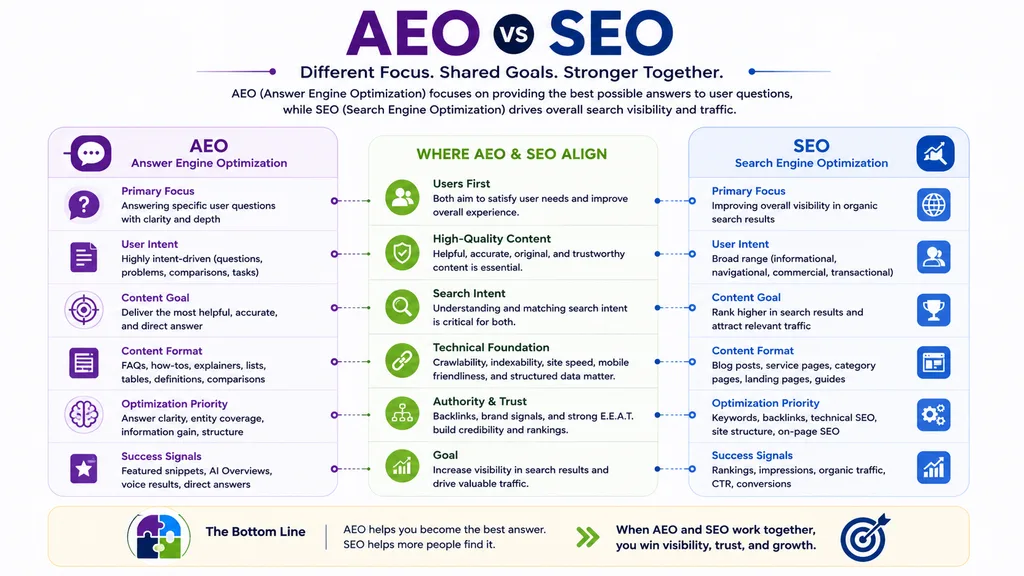
SEO is the broader discipline of improving a website’s ability to be discovered and understood through search while providing a strong experience for users.
AEO emphasizes the answerability of information.
AEO vs SEO
| SEO | AEO |
| Broad search visibility discipline | Emphasizes clear answers and retrieval |
| Covers technical SEO | Depends on the same technical foundation |
| Targets search intent | Places particularly strong emphasis on questions and tasks |
| Uses internal linking | Uses contextual relationships between related information |
| Requires useful content | Requires clear, useful and extractable answers |
| Supports traditional Search | Often discussed in relation to answer and AI experiences |
| Remains essential | Should complement rather than replace SEO |
The wrong conclusion is:
SEO is dead, so websites now need AEO instead.
A more accurate model is:
Strong SEO foundation + useful content + answer clarity + information gain = a sensible AEO strategy.
Google’s 2026 guidance is particularly important here. Google states that SEO best practices remain relevant to its generative AI Search features and addresses misconceptions surrounding separate AEO and GEO techniques.
Why Is AEO Becoming Important?
Search interfaces are becoming more conversational.
People increasingly search using complete questions, comparisons, follow up queries, and complex tasks.
Instead of typing:
AEO
someone may search:
What is AEO in digital marketing?
Then:
Is AEO different from SEO?
Then:
How do I optimize my WordPress website for AEO?
Then:
Does schema help with AEO?
A useful page therefore needs to understand the question journey, not merely one keyword.
Google’s generative Search systems can also use a process described as query fan out, in which related queries may be generated to retrieve information relevant to a broader user request.
This provides a useful editorial lesson.
Do not create dozens of shallow pages for tiny keyword variations. Build a logically complete resource that answers the main query and the closely related questions a real person is likely to ask next.
How Does Answer Engine Optimization Work?
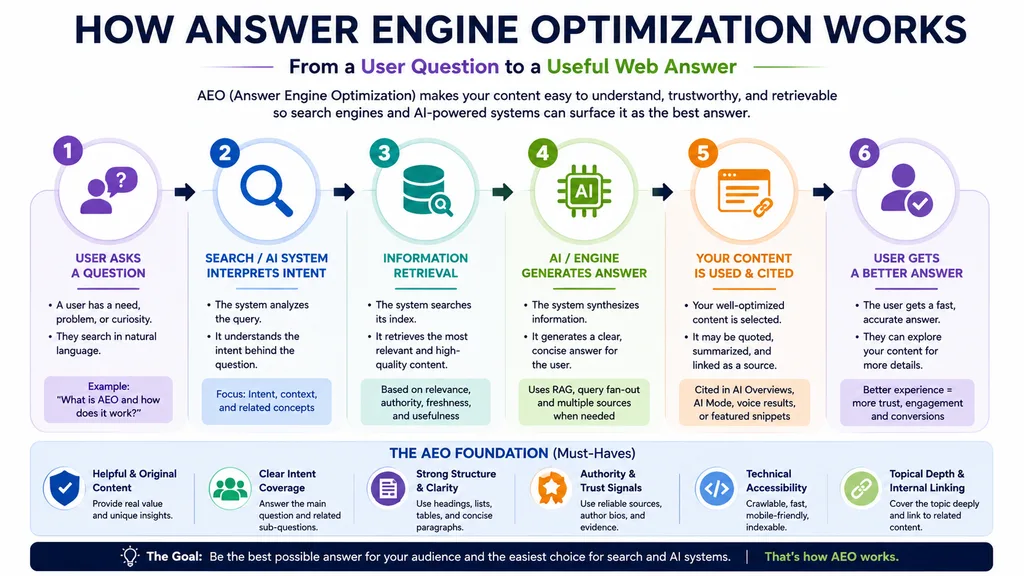
A practical AEO workflow can be understood in six stages.
1. Understand the Searcher’s Intent
Start with the user, not the keyword.
Ask:
- What does this person actually want?
- Is the person learning, comparing, troubleshooting, or buying?
- What answer is needed immediately?
- What questions will naturally follow?
- What evidence would make the answer credible?
For the query AEO basics, the likely primary intent is educational.
The searcher probably wants to understand what AEO means, whether it differs from SEO, how it works, and what practical actions to take.
An article that immediately starts discussing advanced schema implementation without first explaining AEO would therefore miss the primary intent.
2. Give the Core Answer Early
Do not make readers work through 600 words before receiving a definition.
For example:
Answer Engine Optimization is the practice of making useful web content easier for search and AI powered systems to understand, retrieve, and use when responding to relevant questions.
The rest of the page can then provide nuance, examples, limitations, and implementation guidance.
This answer first structure benefits human readers because they can immediately determine whether the page addresses their question.
3. Build Semantic Context
A page about AEO should naturally explain related concepts such as:
- SEO
- search intent
- entities
- content quality
- AI Overviews
- AI Mode
- crawling
- indexing
- internal links
- structured data
- citations
- information gain
- query fan out
- retrieval
- content architecture
These concepts should appear because they are necessary to understand AEO, not because an SEO tool suggests inserting them.
4. Provide Information Worth Retrieving
A page that merely paraphrases ten competing articles has limited independent value.
Useful information gain might include:
- an original AEO workflow
- screenshots
- real implementation examples
- before and after content examples
- decision matrices
- original diagrams
- practical checklists
- mistakes discovered during implementation
- original Search Console observations
- industry specific examples
Google’s current guidance for generative AI Search places substantial emphasis on providing unique, useful, non commodity content.
5. Maintain Technical Accessibility
Excellent writing cannot perform well in Search if Google cannot properly access the page.
Your AEO strategy therefore still depends on conventional technical SEO fundamentals, including sensible crawlability, indexability, internal navigation, page performance, and accessible content.
6. Measure What Actually Happens
Do not assume an AEO strategy succeeded because an SEO plugin displays a green score.
Use actual performance data.
Google Search Console can help you evaluate queries, impressions, clicks, CTR, pages, countries, devices, and other Search performance information.
Optimization should become an evidence based cycle:
Publish → Measure → Learn → Improve
How to Do AEO for a Website
Here is a practical implementation framework.
Step 1. Identify One Primary Search Problem
Each page should have a clear purpose.
Instead of starting with:
I need an article containing these 25 keywords.
Start with:
What problem should this page solve better than the existing alternatives?
For this article, that problem is:
A beginner needs to understand AEO and implement its core principles without being misled by AI SEO myths.
That single statement gives the entire page direction.
Step 2. Map the Question Journey
Identify the questions that naturally follow the primary query.
For AEO basics, that journey might be:
- What is AEO?
- How does AEO work?
- Is AEO different from SEO?
- Does AEO replace SEO?
- How do I optimize content for answer engines?
- How should an AEO article be structured?
- Do I need schema?
- Do I need an llms.txt file?
- How does AEO apply to WordPress?
- How can I measure results?
These questions can become sections, supporting explanations, or FAQs depending on their importance.
Step 3. Create an Answer First Introduction
A weak opening often delays the useful information.
Avoid introductions built around statements such as:
“Digital marketing is constantly evolving.”
That sentence provides almost no information.
A better introduction immediately defines the subject and establishes the practical issue.
For example:
AEO focuses on making website information easy to understand and retrieve when search or AI systems answer questions. For Google, however, AEO should be treated as an extension of strong SEO rather than a replacement for it.
The reader immediately learns something meaningful.
Step 4. Use Descriptive Headings
A heading should tell readers what they will learn.
Weak:
Important Things
Better:
How to Optimize Content for Answer Engines
Weak:
More Information
Better:
Does AEO Require Structured Data?
Clear headings also establish the logical relationships between concepts.
Step 5. Make Each Section Independently Useful
A strong section should make sense even when a reader lands directly on it.
Consider this question:
Does AEO Replace SEO?
A complete short answer would be:
No. AEO does not replace SEO. For Google Search specifically, Google’s current guidance says its generative AI features continue to use the core Search ranking and quality systems, so established SEO practices remain relevant.
The reader receives the answer without needing to read the entire article.
That is good information architecture.
Step 6. Add Evidence Where Evidence Matters
Not every sentence requires a citation.
Definitions, explanations, and editorial examples can often stand without one.
Claims about Google, however, should ideally link to Google’s own documentation.
Claims about a software product should preferably reference official documentation.
Statistics should reference the underlying study whenever possible.
The principle is:
Match the authority of the evidence to the importance of the claim.
This strengthens trust for both readers and editorial review.
Step 7. Add Original Value
Before publishing, ask:
What does this page contain that a reader cannot get by opening the first three competing results?
If the answer is “nothing,” the page needs additional work.
Original value does not require expensive research.
You could add:
An AEO Content Evaluation Matrix
| Question | Poor Page | Strong AEO Page |
| Is the main question answered quickly? | No | Yes |
| Is search intent clear? | Unclear | Explicit |
| Are important claims supported? | Rarely | Where necessary |
| Does the article add original value? | Minimal | Meaningful |
| Are headings descriptive? | Generic | Specific |
| Are related concepts explained? | Random keywords | Logical semantic coverage |
| Is firsthand evidence fabricated? | Possibly | Never |
| Are limitations discussed? | Hidden | Transparent |
| Is content written naturally? | Keyword driven | Reader driven |
| Can the page be crawled and indexed? | Uncertain | Technically checked |
This framework is more actionable than simply telling readers to “write high quality content.”
AEO Content Optimization
Content optimization for AEO should focus on clarity, completeness, evidence, and retrieval rather than keyword density.
Use a Question and Answer Pattern Where Natural
Questions make excellent headings when users genuinely ask them.
For example:
What Is AEO?
Then answer it directly.
Does AEO Require Schema?
Answer directly again.
But do not convert every heading into a question simply because you are targeting AEO.
Natural editorial structure still matters.
Define Important Concepts Precisely
Avoid vague language.
Instead of:
AEO helps AI like your website.
Use:
AEO is an optimization approach aimed at making web information useful, clear, and retrievable for answer oriented search experiences.
Precision increases both readability and semantic clarity.
Use Lists for Processes
If something has five steps, present those five steps clearly.
Do not bury a process inside a 500 word paragraph.
Lists work particularly well for:
- checklists
- requirements
- processes
- advantages
- limitations
- troubleshooting
- decision criteria
Use Tables for Genuine Comparisons
Tables are useful when readers need to compare several attributes simultaneously.
They should not exist merely because an SEO template says every article needs a table.
Good candidates include:
- AEO vs SEO
- optimization priorities
- tools
- workflows
- implementation options
- before and after examples
Use Examples
Abstract SEO advice becomes far easier to understand through examples.
Weak Answer
“AEO is important because AI is changing search.”
Better Answer
“A local web development company might publish a page answering ‘How much does a small business website cost?’ A strong answer would explain the major cost drivers, distinguish setup costs from ongoing costs, show realistic scenarios, disclose variables, and link to supporting pricing or methodology rather than repeating ‘website development cost’ throughout the page.”
The second example demonstrates what optimization actually means.
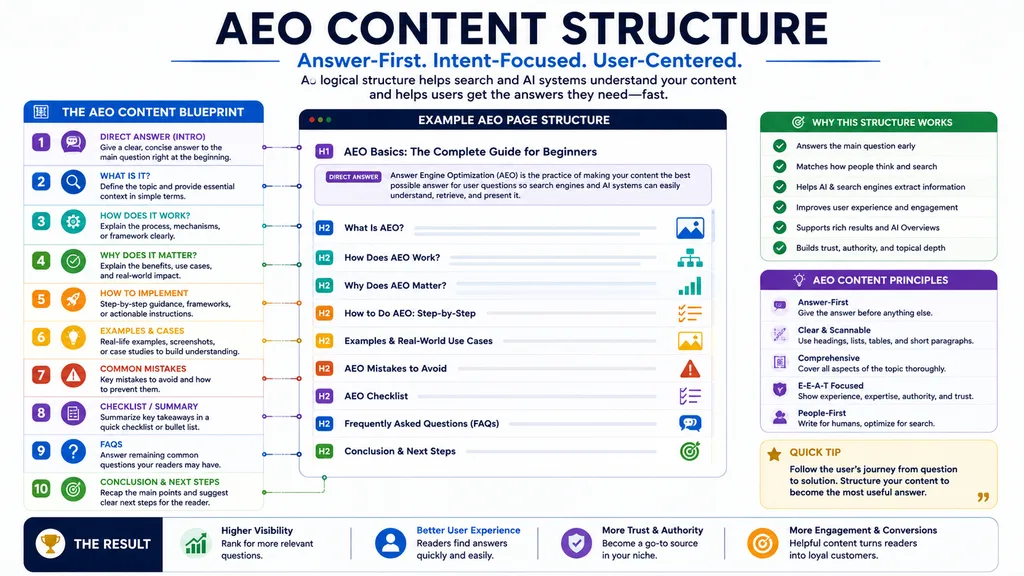
AEO for Beginners (Content Structure)
There is no universal template that every AEO article must follow.
A practical informational structure is:
H1: Main Topic
Short direct answer.
Introduction.
H2: What Is It?
Definition and context.
H2: How Does It Work?
Process.
H2: Why Does It Matter?
Practical implications.
H2: How to Implement It
Actionable tutorial.
H2: Examples
Demonstration.
H2: Common Mistakes
Risk prevention.
H2: Checklist
Implementation summary.
H2: FAQs
Genuine remaining questions.
H2: Conclusion
Clear next steps.
The structure should change when search intent changes.
A comparison article needs a comparison framework.
A troubleshooting page needs symptoms, causes, diagnostic steps, and fixes.
A commercial page needs decision criteria.
The searcher’s task determines the architecture.
AEO for Google AI Overviews and AI Mode
Google AI Overviews and AI Mode have made AEO particularly interesting to website owners.
But this is also where misinformation becomes common.
Google’s current documentation says its generative AI Search features build on the company’s existing Search ranking and quality systems. Google also discusses retrieval augmented generation and query fan out in explaining these experiences.
The practical implication is significant.
You should not build two completely different websites:
Website A for Google Search
and
Website B for Google AI.
Instead, build a technically sound website containing useful, original, trustworthy information that can serve people across different Search experiences.
Do You Need Special AEO Schema?
No special “AEO schema” is required for Google Search.
Structured data can still be useful when Google supports an applicable structured data feature and your page genuinely qualifies.
However, Google explicitly warns against over focusing on structured data as a special generative AI optimization technique. Its AI Search guidance says no special schema.org markup is required specifically for generative AI Search.
Therefore:
Use structured data for its legitimate SEO purpose, not as an invented AI ranking hack.
Do You Need llms.txt for Google AEO?
Not for Google Search visibility.
Google’s 2026 documentation specifically clarified its position on llms.txt, and its generative AI optimization guidance says special AI text files or machine oriented markup are not required for appearing in Google Search’s generative AI features.
That does not mean every possible use of llms.txt across the broader web is meaningless.
It means you should not present it as a requirement for Google visibility.
AEO for WordPress Websites
WordPress does not require a special AEO system.
A WordPress site should first have strong fundamentals:
- sensible site architecture
- indexable important pages
- useful navigation
- descriptive titles
- logical heading structure
- appropriate internal links
- accurate content
- fast and usable pages
- useful image metadata
- canonical implementation where needed
- XML sitemap availability
- Search Console monitoring
Then improve answer quality.
For example, a WordPress article about SSL certificates should not merely repeat “SSL certificate” dozens of times.
It should answer:
- What is an SSL certificate?
- Does my website need one?
- What does HTTPS mean?
- Are free SSL certificates safe?
- Why is my certificate showing an error?
- How do I install or activate one?
- When does it expire?
- What should I do after migration to HTTPS?
That creates genuine topical usefulness.
AEO Strategy for Small Businesses
Small businesses do not need to compete for every broad industry keyword.
Specific expertise can be more useful.
Suppose a web development company wants visibility.
Instead of publishing only:
Website Development
it could build genuinely useful resources around real customer problems:
How Much Does a Small Business Website Cost?
What Pages Does a Business Website Need?
WordPress vs Custom Website for Small Business
Why Is My Business Website Not Generating Leads?
How Long Does Website Development Take?
What Should I Give a Web Developer Before Starting a Project?
These questions map directly to real decisions.
That is where SEO, AEO, topical authority, and business value can align.
AEO Best Practices for Websites
A sustainable strategy can be summarized in twelve practices.
- Identify the real search intent.
- Answer the primary question without unnecessary delay.
- Cover necessary related concepts naturally.
- Use clear, descriptive headings.
- Support important factual claims with appropriate evidence.
- Add original examples, analysis, data, screenshots, or workflows when available.
- Maintain crawlability and indexability.
- Use contextual internal links.
- Use structured data only where appropriate and supported.
- Keep important changing information current.
- Avoid keyword stuffing and speculative AI hacks.
- Use Search Console data to improve content after publication.
These practices are deliberately less exciting than promises of secret AI optimization formulas.
They are also more defensible.
AEO Mistakes to Avoid
Mistake 1. Treating AEO as a Replacement for SEO
This creates an artificial distinction.
For Google, conventional Search fundamentals remain highly relevant to generative AI experiences.
Mistake 2. Writing Only for AI Systems
Humans are still the audience.
Machine readability should improve human communication rather than damage it.
Mistake 3. Keyword Stuffing
Repeating:
“AEO basics, AEO optimization, AEO content optimization, AEO SEO optimization…”
does not make a paragraph more useful.
Use terminology naturally.
Mistake 4. Publishing Hundreds of Question Pages
Do not turn every slight query variation into another URL.
Questions with the same underlying intent often belong on one comprehensive page.
Mistake 5. Inventing Experience
Do not say:
“We tested 100 AEO pages…”
unless that test actually happened and you can describe the methodology.
Research based expertise is more trustworthy than fabricated firsthand experience.
Mistake 6. Using Unsupported AI Schema
There is no need to invent structured data specifically to tell Google that a page is “AI optimized.”
Use supported markup accurately.
Mistake 7. Chasing Mentions Artificially
Google’s current AI optimization guidance also cautions against unreliable attempts to manufacture web mentions as an optimization tactic.
Build reputation through genuinely useful work instead.
Mistake 8. Ignoring Technical SEO
Content that cannot be properly accessed or indexed has a fundamental visibility problem regardless of how elegantly it answers a question.
Mistake 9. Copying Competitors
Reading the top results and rewriting everything they say in different words provides little information gain.
Research competitors to discover what they failed to explain, not merely what they already covered.
Mistake 10. Promising AI Citations
No ethical SEO consultant can guarantee that a particular page will appear in an AI Overview or AI Mode response.
Optimization improves eligibility and quality. It does not create guaranteed placement.
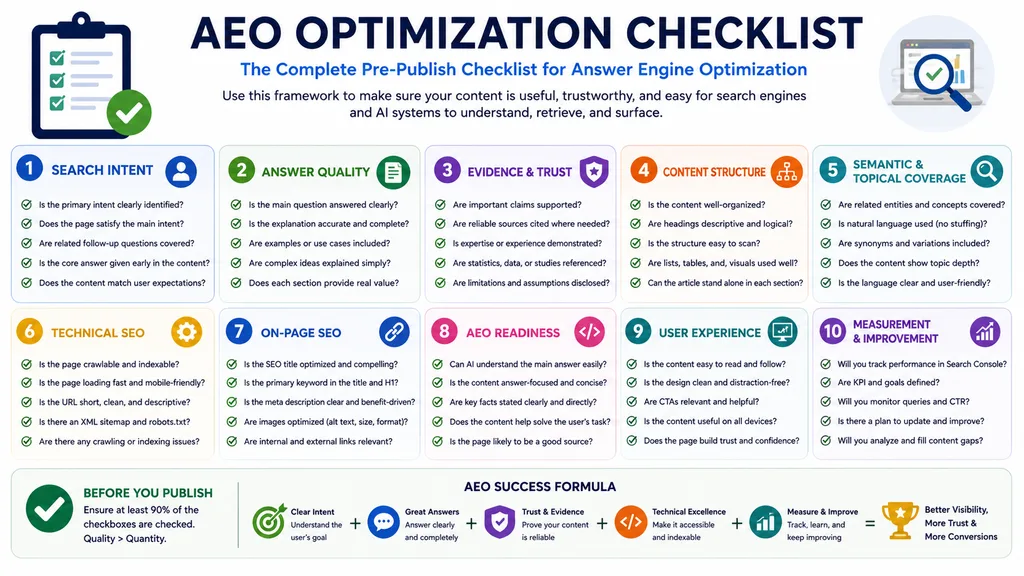
AEO Optimization Checklist
Use this checklist before publishing an important page.
Search Intent
- Is there one clearly defined primary user problem?
- Does the page satisfy that problem?
- Does the opening confirm that the reader is in the right place?
Answer Quality
- Is the core answer available early?
- Are important definitions precise?
- Are follow up questions addressed?
- Are limitations explained?
Information Gain
- Does the page add something beyond existing generic summaries?
- Can original screenshots improve it?
- Can an original table improve understanding?
- Is there a practical example?
- Is there firsthand evidence available?
- Can an original workflow or decision framework be added?
E.E.A.T. and Trust
- Are important claims supported?
- Are primary sources used where practical?
- Is firsthand experience genuine?
- Are uncertainties identified?
- Is the author information transparent?
- Is outdated information removed?
Semantic SEO
- Are important entities explained naturally?
- Are related concepts covered?
- Are synonyms used naturally?
- Have unnecessary exact match repetitions been removed?
Technical SEO
- Is the page crawlable?
- Is it intended to be indexable?
- Is the canonical configuration appropriate?
- Is it internally linked?
- Are important resources accessible?
- Does the page work properly on mobile?
On Page SEO
- Does the SEO title describe the page accurately?
- Is there one clear H1?
- Is the URL concise?
- Does the meta description communicate the benefit?
- Are headings logically nested?
- Are images genuinely useful?
AEO Readiness
- Can major sections answer their questions independently?
- Are factual statements explicit?
- Is the content easy to interpret?
- Are comparisons clearly structured?
- Are lists used for processes?
- Are unsupported AI optimization tricks absent?
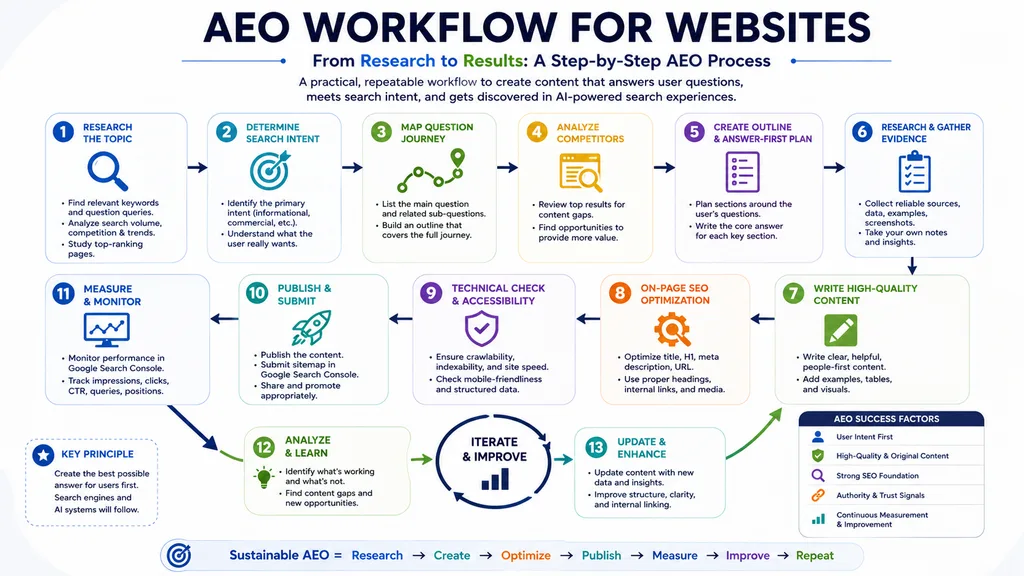
A Practical AEO Workflow
A beginner can use the following process for every new article:
Research the query
↓
Determine primary search intent
↓
Analyze the questions surrounding the query
↓
Review competing results
↓
Identify missing information
↓
Choose an original information gain angle
↓
Create the answer first outline
↓
Research authoritative sources
↓
Write for the reader
↓
Add examples and evidence
↓
Optimize title, H1, URL and description
↓
Add contextual internal links
↓
Check technical accessibility
↓
Publish
↓
Submit or monitor through Search Console
↓
Improve using actual performance data
This creates a repeatable editorial system rather than a collection of isolated SEO tricks.
How to Measure AEO Performance
There is no single universal “AEO score” that proves a page is successful.
Measure outcomes instead.
Useful Search Console indicators include:
Impressions
Is Google increasingly surfacing the page for relevant searches?
Queries
Is the page being discovered for the range of questions you intended to answer?
Clicks
Are searchers choosing your result when it appears?
CTR
Does your search presentation match user intent sufficiently to earn clicks?
Average Position
How is visibility changing across relevant queries?
Page Performance
Which URLs are gaining or losing Search visibility?
Query Diversification
Is the article expanding from one narrow keyword into a broader group of semantically relevant searches?
Google also states that AI Mode contributes to overall totals in the Search Console Performance report, while AI Overviews are logged within Search Console’s Performance reporting methodology.
Use these measurements carefully.
One week’s movement is not automatically proof that an optimization succeeded or failed.
Look for meaningful patterns.
Frequently Asked Questions About AEO Basics
What does AEO stand for?
AEO stands for Answer Engine Optimization. It generally refers to optimizing information so it can effectively satisfy questions in answer oriented search experiences.
What are AEO basics?
AEO basics include understanding search intent, answering questions clearly, structuring information logically, providing useful and original information, supporting important claims, maintaining technical SEO, and monitoring real search performance.
Is AEO the same as SEO?
Not exactly. AEO emphasizes answer clarity and retrieval, while SEO covers the broader search optimization discipline. For Google, however, AEO should not be treated as a separate replacement for SEO because Google’s generative AI Search features continue to rely on its core Search ranking and quality systems.
Does AEO replace traditional SEO?
No. Technical SEO, content quality, crawlability, indexing, internal linking, search intent, and other established fundamentals remain relevant.
How do I optimize content for answer engines?
Start by identifying the user’s actual question. Provide a concise answer, explain it thoroughly, organize related information logically, support factual claims, add original value, and make the page technically accessible.
What is AEO content optimization?
AEO content optimization means improving a page’s clarity, usefulness, structure, evidence, semantic context, and accessibility so its information can effectively satisfy relevant questions.
Does AEO require structured data?
No special AEO structured data is required for Google. Use supported structured data when your content genuinely qualifies for it, not as a speculative AI visibility technique.
Do I need llms.txt for Google AEO?
Google does not require llms.txt for visibility in Google Search or its generative AI Search features.
Can AEO guarantee an AI Overview citation?
No. There is no legitimate way to guarantee that a page will be cited or displayed in a particular Google generative AI response.
Is AEO useful for WordPress?
Yes. The principles apply regardless of the content management system. WordPress websites can improve answer clarity, information architecture, internal linking, content quality, technical accessibility, and evidence.
Is AEO useful for small businesses?
Potentially, especially when a business can answer specific customer questions with genuine expertise, examples, local or industry context, and practical decision support.
Should every article have an FAQ section?
No. Add FAQs only when important reader questions remain after the main article. An FAQ section should solve genuine information needs rather than repeat keywords.
Final Verdict: What Beginners Should Understand About AEO
AEO is useful, but it becomes counterproductive when treated as a collection of shortcuts for manipulating AI systems.
For Google Search, the stronger approach is straightforward:
Build technically accessible pages that provide clear answers, satisfy real search intent, demonstrate appropriate expertise, support important claims, add information beyond commodity summaries, and connect logically with the rest of your website.
Then measure what happens.
Google’s latest guidance reinforces rather than overturns this principle. SEO best practices remain relevant to generative AI Search, while special AEO markup, excessive structured data, llms.txt requirements, manufactured mentions, and similar supposed shortcuts should not become the foundation of your strategy.
For a beginner, the most productive sequence is therefore:
Learn SEO fundamentals → understand search intent → improve answer quality → build topical depth → add original evidence → maintain technical accessibility → measure real performance.
That is a far stronger foundation for sustainable search visibility than chasing whatever AI optimization trick happens to be trending.
Recommended Internal References for Further Reading
- Technical SEO Guide 2026: Complete Guide to Crawlability, Indexing and Search Performance
- Google Search Console Guide 2026: Complete SEO Tutorial for Search Performance
- Website Planning Checklist: 21 Critical Steps for Website Success
- Website Maintenance Guide 2026–2027: Complete Checklist for a Secure, Fast and Reliable Website
- Professional Website Development Services
- Marjan Services: Professional Website Development and SEO Solutions
Recommended External References and Official Sources
- Google Search Essentials
- Google Guide to Optimizing for Generative AI Features in Search
- Creating Helpful, Reliable, People-First Content
- AI Features and Your Website: AI Overviews and AI Mode
- Google Search Guidance on Generative AI Content
- Search Generative AI Performance Reports in Google Search Console
- Latest Google Search Documentation Updates
- Google Search Core Updates Guidance
- Google Search Guidance for Succeeding in AI Search
1 Comment