Table of Contents
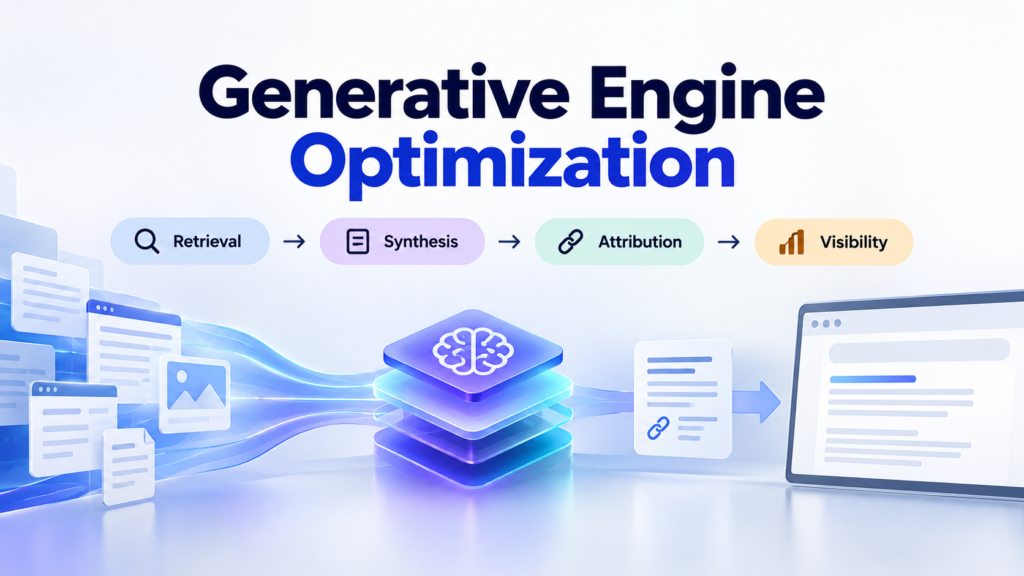
Generative Engine Optimization, or GEO, is an emerging practice focused on improving how useful web information and clearly defined entities may be discovered, retrieved, understood, attributed, and represented within generative search experiences.
GEO does not replace SEO or Answer Engine Optimization (AEO). It addresses a different question:
When a generative system constructs an answer, what can publishers responsibly do to make their information more useful, verifiable, attributable, and measurable without relying on unsupported AI-ranking tactics?
The answer is not a secret schema, keyword-density formula, llms.txt shortcut, or guaranteed citation technique.
A defensible GEO strategy combines technical eligibility, information quality, primary evidence, entity clarity, source attribution, platform-specific research, and careful measurement.
This guide focuses specifically on that generative layer.
For detailed AEO implementation, use our separate AEO resources. For crawling, indexing, canonicalization, rendering, and other technical foundations, use our Technical SEO guide.
What Is Generative Engine Optimization?
Generative Engine Optimization is the process of improving the conditions under which web information may be retrieved, interpreted, used, cited, or otherwise represented by generative systems.
The term gained academic prominence through GEO: Generative Engine Optimization, research by Pranjal Aggarwal and colleagues presented at KDD 2024.
The research introduced a framework for evaluating the visibility of source content in generative-engine responses and demonstrated that content characteristics could influence visibility within tested environments.
That finding is important, but its limits are equally important.
GEO research does not establish a universal formula that guarantees citations across Google, ChatGPT, Gemini, Perplexity, or other systems.
For practical website strategy, GEO should therefore be treated as:
an evidence-based process for improving the quality, accessibility, clarity, verifiability, and attribution potential of information while measuring generative visibility without assuming guaranteed outcomes.
The Generative Visibility Pipeline
A major GEO mistake is starting with citations.
Citation occurs relatively late in the process.
A more useful conceptual model is:
Discovery → Retrieval → Selection → Synthesis → Attribution → Visibility → Visit → Business Outcome
This is a simplified editorial framework, not a claim about the proprietary architecture of every AI platform.
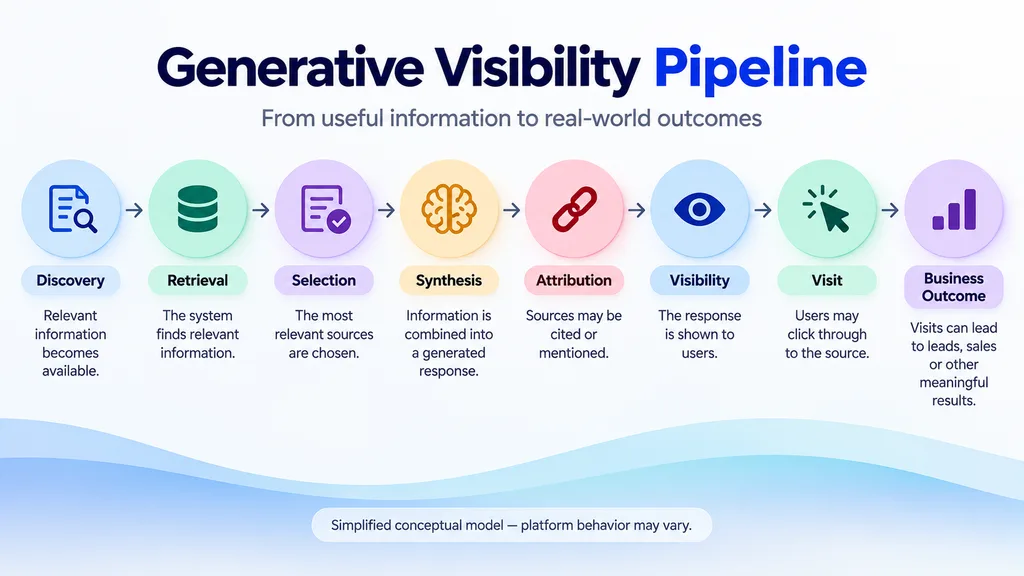
Discovery
Relevant information must be available through mechanisms the particular system can access or use.
Retrieval
Available information still has to be considered relevant to the user’s information need.
Selection
A retrieved source may compete with many other sources. Retrieval therefore does not guarantee use.
Synthesis
Generative systems can combine information from multiple sources into a new response.
Attribution
Some systems provide citations or links. Others may mention an entity without the same form of source attribution.
Visibility
A source can appear without receiving meaningful user attention.
Visit
A citation does not necessarily produce a click.
Business Outcome
A click does not necessarily become a qualified lead, sale, subscription, or other meaningful outcome.
This distinction is fundamental to GEO measurement.
Retrieval-Augmented Generation and GEO
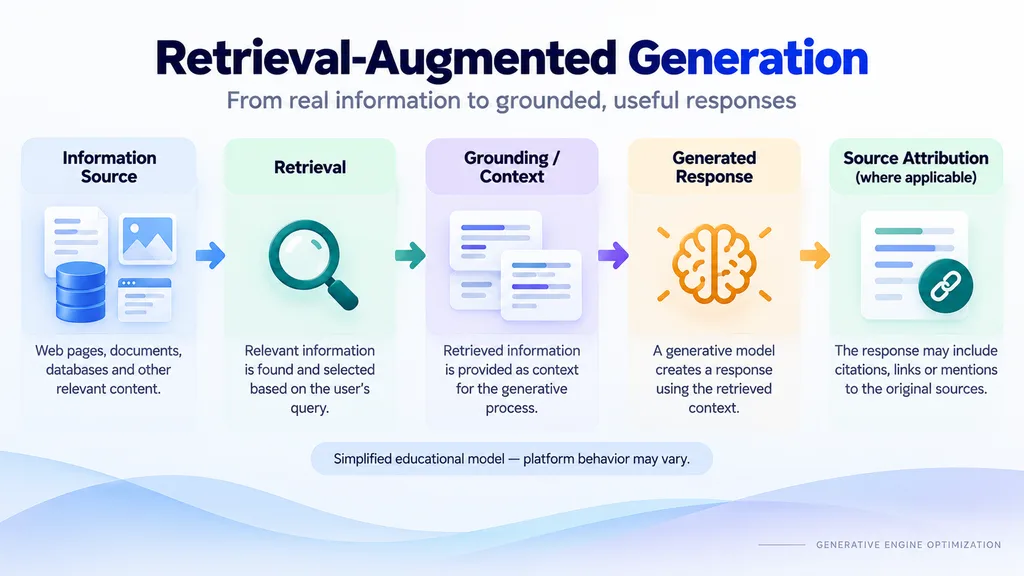
Retrieval-augmented generation, commonly called RAG, combines information retrieval with generative output.
In a simplified model:
Information source → Retrieval → Context or grounding → Generated response → Source attribution where applicable
This helps explain why GEO cannot be reduced to rewriting individual paragraphs.
The source first needs to exist within an information environment that the relevant system can use. The information then needs to be relevant enough to retrieve and useful enough to contribute to the response.
For publishers, the practical lesson is straightforward:
Do not optimize only the sentence you hope will be quoted. Improve the quality and context of the underlying resource.
GEO Is Platform-Specific
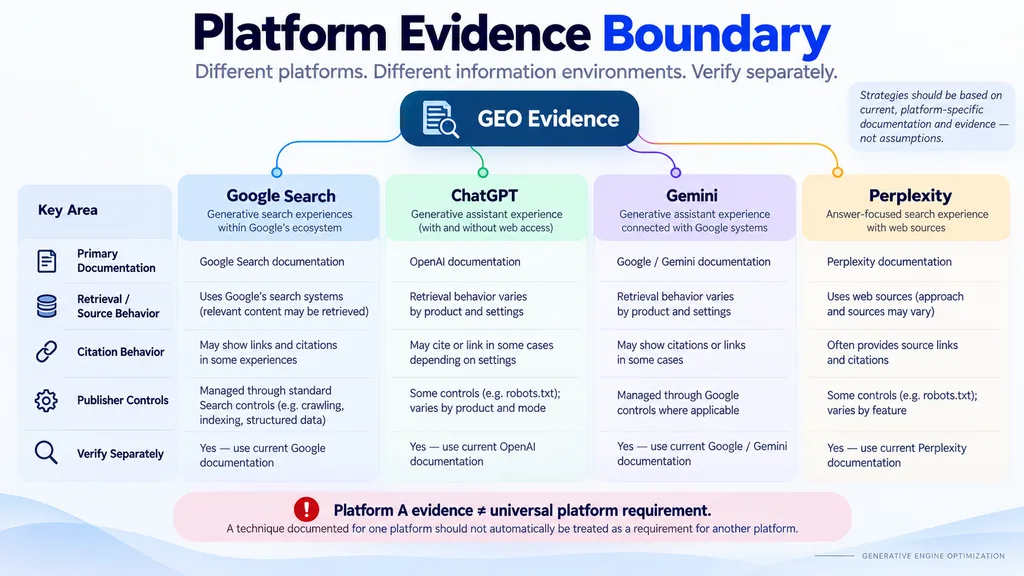
There is no single universal “AI search engine.”
Google Search, ChatGPT, Gemini, Perplexity, and other generative products may differ in:
retrieval mechanisms,
source availability,
indexes,
citation behavior,
web access,
interface design,
source controls,
and how responses are generated.
This creates an important evidence rule:
A technique documented for one platform should not automatically be described as a requirement for another platform.
A Google Search requirement is not automatically a ChatGPT requirement.
A Perplexity observation is not automatically a Google ranking factor.
A third-party experiment is not automatically evidence of universal generative behavior.
Platform-specific recommendations should use current primary documentation wherever possible.
When that evidence does not exist, label the recommendation as experimental or observational.
What Google Documentation Means for GEO
Google’s generative Search experiences remain connected to its broader Search ecosystem.
For publishers, this means there is no need to replace established website and Search fundamentals with a separate collection of supposed AI hacks.
Google does not document a requirement for:
a special GEO schema,
a special AI Overview schema,
a specific keyword density,
an arbitrary paragraph length,
a separate page for every AI prompt,
or guaranteed AI citations.
For Google-specific technical eligibility, crawling, indexing, structured data, and Search implementation, refer to our Technical SEO and Google Search resources.
The GEO-specific lesson is narrower:
Google’s generative experiences do not create a justification for abandoning people-first content and established Search fundamentals.
GEO Myths That Should Not Drive Your Strategy
| Claim | Evidence-Based Position |
|---|---|
| GEO replaces SEO | No |
| Every AI query needs a separate page | No |
| Special GEO schema guarantees citations | No |
| A particular keyword density is required | No |
| Every paragraph needs an artificial AI format | No |
| One optimization works identically across platforms | No |
| One AI response proves stable visibility | No |
| GEO can guarantee citations | No |
| Original evidence and useful information matter | Yes |
| Platform-specific evidence matters | Yes |
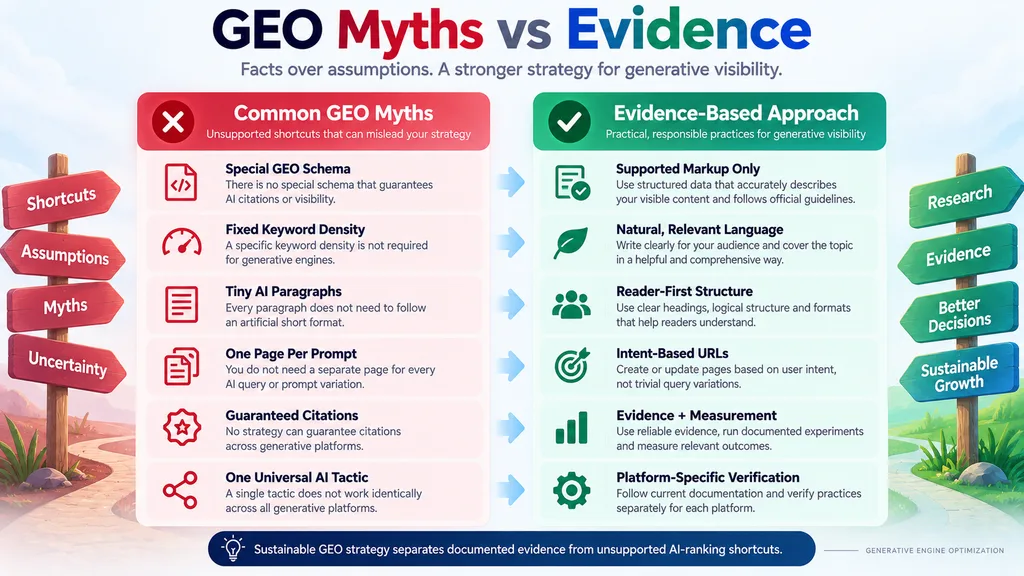
The purpose of GEO is not to create another checklist of artificial ranking signals.
It is to improve the information resource and evaluate how it performs in relevant generative environments.
Does llms.txt Improve GEO?
llms.txt should not be presented as a universal GEO ranking mechanism.
For Google Search specifically, it should not be treated as a requirement for ranking or inclusion in Google’s generative Search experiences.
That does not establish how every other platform will treat the convention now or in the future.
Before implementing any AI-oriented machine-readable convention, ask:
- Does the target platform officially support it?
- What documented purpose does it serve?
- What outcome can reasonably be measured?
- What maintenance implications does it introduce?
If those questions cannot be answered from reliable evidence, classify the implementation as experimental.
Stop Writing for an Imaginary AI Word Count
Clear structure helps readers.
Descriptive headings help readers.
Direct answers can help readers.
Tables can clarify comparisons.
Procedural steps can make tasks easier to complete.
None of this means every paragraph should be forced into an arbitrary “AI-friendly” length.
The correct question is:
What structure communicates this information most effectively?
Use short answers when the question deserves a short answer.
Use detailed explanations when complexity requires them.
Use tables when comparison is genuinely easier in tabular form.
Use diagrams when relationships are easier to understand visually.
GEO should improve communication rather than deform it.
The GEO Evidence Ladder
Not every GEO claim deserves equal confidence.
Use the following hierarchy.
| Level | Evidence Type | Appropriate Interpretation |
|---|---|---|
| 1 | Current primary platform documentation | Strong evidence for documented platform requirements or behavior |
| 2 | Rigorous academic research | Strong within the tested methodology |
| 3 | Reproducible controlled experiment | Useful within clearly defined conditions |
| 4 | Documented repeated observation | Useful signal, but causation may remain uncertain |
| 5 | Transparent editorial inference | Reasonable interpretation that must be labeled |
| 6 | Vendor or commercial claim | Requires independent verification |
| 7 | Unsupported assertion | Do not present as fact |
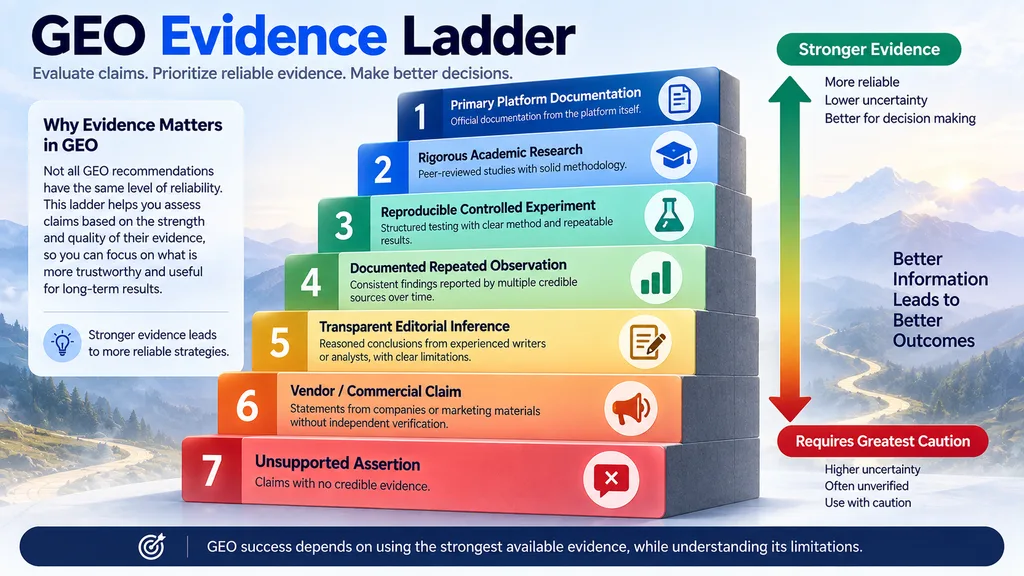
Even Level 1 requires interpretation.
Official documentation can establish what a platform says it supports or requires.
It does not automatically prove that implementing a particular practice will increase leads or revenue.
What Foundational GEO Research Actually Demonstrated
The foundational GEO research provided an important contribution: generative visibility could be studied systematically rather than discussed only through anecdotal marketing claims.
Researchers evaluated different content modifications and observed changes in source visibility within their experimental environments.
Some tested conditions produced substantial improvements, with the research reporting improvements reaching up to 40 percent in evaluated settings.
That result requires context.
It does not mean:
“Use GEO and get 40% more AI traffic.”
It does not establish a guaranteed citation increase across every current generative platform.
It does not establish permanent effects as models, retrieval systems, competitors, indexes, and interfaces change.
The defensible conclusion is:
Content characteristics can influence visibility in tested generative environments, but the size and transferability of the effect depend on the system, methodology, query, domain, and experimental conditions.
This distinction prevents research from becoming a marketing promise.
What Later GEO Research Tells Us
The research landscape has continued developing.
Later work has emphasized that generative visibility should be considered across multiple stages rather than measured as one event.
That distinction matters.
A page could:
be available but not retrieved,
be retrieved but not used,
be used but not cited,
be cited but receive no click,
receive a click but produce no meaningful business outcome.
A content intervention can therefore affect one stage without affecting another.
This is why claims such as “this technique increases AI visibility” need a precise definition of what visibility means.
The Most Important GEO Asset: Non-Commodity Information
Generative systems make generic content extraordinarily easy to produce.
Publishing another summary of information already available everywhere provides little differentiation.
A stronger GEO strategy asks:
What does this page contribute that is genuinely worth retrieving?
Compare the difference:
| Commodity Content | Higher-Information-Gain Content |
|---|---|
| Generic definition | Primary-source synthesis |
| Repeated industry statistic | Original calculation or primary evidence |
| Generic checklist | Original decision framework |
| Rewritten vendor features | Documented evaluation |
| Unsupported prediction | Evidence with limitations |
| Generic AI graphic | Original explanatory diagram |
| One-off AI observation | Documented repeated experiment |
| “Best practices” list | Problem → evidence → decision → limitation |
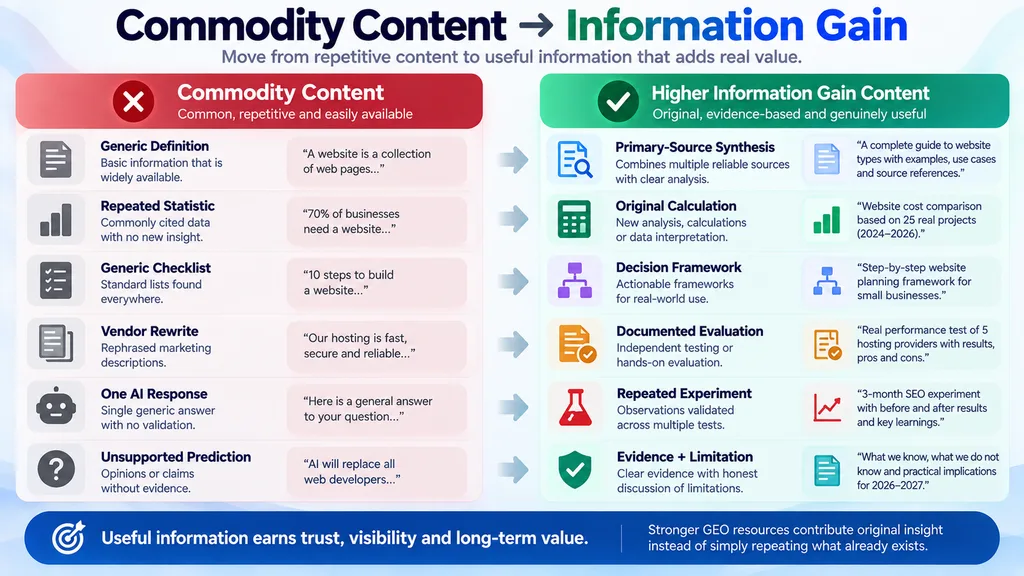
The objective is not novelty for novelty’s sake.
Information gain should help the reader make a better decision, understand a difficult concept, verify a claim, or complete a task.
Build a GEO Evidence Layer
Important claims should be traceable.
A useful editorial structure is:
Claim → Evidence → Source → Interpretation
Example:
Claim: Content characteristics can influence generative visibility.
Evidence: Controlled GEO research observed visibility differences after tested content modifications.
Source: The foundational GEO research.
Interpretation: Content design can affect generative representation under tested conditions, but this should not be converted into a universal citation guarantee.
This structure makes unsupported claims easier to detect before publication.
Entity Clarity Matters
Generative information environments frequently involve relationships between entities.
Depending on the page, those entities might include:
an organization,
author,
service,
product,
technology,
person,
location,
research paper,
or concept.
A publisher should make important factual relationships consistent and understandable.
For example:
Marjan Web Studio → provides → website development services
Generative Engine Optimization → relates to → generative search visibility
GEO research → evaluates → source visibility in generative environments
Entity clarity does not mean stuffing pages with named entities.
Include an entity only when it improves understanding.
Structured Data: Useful Context, Not a GEO Switch
Structured data can provide machine-readable context when it accurately represents visible page content.
It should not be treated as an AI citation switch.
For an editorial guide, appropriate Article or BlogPosting markup may describe elements such as:
headline,
author,
publisher,
publication date,
modified date,
and representative image.
Do not invent fictional types such as:
GEO
AIOverview
AICitation
or GenerativeEngineOptimization
simply to appear optimized for AI.
Structured data should describe reality.
It should not manufacture relevance.
Multimedia Should Add Evidence or Understanding
A GEO article should not contain images merely to increase image count.
The strongest hierarchy is:
Real evidence → Original diagram/chart → Useful illustration → Decorative image
Useful assets may include:
real screenshots of primary documentation,
real experiment records,
original process diagrams,
original decision matrices,
charts based on genuine data,
or relevant demonstration video.
Never use an AI-generated image as if it were a real Search Console screenshot, AI citation, experiment, research result, or platform interface.
Evidence must remain evidence.
GEO Experiments Need a Method
A single AI response is not a case study.
Generative outputs can vary across prompts, sessions, dates, models, retrieval conditions, and product changes.
A credible GEO experiment begins with a documented hypothesis.
Example:
Adding a primary-source evidence table may improve the clarity and verifiability of the page’s core claims.
Then record:
| Field | What to Record |
|---|---|
| URL | Exact page tested |
| Hypothesis | Expected effect and reasoning |
| Baseline | Available pre-change data |
| Intervention | Exact modification |
| Date | Implementation date |
| Platform | System evaluated |
| Prompt set | Exact test prompts |
| Observations | Number of repeated tests |
| Result | What was actually observed |
| Limitation | What the experiment cannot establish |
| Decision | Keep, revert, investigate, or retest |
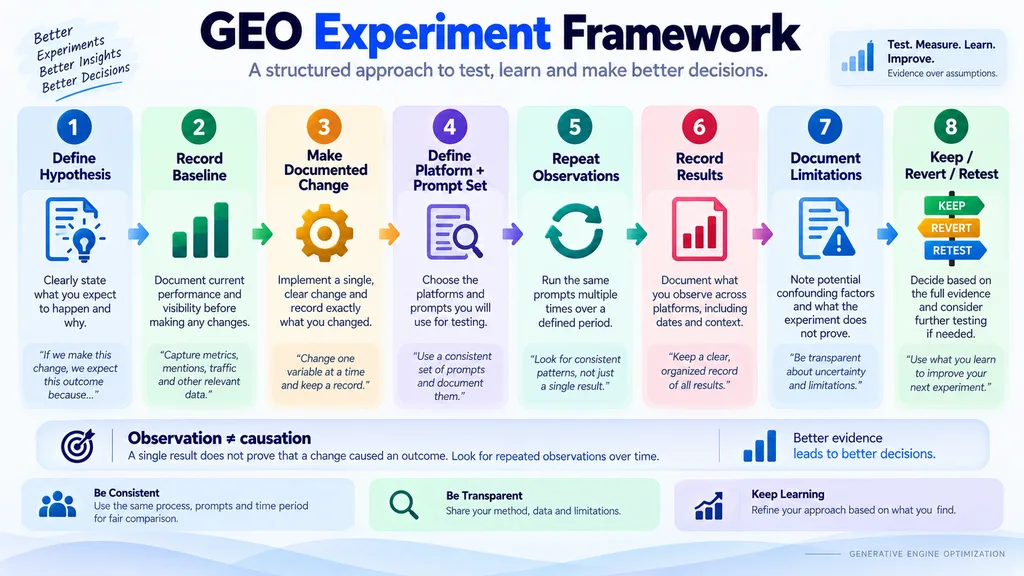
If an experiment cannot be reproduced or adequately documented, describe it as an observation rather than proof.
How to Measure GEO
Do not create one arbitrary GEO score.
Separate the stages:
Eligibility → Retrieval/Visibility Observation → Attribution → Referral → Engagement → Conversion → Business Outcome
| Layer | Measurement Question |
|---|---|
| Eligibility | Is the resource technically available where appropriate? |
| Generative observation | Was the source or entity observed in the tested experience? |
| Attribution | Was it mentioned, linked, or cited? |
| Referral | Did identifiable traffic arrive? |
| Engagement | Did the visitor meaningfully use the page? |
| Conversion | Did a defined action occur? |
| Business outcome | Did the activity contribute to a meaningful objective? |
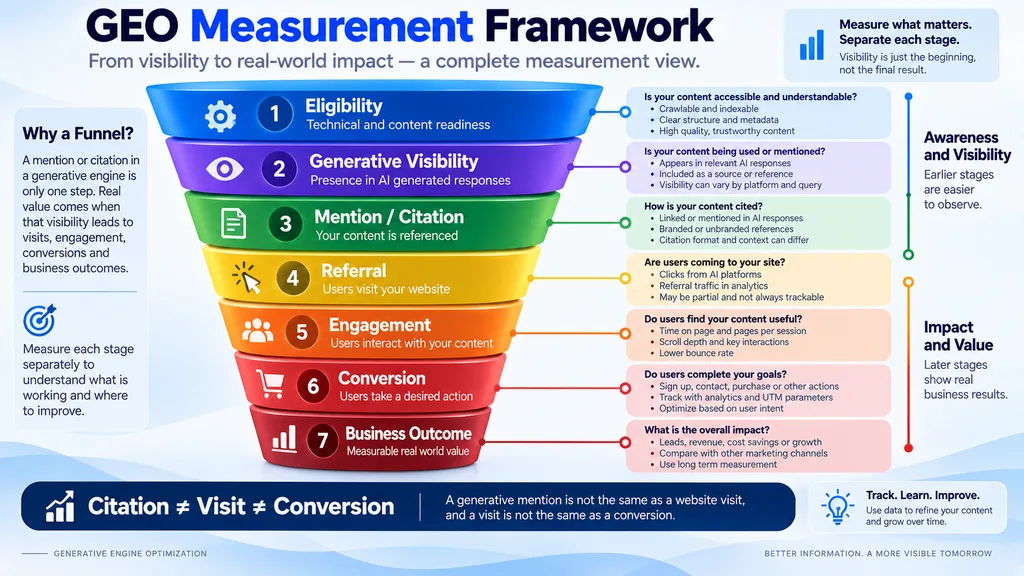
These events should not be treated as interchangeable.
A mention is not necessarily a citation.
A citation is not necessarily a visit.
A visit is not necessarily a lead.
A lead is not necessarily revenue.
Measuring Google and Other AI Platforms Separately
Do not present Google Search Console as a universal AI visibility platform.
Use Google Search Console for the Google Search data it provides.
Use relevant analytics for attributable website activity.
If another generative platform is evaluated manually, document that evaluation separately.
Record:
platform,
testing date,
prompt set,
number of observations,
definition of a mention,
definition of a citation,
and methodological limitations.
Cross-platform results should not be combined into a single number unless the methodology genuinely supports that comparison.
GEO and AI Crawlers
Crawler policies require platform-specific decisions.
Do not copy a historical list of AI user agents and automatically block or allow everything on it.
Before changing sitewide crawler rules, verify:
the operator,
crawler name,
documented purpose,
current control mechanism,
and potential business consequences.
Search retrieval, user-triggered browsing, model training, and other automated access can have different purposes.
Treat crawler governance as a separate technical decision rather than a generic GEO hack.
GEO May Extend Beyond Generated Answers
Generative systems are increasingly capable of helping users perform actions rather than simply presenting informational responses.
This could make areas such as accurate business data, accessible workflows, structured product or service information, security, and reliable website architecture increasingly important.
However, this area is evolving rapidly.
Do not rebuild a website around speculative future AI-agent requirements.
Separate:
documented current capabilities
from
reasonable future possibilities
from
unsupported predictions.
A Practical GEO Workflow
1. Define the Information Need
Start with the user’s problem rather than an AI keyword.
2. Check Existing URLs
Determine whether the site already has a page that owns the intent.
Update that page when appropriate instead of creating a competing URL.
3. Study the Current Search Landscape
Identify what existing results already explain well.
Then identify the genuine satisfaction gap.
4. Define the GEO-Specific Scope
Decide whether the resource genuinely requires generative retrieval, attribution, platform, evidence, or measurement coverage.
If the intent is primarily AEO or Technical SEO, use the appropriate existing resource instead.
5. Map Necessary Entities
Include entities and relationships that improve comprehension.
6. Build an Evidence Plan
Identify the best source for every important factual claim.
7. Plan Information Gain
Decide what the page contributes beyond existing summaries.
8. Build the Resource
Write for the reader.
Use the format that best communicates the information.
9. Add Evidence and Multimedia
Prefer real evidence and original explanatory assets.
10. Connect the Content Architecture
Link the page to its parent topic, supporting resources, and relevant commercial next step.
11. Record a Baseline
Document available measurements before significant experiments.
12. Publish and Observe
Allow enough time for meaningful observations rather than repeatedly rewriting the page.
13. Test Carefully
Record platform, prompts, dates, observations, and limitations.
14. Review Evidence
Separate correlation, observation, and causation.
15. Update Only When Justified
Update when evidence, platform documentation, research, or the resource itself materially changes.
Do not alter dates simply to simulate freshness.
Methodology and Evidence Policy
This guide distinguishes between:
Primary platform documentation — used for platform-specific requirements and documented behavior.
Academic research — interpreted within the conditions and limitations of the research.
Documented observations — useful for generating hypotheses but not automatically treated as causal evidence.
Editorial interpretation — clearly separated from verified platform requirements.
Commercial vendor claims should not be converted into facts without appropriate evidence.
Marjan Web Studio does not treat isolated generative responses as proof of stable rankings or guaranteed citation behavior.
Where platform architecture is proprietary, diagrams in this guide are conceptual models rather than claims about undisclosed internal systems.
GEO Publication Checklist
Before publishing a GEO-focused resource, verify:
- The intent is genuinely distinct from existing pages.
- No existing URL already owns the same primary intent.
- Current results have been reviewed for satisfaction gaps.
- The page contributes meaningful information gain.
- Important claims use appropriate evidence.
- Academic findings retain their limitations.
- Platform-specific claims are not generalized.
- Entities are clear and relevant.
- The underlying page is technically eligible where appropriate.
- Structured data matches visible content.
- Multimedia adds evidence or comprehension.
- Real evidence has not been fabricated.
- No invented GEO schema is used.
- No guaranteed citations are promised.
- No arbitrary keyword density is enforced.
- No trivial query variations receive unnecessary URLs.
- A measurement method exists where appropriate.
- Authorship and methodology are transparent.
- Future updates will be evidence-driven.
Frequently Asked Questions
Does Google Require llms.txt for GEO?
No. llms.txt should not be treated as a Google Search ranking or generative-search requirement. Evaluate machine-readable AI conventions platform by platform rather than assuming universal support.
Is There Special GEO Schema?
No dedicated GEO schema should be invented. Use appropriate structured data only when it accurately describes the visible content and is appropriate for the page.
Can GEO Guarantee AI Citations?
No. Publishers can improve their information, evidence, accessibility, entity clarity, and measurement practices, but independent generative systems ultimately determine which information they retrieve, use, mention, or cite.
Build the Foundation Before Chasing AI Citations
GEO experimentation is unlikely to solve fundamental website-quality problems.
If a website has serious technical, architecture, content-quality, trust, or discoverability issues, address those foundations first.
Marjan Web Studio’s website development and search-readiness services focus on creating that underlying foundation before advanced generative-search experimentation.
Conclusion
Generative Engine Optimization is best understood as an emerging evidence and visibility discipline rather than a collection of AI-ranking tricks.
Its most useful questions are not:
“How many words should an AI paragraph contain?”
“What secret schema gets citations?”
or
“How do I guarantee ChatGPT mentions my business?”
The better questions are:
Is this information genuinely worth retrieving?
Can important claims be verified?
Are entities and relationships clear?
Which platform does the evidence actually apply to?
Can an observation be reproduced?
Does generative visibility produce useful outcomes?
A durable GEO strategy therefore combines high-quality information, evidence, platform awareness, careful experimentation, transparent limitations, and meaningful measurement.
That approach is slower than chasing every new GEO tactic.
It is also much more defensible.
Internal Links — Related Articles
- AEO Basics Guide for Beginners
- How to Use AEO in Digital Marketing
- Technical SEO Guide
- Google Search Console Guide
- Website Mistakes to Avoid
- Website Planning Checklist
- Website Maintenance Guide
External Links — Authoritative Sources
- Google — Optimizing Your Website for Generative AI Features
- Google — AI Features and Your Website
- Google Search Essentials
- Google — Guidance on Generative AI Content
- GEO: Generative Engine Optimization — Foundational Research Paper
- Princeton University — GEO Research Publication Record
- OpenAI — Publishers and Developers FAQ