Table of Contents
Introduction to On-Page SEO Services 2026
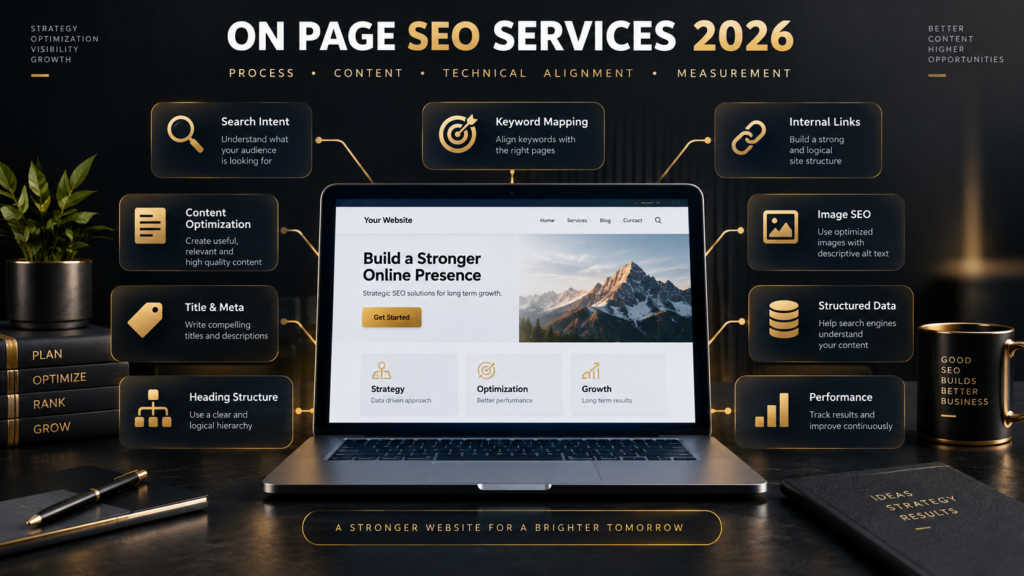
On Page SEO Services 2026: Professional on-page SEO services improve the content, structure, internal links, search intent alignment, metadata, images, and other page-level elements that help users and search engines understand an individual web page.
The objective is not to repeat keywords or chase an artificial SEO score.
The objective is to make the right page answer the right search clearly, accurately, efficiently, and persuasively.
A complete on-page SEO project may involve keyword-to-page mapping, search intent analysis, title and meta description improvement, heading restructuring, content enhancement, internal linking, image optimization, cannibalization checks, structured data review, conversion improvements, and performance measurement.
However, on-page SEO has limits. It cannot guarantee rankings, compensate for serious indexing problems, replace genuine authority, or turn an unsuitable product or service into a successful business.
This guide explains what professional on-page SEO services should include in 2026, how the process works, what buyers should check, how pricing should be evaluated, and how on-page SEO now fits into both traditional and AI-powered search.
Quick Answer: What Are On-Page SEO Services?
On-page SEO services are professional improvements made directly to individual website pages to strengthen their relevance, clarity, usefulness, structure, search visibility, and ability to guide visitors toward a meaningful next action.
Typical work includes:
- Search intent analysis.
- Keyword-to-page mapping.
- Title optimization.
- Meta description improvement.
- H1, H2, and H3 structure.
- Content enhancement.
- Internal linking.
- Image optimization.
- Cannibalization checks.
- URL review.
- Structured data assessment.
- Page experience review.
- Conversion path improvement.
- Search Console monitoring.
On-page SEO is different from technical SEO and off-page SEO, although the three areas frequently overlap.
What Is On Page SEO?
On page SEO is the process of improving the information and page-level signals that users and search engines encounter directly on a webpage.
For a service page, that may mean clarifying exactly what the business provides, which audience it serves, what problems the service solves, what is included, how the process works, and what the visitor should do next.
For an informational article, the emphasis may instead be on answering the searcher’s question clearly, explaining important concepts, supporting factual claims, and connecting the article to useful related resources.
Good on page SEO therefore begins with purpose, not keywords.
A page should first have a reason to exist.
Only then should keywords, headings, links, media, structured data, and conversion elements be optimized around that purpose.
When Does a Website Need On Page SEO?
A website may benefit from on-page SEO when its important pages are indexed but fail to attract relevant impressions, clicks, enquiries, or sales.
Common warning signs include:
- Important pages targeting unclear or overlapping topics.
- Titles that do not accurately describe page content.
- Several pages competing for the same search intent.
- Thin service pages.
- Outdated content.
- Weak heading structure.
- Generic introductory paragraphs.
- Missing internal links.
- Important pages buried deep within the website.
- Poor mobile readability.
- Unhelpful calls to action.
- Pages receiving impressions but weak click-through rates.
- Pages receiving traffic but failing to support conversions.
These symptoms should not automatically be blamed on on page SEO.
An indexing problem, technical configuration error, weak authority profile, poor product market fit, strong competitors, or limited search demand may also be responsible.
Professional work should therefore begin with diagnosis rather than assumptions.
What Should Professional On Page SEO Services Include?
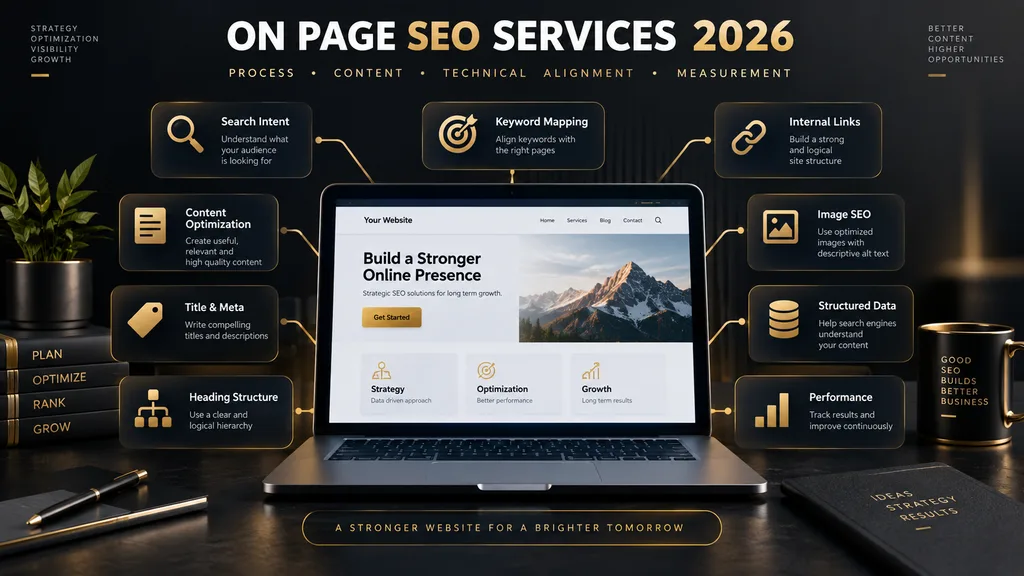
A credible service should explain exactly what will be reviewed, what will be changed, who will implement the changes, and how the outcome will be measured.
A useful scope normally covers the following areas.
1. Search Intent Analysis
Search intent describes what the person behind a query is actually trying to accomplish.
A user searching for “what is on page SEO” usually wants education.
A user searching for “on page SEO services” is more likely to be evaluating providers.
A user searching for “on page SEO services pricing” has moved closer to a commercial decision.
These searches should not automatically lead to identical pages.
A professional SEO should identify the dominant intent before rewriting content.
The page format, depth, examples, calls to action, and internal links should then support that intent.
2. Keyword to Page Mapping
Keyword mapping assigns closely related search topics to appropriate URLs.
The purpose is not to create one page for every keyword variation.
The purpose is to prevent unnecessary overlap.
For example, one strong page may naturally cover:
“on page SEO services.”
“professional on page SEO.”
“on page SEO optimization services.”
“on page SEO agency.”
Creating four nearly identical landing pages for those variations may provide little additional value and may create internal competition.
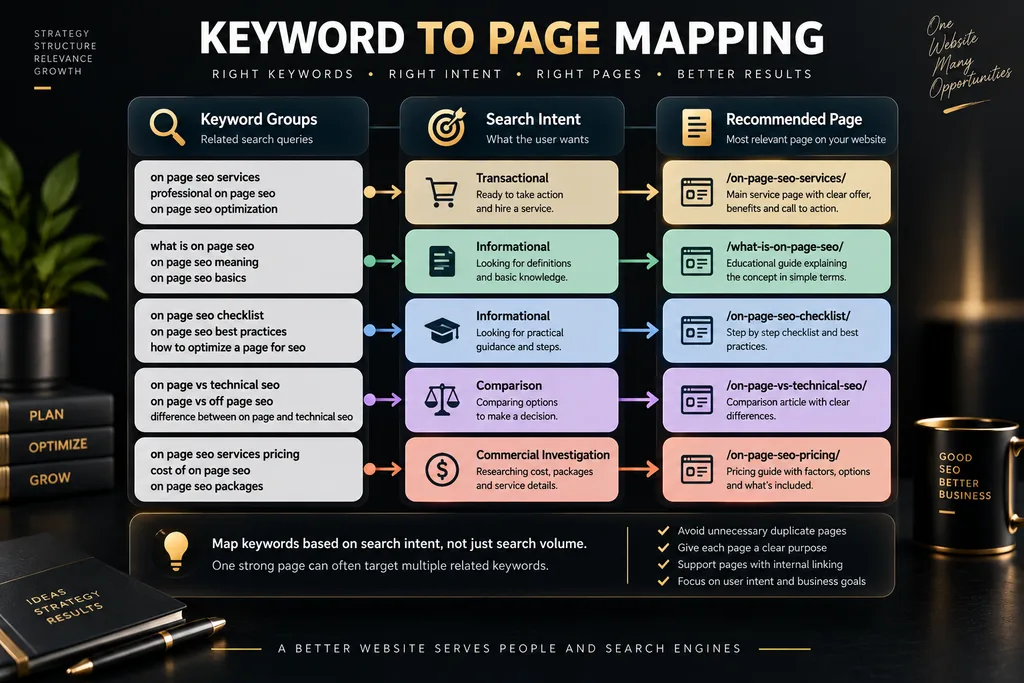
A keyword map should identify:
- The main intent of every important URL.
- Its primary topic.
- Related secondary topics.
- Existing overlap.
- Pages that should be consolidated.
- Supporting content opportunities.
- Internal linking relationships.
3. Title Element Optimization
The page title helps searchers understand what a result is about before clicking.
A professional title should be descriptive, specific, useful, and consistent with the actual page.
Avoid turning title optimization into a rigid character counting exercise.
The objective is clarity.
A good title should communicate the subject quickly without repeating keywords unnaturally.
For example:
Weak title:
SEO Services | SEO Optimization | SEO Experts | Best SEO
Clearer title:
On Page SEO Services: Audit, Content and Page Optimization
The second version tells the reader what the page actually covers.
4. Meta Description Improvement
A meta description can summarize the page and communicate why the result may be useful.
It should not simply repeat the title.
An effective description usually explains:
- What the page offers.
- Who it is for.
- What the reader will learn or receive.
- Why the page is relevant.
Search engines may generate their own snippets from visible content, so a meta description should be treated as a strong recommendation rather than a guaranteed search snippet.
5. Heading Structure
Headings help readers scan content and help organize a page into meaningful sections.
A simple hierarchy normally works well:
H1 for the main page topic.
H2 for major sections.
H3 for subsections.
H4 only where another level is genuinely useful.
Headings should describe the content underneath them.
Avoid creating headings simply to insert keywords.
One clear primary H1 is generally easier to manage than several competing main titles.
6. Content Quality and Search Intent Alignment
Content optimization is usually the most important part of on page work.
The objective is not automatically to make every page longer.
The objective is to make it more useful.
A professional content review should ask:
- Does the opening answer the user’s main need?
- Is the page written for the correct audience?
- Are important questions unanswered?
- Are explanations specific enough?
- Are claims supported?
- Is information current?
- Are unnecessary paragraphs present?
- Is important information hidden too far down the page?
- Does the page provide anything better than a generic summary?
- Does the page have a logical next action?
A 1,200-word page that completely satisfies intent can be stronger than a 4,000-word page filled with repetition.
7. Cannibalization Analysis
Keyword cannibalization occurs when multiple pages compete for substantially the same search intent.
This does not mean that two pages can never mention the same phrase.
The real problem appears when Google and users have difficulty distinguishing which URL is supposed to serve which purpose.
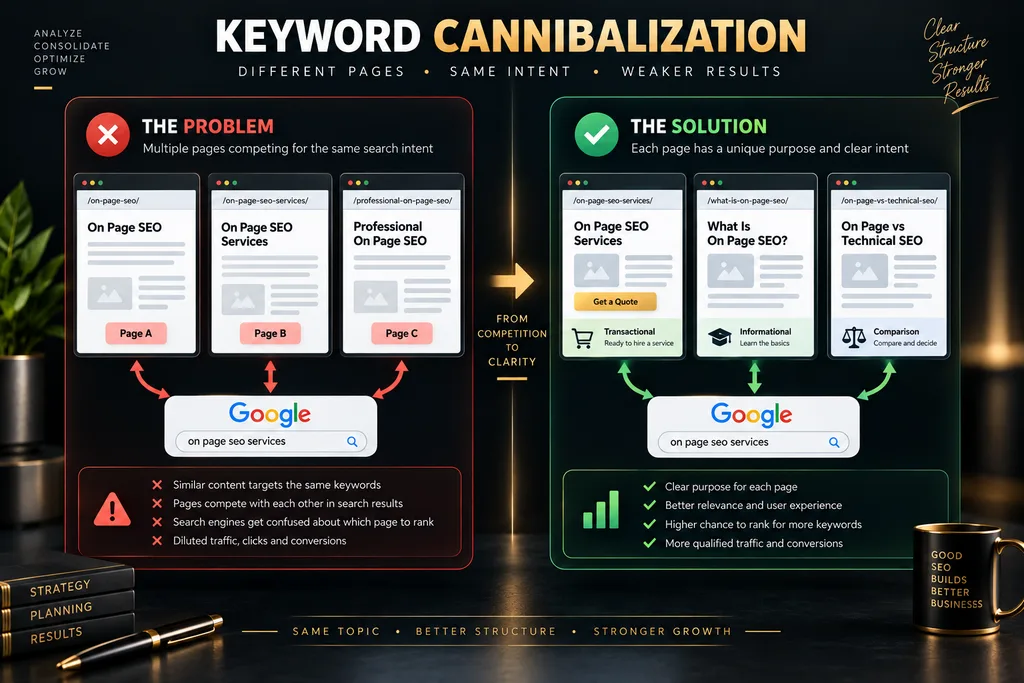
A cannibalization audit may recommend:
- Merging pages.
- Rewriting one page for a different intent.
- Redirecting an obsolete URL.
- Changing internal links.
- Consolidating duplicate content.
- Retaining both pages when their purposes are genuinely different.
This work is particularly important on older websites that have published many similar service pages or blog posts over time.
Internal Linking Optimization
Internal links help users move between related information and help establish relationships between pages.
Good internal linking is contextual.
For example, an article discussing indexing problems may naturally link to a Technical SEO Guide.
A section about analytics may link to a GA4 or conversion tracking resource.
A service comparison may link to the relevant service page.
Internal links should use descriptive anchor text where practical.
Avoid forcing the same match anchor into dozens of pages.
A useful internal link should answer one question:
Would clicking this link genuinely help the reader continue their task?
If the answer is no, the link probably does not belong there.
Image Optimization
Images should support the page rather than simply decorate it.
Useful image optimization may include:
- Descriptive filenames.
- Appropriate dimensions.
- Efficient file formats.
- Compression.
- Relevant alternative text.
- Width and height attributes where appropriate.
- Lazy loading below the fold where suitable.
- Captions when they add context.
- Original screenshots or diagrams where they improve understanding.
Alternative text should describe the purpose or meaning of an informative image.
It should not be used as another place to repeat target keywords unnecessarily.
URL Review
URLs should normally be understandable, stable, and descriptive.
A professional audit may review:
- Unnecessary parameters.
- Duplicate URL variants.
- Legacy slugs.
- Date-based URLs.
- Redirect chains.
- Inconsistent naming.
- URLs that no longer reflect page intent.
Do not change an established URL merely because a shorter one looks cleaner.
Changing a live URL can create unnecessary migration work and requires appropriate redirects, internal link updates, sitemap changes, and monitoring.
Structured Data Review
Structured data can provide machine-readable information about a webpage and the entities it represents.
Relevant schema may include:
- Article or BlogPosting.
- BreadcrumbList.
- Organization.
- Person.
- Product.
- LocalBusiness.
- Other types genuinely appropriate to visible content.
Structured data should describe what is actually present on the page.
It should not be used to invent reviews, ratings, credentials, services, or business information.
Correct structured data can make pages eligible for supported enhanced search appearances, but it does not guarantee that a particular result will be displayed.
Core Web Vitals and Page Experience
Some on-page projects include limited page experience work, although deep performance engineering usually belongs within technical SEO.
The current Core Web Vitals are:
Largest Contentful Paint (LCP.
A good user experience target is 2.5 seconds or less.
Interaction to Next Paint, INP.
A good target is 200 milliseconds or less.
Cumulative Layout Shift, CLS.
A good target is 0.1 or less.
These metrics represent loading performance, responsiveness, and visual stability.
They matter because users benefit from responsive and stable websites.
Passing Core Web Vitals does not guarantee a particular ranking.
On Page SEO for AI Search in 2026
AI-powered search has increased interest in terms such as AEO, Answer Engine Optimization, and GEO, Generative Engine Optimization.
The practical lesson is simpler than much of the marketing around these terms suggests.
Pages still need to be useful, accessible, crawlable, indexable, clearly organized, and supported by reliable information.
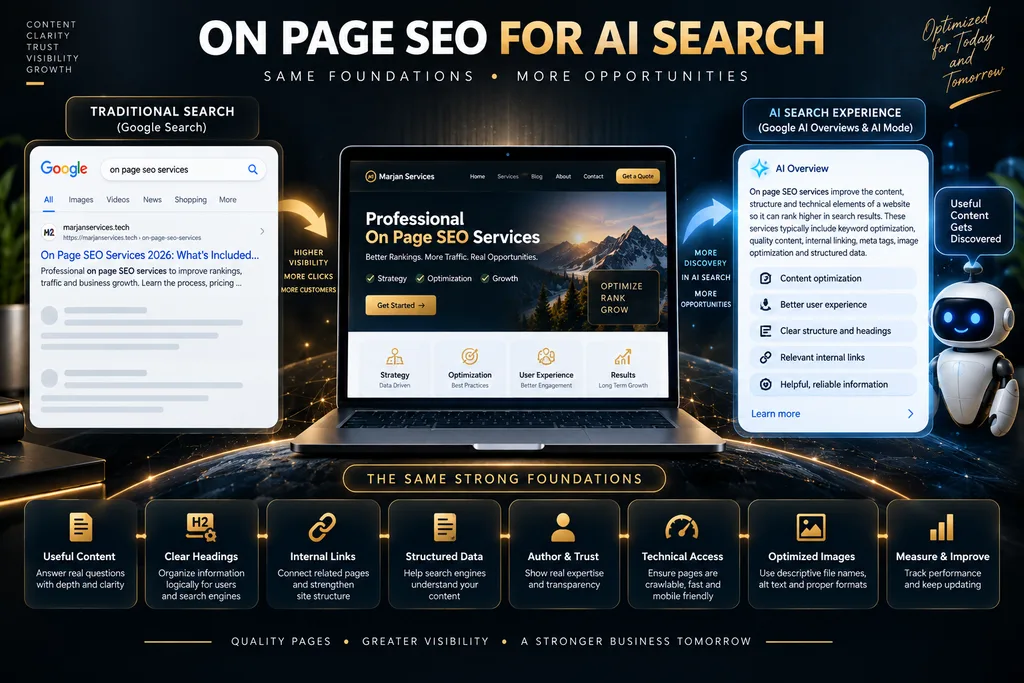
Useful practices include:
- Clear definitions.
- Direct answers where appropriate.
- Descriptive headings.
- Accurate facts.
- Strong internal linking.
- Explicit entity relationships.
- Useful tables.
- Original examples.
- Current sources.
- Author transparency.
- Clear page purpose.
Do not create dozens of near-duplicate pages for every conversational search variation.
Do not stuff entities into paragraphs simply because an AI tool generated a semantic keyword list.
Do not assume special AI markup guarantees inclusion in generated answers.
For Google Search specifically, normal SEO fundamentals remain the foundation for AI Overviews and AI Mode.
On Page SEO vs Technical SEO
These disciplines overlap, but their primary responsibilities differ.
| Area | On Page SEO | Technical SEO |
|---|---|---|
| Main focus | Relevance and page quality | Accessibility and technical processing |
| Typical scope | Individual pages | Sitewide systems and templates |
| Search intent | Core responsibility | Supporting consideration |
| Titles and headings | Yes | Usually limited |
| Content optimization | Yes | Usually not primary |
| Internal links | Yes | Architecture may overlap |
| Canonicals | Review may occur | Core technical responsibility |
| Crawlability | Limited review | Core responsibility |
| Rendering | Rarely primary | Core responsibility |
| XML sitemaps | Rarely primary | Core responsibility |
| Core Web Vitals | Basic overlap | Deeper implementation |
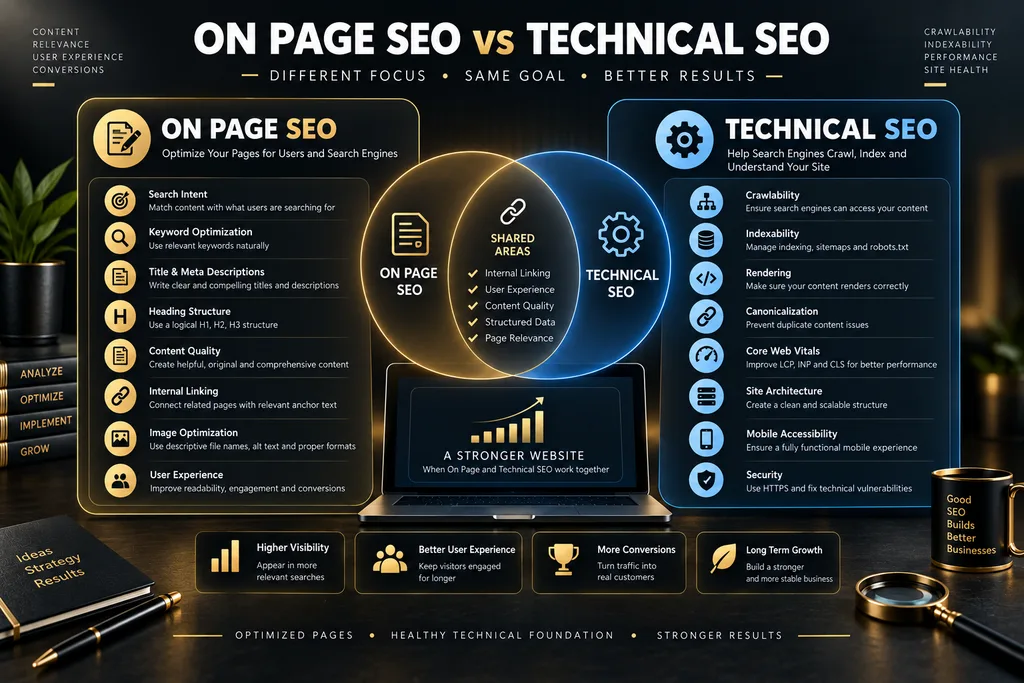
Neither replaces the other.
A useful page cannot rank effectively if serious technical issues prevent it from being processed correctly.
A technically perfect page can still underperform if it does not satisfy search intent.
On Page SEO vs Off Page SEO
Off-page SEO focuses mainly on external signals such as earned backlinks, brand mentions, digital PR, third-party references, and broader reputation.
On page SEO focuses primarily on your own pages.
Businesses should avoid treating the two disciplines as competing alternatives.
The right priority depends on the website.
A website with excellent authority but weak pages may need substantial on page work.
A useful and technically sound site competing in a highly authoritative market may eventually need stronger external recognition.
A Professional On Page SEO Process
A structured process should normally follow five stages.
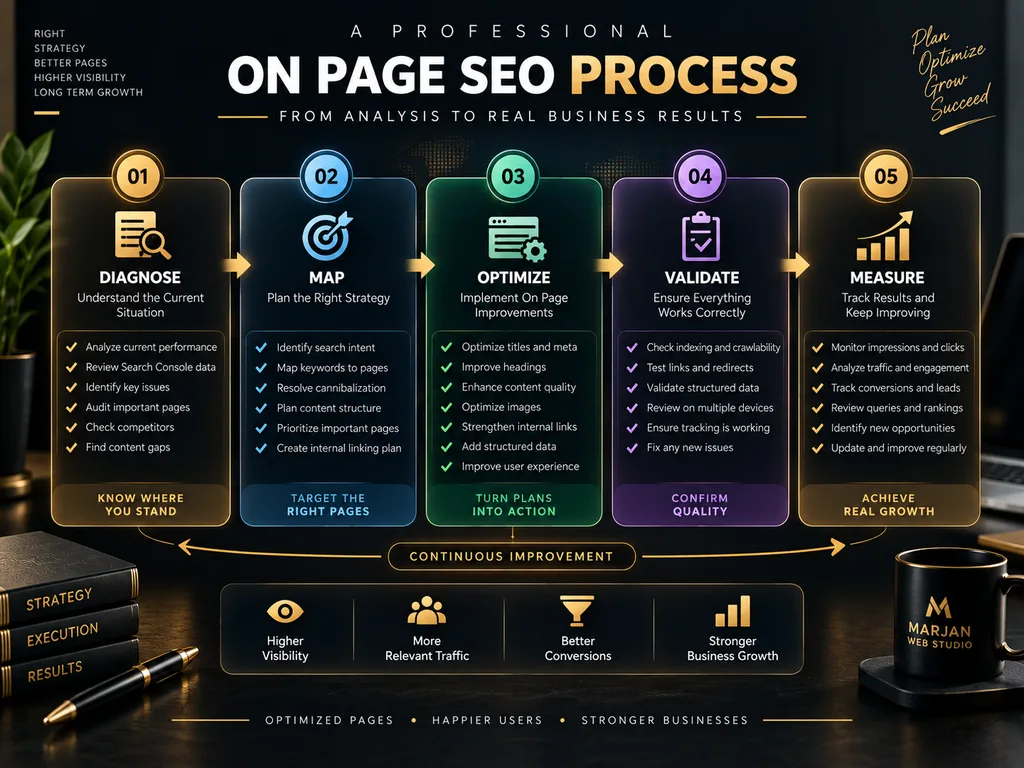
Phase 1. Diagnose
Review:
- Current organic performance.
- Existing rankings.
- Search Console queries.
- Important pages.
- Indexation.
- Competitor pages.
- Conversion paths.
- Content overlap.
- Internal links.
The objective is to identify the problem before prescribing a solution.
Phase 2. Map
Assign search intent and topics to the correct URLs.
Decide which pages should be:
- Retained.
- Improved.
- Consolidated.
- Redirected.
- Repositioned.
- Supported by new content.
Phase 3. Optimize
Implement approved changes to:
- Titles.
- Descriptions.
- Headings.
- Content.
- Internal links.
- Images.
- Calls to action.
- Structured information where appropriate.
Phase 4. Validate
After implementation, verify:
- Pages remain indexable.
- Links work.
- Canonicals are correct.
- Redirects work where used.
- Important text is visible.
- Structured data is valid.
- Mobile layouts remain usable.
- Tracking has not been broken.
Phase 5. Measure and Improve
Monitor:
- Impressions.
- Clicks.
- Query visibility.
- Landing page traffic.
- Conversions.
- Leads.
- Revenue where tracked.
- Engagement.
- Important crawl or indexing changes.
SEO should be evaluated using business-relevant data rather than rankings alone.
How Much Do On Page SEO Services Cost?
There is no universal price.
Cost depends on:
- Number of pages.
- Website size.
- Current condition.
- Competition.
- Required research.
- Content rewriting.
- Implementation responsibility.
- Technical complexity.
- Number of target markets.
- Reporting requirements.
- Ongoing monitoring.
A single-page review and a complete 500-page e-commerce optimization project should not cost the same.
Marjan Web Studio currently lists its broader SEO Services starting from PKR 20,000, with final pricing dependent on confirmed scope.
International projects can be quoted separately according to project requirements.
Prices should always be confirmed before work begins because scope, platform, content volume, and implementation requirements can change the final quotation.
Audit Only vs Implementation
This distinction should be confirmed before hiring anyone.
Some SEO providers deliver a spreadsheet containing recommendations.
Others implement approved changes directly.
Both models can be valid.
An audit-only engagement works when the business has a capable internal developer, writer, or marketing team.
Implementation is more useful when the client needs the provider to complete the actual work.
Before purchasing, ask:
Does the quoted price include implementation or recommendations only?
That one question prevents considerable confusion.
DIY vs Professional On Page SEO
Website owners can perform many basic tasks themselves.
DIY work may be suitable when:
- The website is small.
- The business understands its customers.
- The owner can use Search Console.
- There are few technical issues.
- The content is straightforward.
- Time is available for research and implementation.
Professional assistance becomes more valuable when:
- The site contains hundreds of URLs.
- Several pages compete with each other.
- Organic traffic has dropped.
- Important pages are not indexed.
- A migration recently occurred.
- International targeting is involved.
- Ecommerce architecture is complex.
- Multiple stakeholders manage content.
- Search visibility is commercially important.
Hiring an SEO does not guarantee results.
The value of professional assistance should come from better diagnosis, prioritization, implementation, documentation, and measurement.
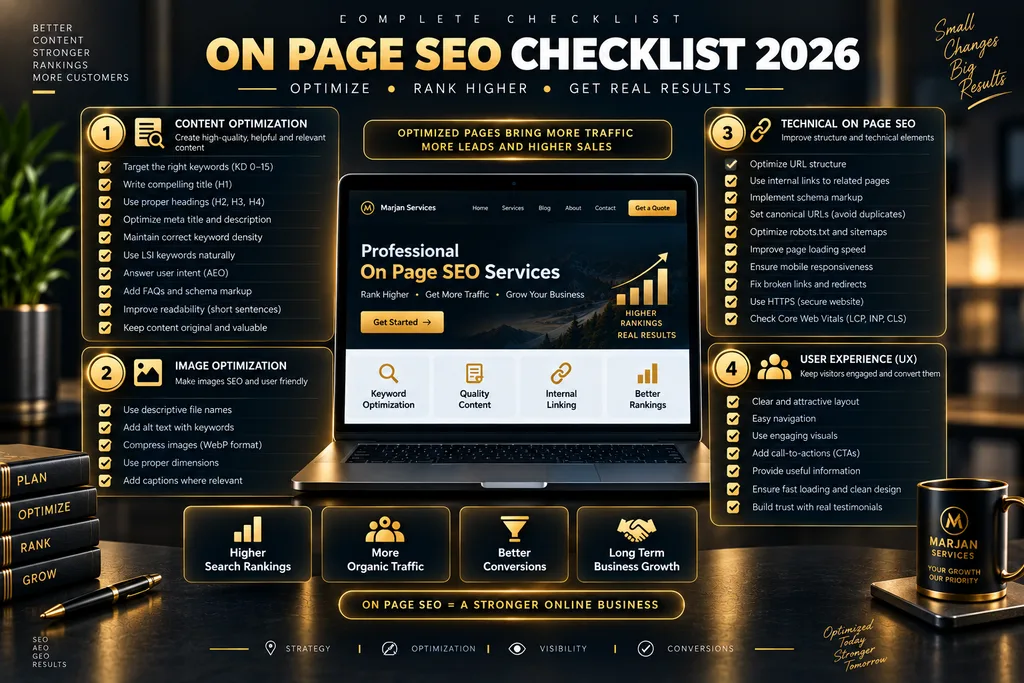
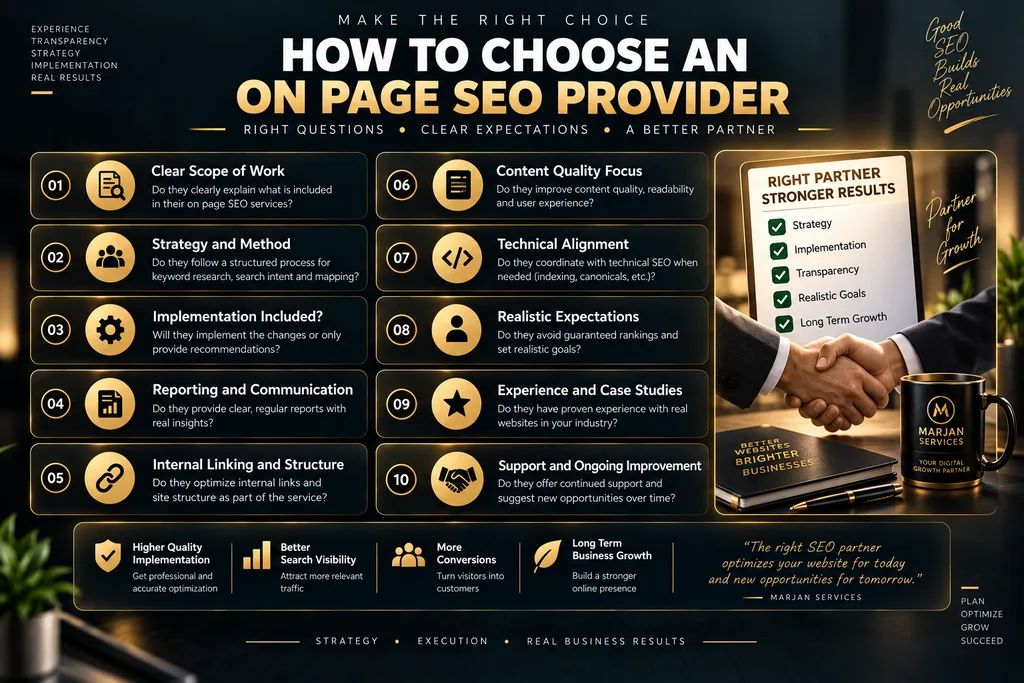
How to Choose an On Page SEO Provider
Do not select a provider solely because the website says “number one SEO agency.”
Ask practical questions.
What exactly will you change?
The scope should name actual deliverables.
Do you implement recommendations?
Clarify whether the provider edits the site or only sends a report.
How do you choose target keywords?
The answer should involve intent, relevance, competition, current performance, and business goals rather than search volume alone.
How do you handle cannibalization?
A serious provider should know how to distinguish overlapping intent from harmless keyword similarity.
How will you measure performance?
Look for Search Console, analytics, conversions, leads, and page-level reporting where appropriate.
Do you guarantee rankings?
A guaranteed ranking should make you cautious.
No provider controls Google’s organic results.
Can you explain your recommendations?
You should understand why a change is being made.
SEO should not be a black box.
Common On Page SEO Mistakes
Keyword Stuffing
Repeating a keyword excessively does not make a page more useful.
Write naturally.
Optimizing Every Page for the Same Keyword
Different URLs should usually serve different primary purposes.
Publishing Content Only for Search Engines
If the page would have no value without Google traffic, reconsider why it exists.
Copying Competitor Structures
Competitor research should identify user expectations and gaps.
It should not become a copying exercise.
Changing URLs Without Need
A cleaner-looking slug is rarely worth creating unnecessary migration risk on an established page.
Treating Metadata as the Entire Strategy
Titles and descriptions matter, but they cannot repair thin content, poor intent alignment, weak architecture, or inaccessible pages.
Inventing Expertise
Do not publish fictional experience, testimonials, awards, certifications, or case studies.
Trust is harder to build than to lose.
Treating AEO and GEO as Hacks
AI search visibility still depends heavily on useful, accessible, trustworthy content.
Special files, entity stuffing, and artificial “AI extraction blocks” should not replace good SEO.
How Should On Page SEO Performance Be Measured?
Measure the page according to its purpose.
For informational pages, useful metrics may include:
- Relevant impressions.
- Clicks.
- Search queries.
- Qualified engagement.
- Assisted conversions.
For service pages:
- Qualified enquiries.
- Calls.
- WhatsApp clicks.
- Forms.
- Quote requests.
- Revenue where properly tracked.
For ecommerce:
- Product discovery.
- Add to cart actions.
- Checkout activity.
- Purchases.
- Revenue.
- Organic assisted conversions.
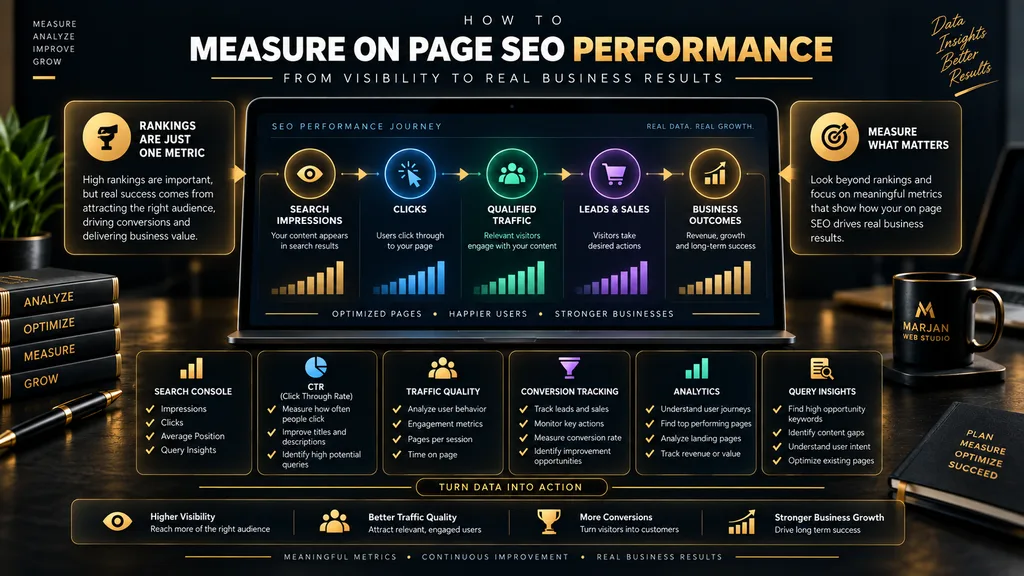
Rankings are useful diagnostic indicators.
They should not be the only business metric.
Frequently Asked Questions
What are on page SEO services?
On page SEO services improve the content, structure, metadata, internal links, images, search intent alignment, and other page-level elements that help users and search engines understand individual webpages.
What does on page SEO include?
It may include keyword mapping, titles, meta descriptions, headings, content optimization, internal links, images, cannibalization checks, URL review, structured data assessment, and measurement.
How much does on page SEO cost?
Pricing varies according to page count, competition, content requirements, implementation scope, website condition, platform, and reporting needs. A fixed universal price is not realistic.
How long does on page SEO take to work?
There is no guaranteed timeline. Search engines need time to recrawl and process changes, and outcomes depend on competition, authority, demand, website condition, and the quality of implementation.
Does on page SEO guarantee first-page rankings?
No. Legitimate on page SEO can improve page quality, relevance, accessibility, and competitiveness, but no provider controls Google’s organic ranking systems.
Is on page SEO different from technical SEO?
Yes. On page SEO primarily focuses on page content, structure, relevance, and internal elements. Technical SEO focuses more heavily on crawling, indexing, rendering, architecture, performance, and technical configuration.
Does on page SEO include content writing?
It can. Some providers optimize existing content while others include partial rewriting or full content production. The scope should state this clearly.
Does on page SEO include backlinks?
Usually not. Link acquisition is normally considered off-page SEO.
Does on-page SEO help AI search visibility?
Good on-page practices can improve clarity, accessibility, usefulness, source quality, and page structure, which are useful foundations for search and AI-powered discovery. There is no guaranteed AI citation method.
Can I do on-page SEO myself?
Yes. Small website owners can perform many basic tasks themselves. Professional assistance becomes more valuable as website size, competition, technical complexity, and commercial dependence on organic search increase.
Conclusion
Professional on-page SEO is not a checklist of keyword placements.
It is a structured process for making each important webpage serve a clear audience, search intent, business purpose, and place within the wider website.
Effective work begins with diagnosis.
It maps topics to the correct URLs.
It improves content where improvement is actually needed.
It strengthens headings, metadata, links, images, and conversion paths.
It prevents unnecessary duplication.
It connects SEO changes to measurable business outcomes.
And it recognizes its own limits.
On-page SEO cannot guarantee rankings or replace technical accessibility, authority, genuine expertise, competitive products, or good customer experience.
For businesses considering professional support, the most important question is not:
“Can you get me to number one?”
A better question is:
“Can you identify what is limiting my important pages, explain why it matters, implement the right improvements, and measure whether those improvements support my business?”
That is the standard a professional on-page SEO service should meet.
Suggested Internal Links
- Proven On-Page SEO 2026
- Website Development Services
- Technical SEO Guide 2026
- Website Mistakes to Avoid
- Website Planning Checklist
- Why Is My Website Not Getting Customers?
- Professional Website Development Services
1 Comment