Table of Contents
Quick Answer
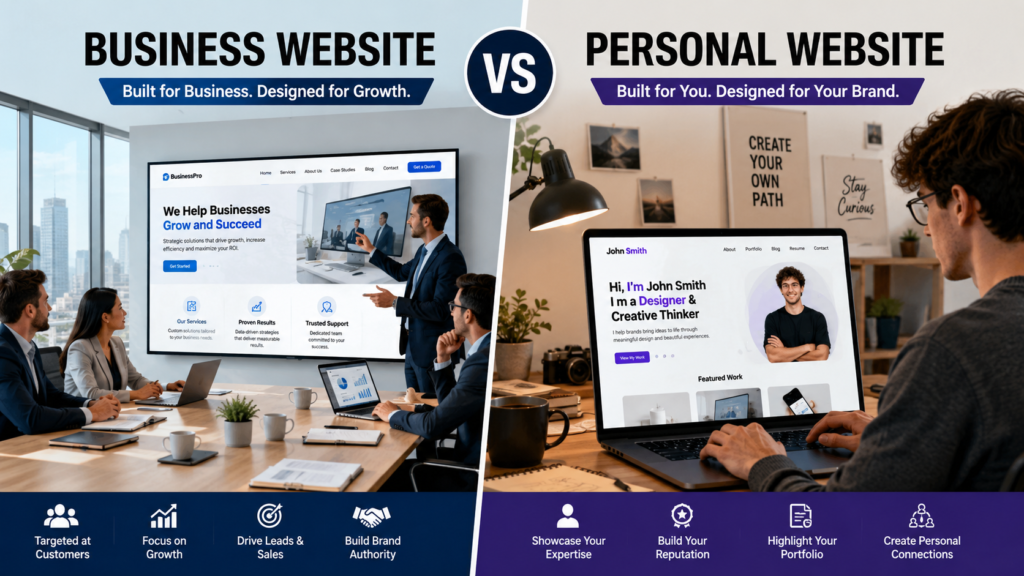
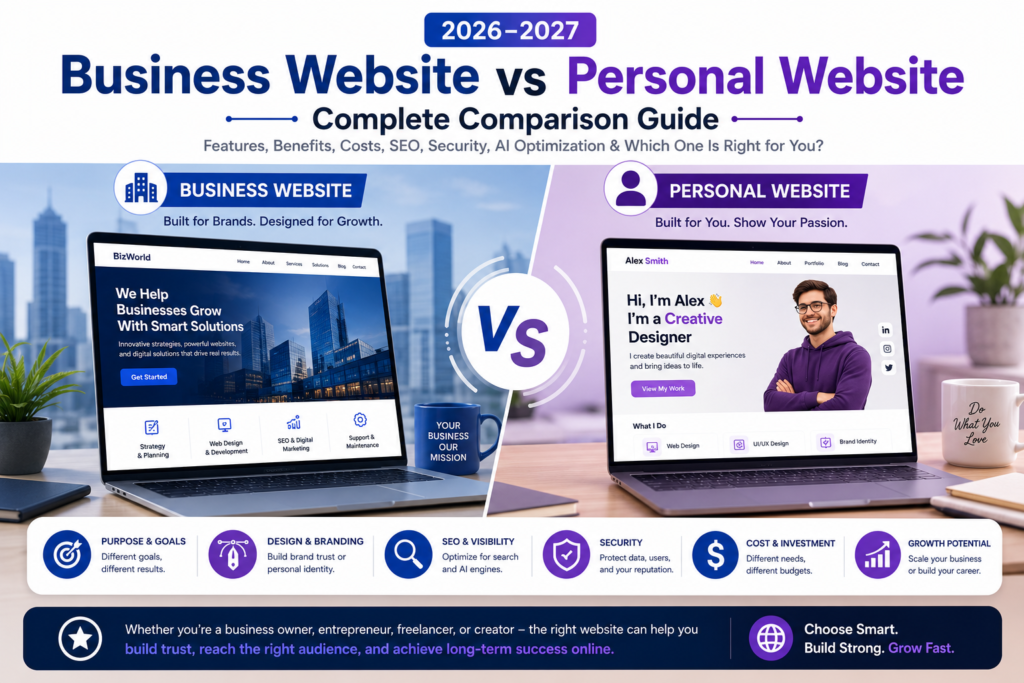
A business website is built to help a company or professional generate leads, sell products or services, strengthen brand credibility, and support long-term business growth. A personal website focuses on presenting an individual’s expertise, achievements, portfolio, experience, or personal brand. If your primary goal is revenue and customer acquisition, a business website is usually the right choice. If you want to build professional credibility, showcase your work, or grow your personal brand, a personal website is often the better option. Many freelancers, consultants, and founders benefit from combining both approaches into a single, well-organized website.
Key Takeaways
- A business website focuses on commercial goals such as lead generation, customer acquisition, and revenue growth.
- A personal website focuses on showcasing an individual’s skills, experience, portfolio, and professional reputation.
- Both website types can rank well in search engines when they provide helpful, trustworthy, and well-structured content.
- The right choice depends on your goals, target audience, branding strategy, and long-term plans.
- In many situations, combining personal branding with business services creates a stronger online presence than maintaining separate websites.
Why This Comparison Matters
Choosing between a business website and a personal website is one of the first strategic decisions anyone makes before building an online presence. Although both are websites, they are designed to achieve different outcomes, attract different audiences, and support different growth strategies.
Many people assume that any website can accomplish every objective. In reality, the purpose of the website influences its structure, navigation, content strategy, calls to action, search engine optimization, and conversion goals. A website designed for selling professional services differs significantly from one built to highlight an individual’s career, achievements, or creative work.
Understanding these differences before investing time and money helps avoid expensive redesigns, inconsistent branding, and poor user experience.
Why People Search for “Business Website vs Personal Website”
People usually search this topic because they have reached a decision point. They know they need a website but are uncertain about which type best fits their current situation.
Common scenarios include:
- A new entrepreneur preparing to launch a company.
- A freelancer deciding whether to market themselves personally or as a business.
- A consultant wanting to attract more clients.
- A student building an online portfolio.
- A startup planning its digital presence.
- A professional considering personal branding.
- A small business owner replacing an outdated website.
Although these situations differ, they share one common question:
Which website will best support my long-term goals?
This guide answers that question by comparing both website types from practical, technical, branding, marketing, and search optimization perspectives.
Search Intent Behind This Topic
The keyword Business Website vs Personal Website represents mixed search intent because users expect more than a simple definition.
Informational Intent
Many readers simply want to understand:
- What is a business website?
- What is a personal website?
- What are the major differences?
- Which one should I choose?
These users are gathering knowledge before making a decision.
Commercial Investigation
Other readers are actively evaluating professional solutions before purchasing website development services.
Typical questions include:
- Which website helps generate more leads?
- Which website is better for SEO?
- Which website should a freelancer build?
- Is hiring a website development agency worth it?
- What features should each website include?
These readers are comparing available options before investing.
Transactional Intent
Some visitors are ready to take action and are looking for:
- Website development services.
- Business website design.
- Personal branding website development.
- Website development agencies.
- WordPress website experts.
- Website design companies.
Providing clear comparisons helps these users make informed purchasing decisions while improving trust.
Who Should Read This Guide?
This article is written for readers worldwide who want to build a professional online presence.
It is particularly useful for:
Entrepreneurs
Business owners planning a new company website need to understand how website structure influences credibility, customer trust, and long-term growth.
Small Business Owners
Local businesses often struggle to decide whether a simple personal website is sufficient or whether investing in a dedicated business website provides greater long-term value.
Freelancers
Freelancers frequently face a unique challenge. They are both the individual behind the work and the business providing services. This guide explains when a personal brand, a business brand, or a hybrid approach works best.
Consultants and Coaches
Consultants must balance professional authority with lead generation. The correct website structure helps build trust while making it easy for potential clients to take action.
Students and Job Seekers
A personal website can function as a digital portfolio, allowing employers to evaluate projects, certifications, and achievements beyond a traditional resume.
Agencies
Marketing agencies, design studios, and development companies can use this comparison to better position their own services while helping clients choose the right website strategy.
The Growing Importance of Websites
A website has become much more than an online brochure. It is often the first place where customers, employers, investors, journalists, or collaborators evaluate a business or an individual.
Unlike social media platforms, a website provides complete ownership over branding, content, user experience, and long-term digital assets.
It also serves as the foundation for:
- Search engine visibility.
- Content marketing.
- Lead generation.
- Customer education.
- Reputation management.
- Email marketing.
- Analytics and measurement.
- Conversion optimization.
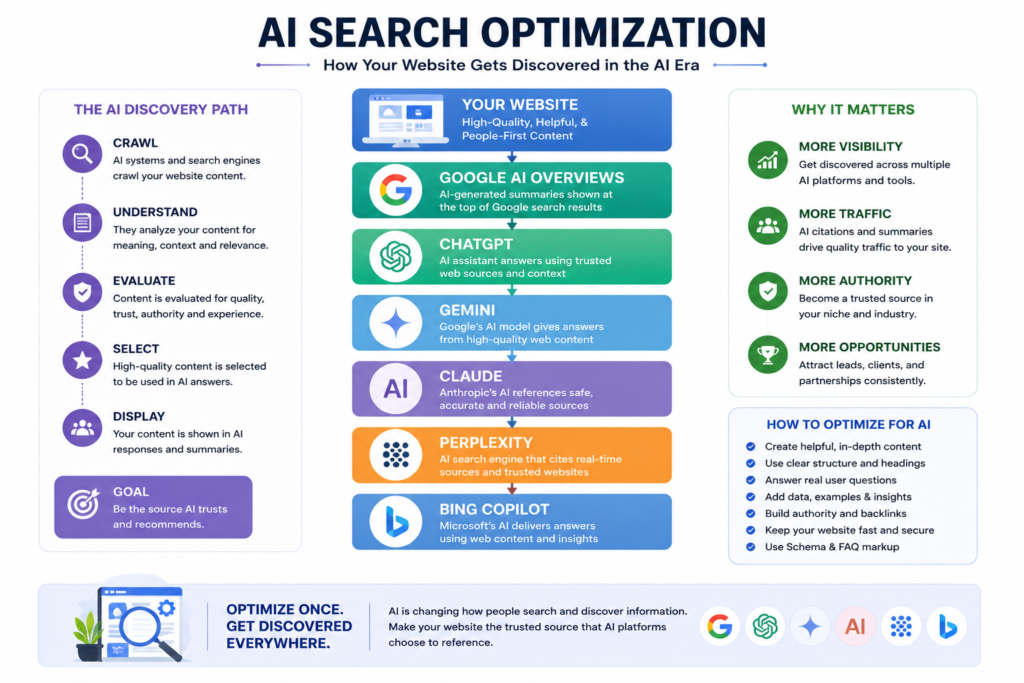
As artificial intelligence continues to reshape online search, well-structured websites are increasingly being used as sources for AI-generated answers. Content that is organized, trustworthy, and easy to understand has a greater chance of being referenced by modern AI search systems.
How Search Has Changed
Traditional SEO focused primarily on helping webpages rank within search engine results.
Today, users also receive answers from systems such as:
- Google AI Overviews.
- ChatGPT Search.
- Microsoft Bing Copilot.
- Perplexity AI.
- Claude.
- Gemini.
These systems prioritize content that is clear, factual, logically structured, and easy to retrieve.
For that reason, every major section in this guide begins with concise explanations before expanding into practical details. This approach improves readability for people while making the content easier for AI systems to understand and reference.
What You Will Learn
By the end of this guide, you will understand:
- The complete difference between a business website and a personal website.
- The strengths and limitations of each approach.
- Which website works best for different professions and industries.
- How both website types influence branding, SEO, and lead generation.
- Whether combining personal branding with business services is the right strategy.
- Which website offers greater long-term value based on your goals.
The goal is not to declare one website universally better than the other. Instead, this guide provides the knowledge needed to make the right decision for your specific situation.
Soft CTA
If you are still deciding which type of website best matches your goals, continue reading. The next sections explain each website type in detail before comparing their features, marketing potential, search visibility, scalability, and long-term business value.
What Is a Business Website?
Quick Definition
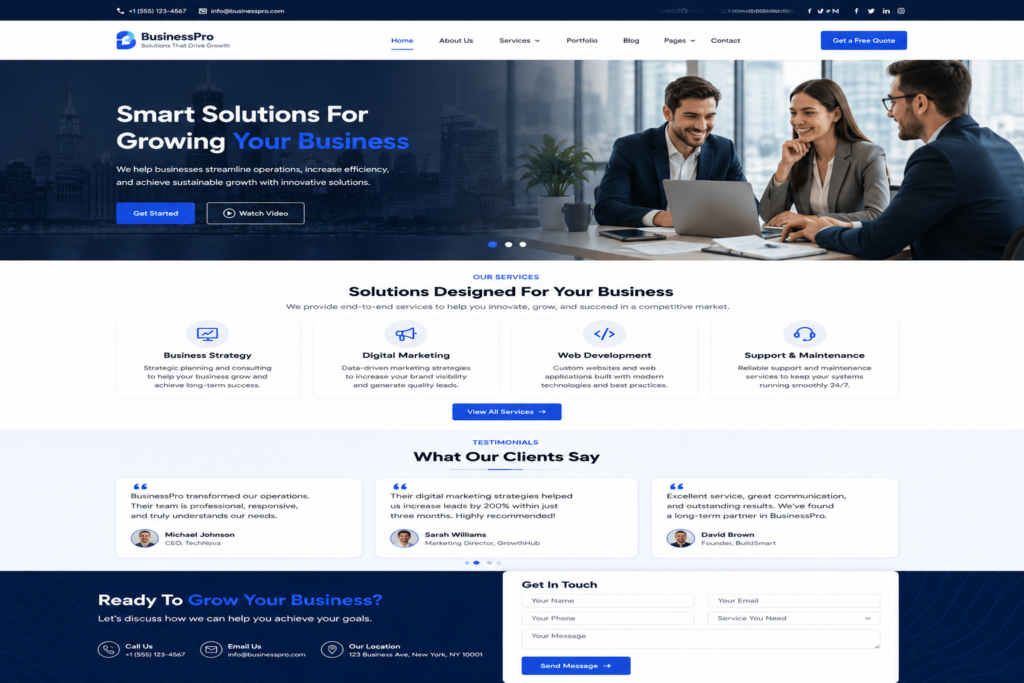
A business website is a professionally designed website that represents a company, organization, agency, startup, or service provider. Its primary purpose is to promote products or services, establish credibility, generate qualified leads, support marketing activities, and help achieve measurable business objectives.
Unlike a personal website, which focuses on an individual, a business website is built around the needs of customers, clients, partners, or stakeholders. Every page, feature, and call-to-action is designed to guide visitors toward a specific business goal, such as requesting a quote, booking a consultation, making a purchase, or contacting the company.
AI Summary
A business website is the digital headquarters of a business. It builds trust, explains products or services, attracts potential customers through search engines and marketing campaigns, and converts visitors into leads or paying clients.
Why Businesses Need a Website
Modern customers expect every legitimate business to have a professional online presence. Before contacting a company, many people research its website to learn about its services, pricing, experience, customer reviews, and contact information.
A well-designed business website helps answer those questions while giving visitors confidence that the company is trustworthy and capable of delivering quality products or services.
Unlike social media platforms, a business website gives complete ownership over branding, content, customer experience, and digital marketing strategy. Businesses are not limited by the design, algorithms, or policies of third-party platforms, making a website one of the most valuable long-term digital assets.
Primary Objectives of a Business Website
Although every organization has different goals, most business websites are designed to achieve one or more of the following objectives:
- Generate qualified leads.
- Increase online sales.
- Promote products or services.
- Build brand awareness.
- Establish credibility and trust.
- Educate potential customers.
- Support digital marketing campaigns.
- Improve visibility in search engines.
- Provide customer support resources.
- Encourage visitors to take action through clear calls-to-action.
These objectives work together to transform a website from a simple online brochure into an active business development tool.
Core Characteristics of a Business Website
A professional business website is usually recognized by several important characteristics.
Customer-Focused Content
Every page is written with the customer in mind. Instead of talking only about the business, the content explains how products or services solve specific customer problems.
Clear Business Identity
Visitors should immediately understand:
- What the business does.
- Who it serves.
- Why it is different.
- How customers can get started.
Confusing messaging often results in higher bounce rates and lower conversions.
Conversion-Oriented Design
Unlike informational websites, business websites encourage visitors to take meaningful actions, such as:
- Request a quotation.
- Book a consultation.
- Purchase a product.
- Contact the sales team.
- Download a brochure.
- Subscribe to a newsletter.
Every important page should include a clear and relevant call-to-action.
Professional Branding
A consistent visual identity strengthens trust. Professional branding includes:
- Company logo.
- Brand colors.
- Typography.
- Consistent messaging.
- High-quality imagery.
- Professional tone of voice.
Strong branding makes the business more memorable and reinforces credibility.
Essential Pages Every Business Website Should Include
Although requirements vary by industry, most successful business websites include the following pages.
Home Page
The homepage introduces the business, explains its value proposition, and directs visitors toward important sections of the website.
About Us
This page tells the company’s story, introduces its mission and values, highlights experience, and helps build trust with potential customers.
Services or Products
These pages explain what the business offers, how the solutions work, and the benefits customers can expect.
Portfolio or Case Studies
Showing completed projects or successful client outcomes provides evidence of expertise and helps visitors make informed decisions.
Testimonials
Authentic customer feedback strengthens credibility and reduces uncertainty during the buying process.
Pricing
Where appropriate, transparent pricing or pricing guidance helps qualify potential customers and reduces unnecessary enquiries.
Blog or Resource Center
Publishing educational articles demonstrates expertise, supports search engine optimization, and answers common customer questions before they contact the business.
Frequently Asked Questions
An FAQ section improves user experience by answering recurring questions in one place while also supporting search visibility for question-based searches.
Contact Page
Every business website should make it easy for visitors to get in touch through contact forms, phone numbers, email addresses, maps, or appointment booking options.
Common Features of a Professional Business Website
Modern business websites frequently include features such as:
- Contact forms.
- Lead generation forms.
- Live chat.
- Appointment scheduling.
- Customer reviews.
- Newsletter signup.
- Search functionality.
- Secure HTTPS connection.
- Mobile-responsive design.
- Fast-loading pages.
- Analytics integration.
- Conversion tracking.
- CRM integration.
- Payment gateways where applicable.
The exact features depend on business goals, industry, and customer expectations.
Who Needs a Business Website?
Almost every organization that serves customers can benefit from a business website.
Examples include:
- Small businesses.
- Startups.
- Professional service providers.
- Marketing agencies.
- Web development companies.
- Law firms.
- Accounting firms.
- Healthcare providers.
- Educational institutions.
- Construction companies.
- Manufacturing businesses.
- Real estate agencies.
- E-commerce stores.
- Restaurants.
- Hotels.
- Non-profit organizations.
Whether a company serves local customers or operates internationally, a professional website improves visibility, trust, and communication.
Hypothetical Example
Imagine a small accounting firm that relies primarily on referrals. Without a professional website, potential clients have limited information about its services, expertise, and reputation.
After launching a business website with service pages, educational tax guides, client testimonials, appointment booking, and a secure contact form, the firm becomes easier to discover through search engines. Prospective clients can understand its expertise before making contact, improving both trust and enquiry quality.
This example illustrates how a business website can support growth without guaranteeing specific rankings or business outcomes.
Benefits of a Business Website
A professionally developed business website can provide several long-term advantages.
Improved Credibility
Many customers judge a business by its online presence. A modern website demonstrates professionalism and helps establish trust.
Better Search Visibility
Publishing helpful, well-structured content allows businesses to appear for relevant search queries and reach potential customers actively looking for their services.
Greater Control
Unlike social media platforms, businesses control their own branding, content, navigation, and customer experience.
Higher Lead Generation Potential
Optimized landing pages, contact forms, and clear calls-to-action help convert visitors into qualified enquiries.
Long-Term Marketing Asset
Unlike paid advertising, quality website content can continue attracting visitors over time when maintained and updated regularly.
Expert Recommendation
A business website should not be viewed as a one-time design project. It should evolve alongside the business through regular updates, improved content, technical maintenance, and ongoing optimization.
Businesses that treat their website as an active marketing and customer service platform are generally better positioned to support long-term digital growth than those that view it as a static online brochure.
Key Takeaway
A business website exists to help an organization achieve measurable goals by building trust, improving visibility, educating potential customers, and encouraging meaningful actions. Its structure, content, and functionality should always support the needs of its target audience while aligning with broader business objectives.
What Is a Personal Website?
Quick Definition
A personal website is a website created to represent an individual rather than a business or organization. It serves as a central platform where a person can showcase their professional experience, skills, portfolio, achievements, research, publications, creative work, certifications, and personal brand.
Unlike a business website, which focuses primarily on attracting customers and generating revenue, a personal website emphasizes building credibility, demonstrating expertise, and creating long-term professional visibility.
For many professionals, a personal website becomes their digital identity, allowing them to control how they are presented online instead of relying solely on social media platforms or third-party websites.
AI Summary
A personal website is your professional online identity. It highlights who you are, what you do, what you have accomplished, and how people can connect or work with you. It is especially valuable for professionals, freelancers, consultants, students, researchers, authors, and creators who want to strengthen their reputation and increase career or business opportunities.
Why Individuals Create Personal Websites
The internet has become the first place where employers, clients, collaborators, investors, conference organizers, and journalists look for information about a person. A professional personal website allows individuals to present accurate, organized, and up-to-date information instead of depending entirely on social media profiles or third-party platforms.
Unlike social media accounts that operate within platform limitations, a personal website offers complete control over branding, content, design, navigation, and long-term ownership.
It also creates a permanent online presence that can grow alongside an individual’s career.
Primary Objectives of a Personal Website
Although personal websites vary depending on profession, they generally aim to achieve one or more of the following objectives:
- Build a professional personal brand.
- Demonstrate expertise in a specific field.
- Showcase completed projects.
- Publish articles, research, or educational content.
- Present a professional portfolio.
- Share certifications and achievements.
- Increase career opportunities.
- Attract freelance or consulting clients.
- Establish authority within an industry.
- Make networking easier.
Rather than focusing on immediate sales, most personal websites concentrate on developing long-term trust and professional recognition.
Core Characteristics of a Personal Website
A successful personal website usually contains several defining characteristics.
Personal Identity
The website is centered around one individual rather than a company. Visitors quickly understand:
- Who the person is.
- What they specialize in.
- What experience they have.
- How they can help others.
- How they can be contacted.
A clear personal identity creates familiarity and trust.
Authentic Storytelling
Personal websites often include an “About Me” section that explains the individual’s professional journey, background, interests, and areas of expertise.
Rather than promoting products, this section helps visitors understand the person behind the work.
Authenticity is often one of the strongest trust signals on a personal website.
Portfolio-Oriented Structure
Many personal websites emphasize examples of completed work rather than commercial services.
Typical portfolio items include:
- Design projects.
- Software applications.
- Research publications.
- Writing samples.
- Photography.
- Artwork.
- Videos.
- Case studies.
- Presentations.
- Certifications.
A strong portfolio allows visitors to evaluate expertise based on real work instead of marketing claims.
Educational Content
Many professionals publish articles, tutorials, guides, or research findings to demonstrate expertise.
Educational content helps:
- Build authority.
- Improve search visibility.
- Answer audience questions.
- Establish topical expertise.
- Encourage backlinks.
- Increase professional recognition.
Publishing genuinely helpful content often benefits both personal branding and long-term career growth.
Essential Pages Every Personal Website Should Include
Although personal websites differ by profession, most include several important pages.
Home
Introduces the individual, summarizes expertise, and guides visitors toward important content.
About Me
Provides a professional biography, background, qualifications, interests, and career journey.
Portfolio
Displays completed projects, publications, creative work, or professional achievements.
Resume or CV
Many professionals include an online resume or downloadable CV that highlights education, work experience, certifications, technical skills, and accomplishments.
Blog
A blog allows individuals to publish expert insights, tutorials, research, opinions, or educational resources that demonstrate knowledge and experience.
Services
Professionals offering consulting, coaching, speaking, design, writing, or freelance services may include dedicated service pages explaining how they help clients.
Testimonials
Recommendations from employers, colleagues, clients, or collaborators strengthen credibility and provide social proof.
Contact
Visitors should have an easy way to connect through:
- Contact forms.
- Email.
- Professional social profiles.
- Appointment scheduling.
- Collaboration enquiries.
Common Features of a Personal Website
A modern personal website often includes:
- Personal biography.
- Professional portfolio.
- Downloadable CV.
- Skills section.
- Certifications.
- Awards.
- Publications.
- Blog.
- Testimonials.
- Contact form.
- Social media integration.
- Newsletter subscription.
- Speaking engagements.
- Project gallery.
- Professional headshot.
The exact combination depends on the individual’s profession and objectives.
Who Should Create a Personal Website?
Personal websites are valuable for many professions, including:
- Freelancers.
- Consultants.
- Coaches.
- Designers.
- Software Developers.
- Writers.
- Journalists.
- Researchers.
- Authors.
- Photographers.
- Architects.
- Engineers.
- Public Speakers.
- Students.
- Job Seekers.
- Educators.
- Healthcare Professionals.
- Artists.
- Influencers.
- Content Creators.
Anyone seeking to build a long-term professional reputation can benefit from owning a personal website.
Hypothetical Example
Imagine a software engineer applying for senior development positions.
Instead of submitting only a resume, the engineer shares a personal website containing:
- Professional biography.
- Technical blog articles.
- GitHub projects.
- Open-source contributions.
- Conference presentations.
- Certifications.
- Case studies.
- Contact information.
Recruiters can evaluate the engineer’s expertise, communication skills, and practical experience in one place. While this does not guarantee employment, it provides a more complete professional profile than a traditional resume alone.
Benefits of a Personal Website
A professionally maintained personal website offers numerous long-term advantages.
Stronger Personal Brand
A personal website allows individuals to shape how they are perceived online rather than depending entirely on third-party platforms.
Greater Professional Credibility
Publishing original content, showcasing projects, and documenting achievements helps establish trust with employers, clients, collaborators, and industry peers.
Improved Search Visibility
Helpful content optimized for relevant topics can increase visibility in search engines and AI-powered search experiences, making it easier for people to discover your expertise.
Career Growth
A personal website often supports:
- Better employment opportunities.
- Speaking invitations.
- Media interviews.
- Consulting enquiries.
- Freelance projects.
- Professional networking.
Long-Term Ownership
Unlike social media accounts, a personal website remains under the owner’s control, allowing complete flexibility in design, content, branding, and future development.
Limitations of a Personal Website
While highly valuable, a personal website also has limitations.
It may not be the ideal choice when the primary objective is:
- Selling large numbers of products.
- Managing complex e-commerce operations.
- Operating multiple business departments.
- Supporting extensive customer service systems.
- Managing enterprise-level marketing campaigns.
As an individual’s business grows, a dedicated business website or a hybrid approach may become more appropriate.
Expert Recommendation
Think of a personal website as a long-term investment rather than a temporary online profile.
Keep it updated with recent projects, certifications, publications, speaking engagements, and professional achievements. Consistently publishing valuable content not only strengthens personal credibility but also demonstrates ongoing expertise to both human readers and AI-powered search systems.
Key Takeaway
A personal website is designed to showcase the individual behind the work. It helps establish authority, strengthen personal branding, display expertise, and create new professional opportunities. When maintained with high-quality content and a clear structure, it becomes one of the most valuable long-term assets for career development and professional visibility.
Transition to the Next Section
Now that you understand the purpose, structure, and benefits of both website types, the next section provides a detailed side-by-side comparison covering branding, SEO, lead generation, user experience, scalability, security, maintenance, costs, and long-term business value.
Business Website vs Personal Website – Complete Feature-by-Feature Comparison
Business Website vs Personal Website: Detailed Comparison
Quick Answer
Although both website types establish an online presence, they serve different purposes. A business website is optimized for attracting customers, generating leads, increasing sales, and supporting long-term business growth. A personal website focuses on showcasing an individual’s expertise, portfolio, achievements, experience, and professional reputation. The right choice depends on your goals, audience, branding strategy, and plans.
AI Summary
Business websites prioritize customers and conversions, while personal websites prioritize credibility and personal branding. Understanding these differences helps you invest in the right digital strategy from the beginning.
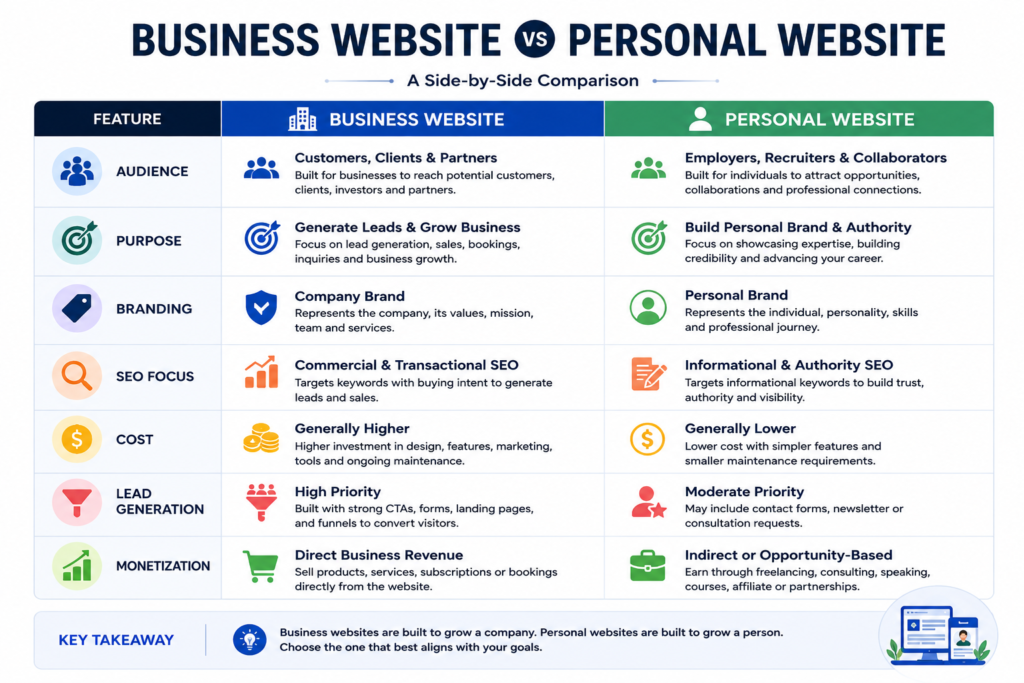
Business Website vs Personal Website Comparison Table
| Feature | Business Website | Personal Website |
|---|---|---|
| Primary Goal | Generate leads and revenue | Build professional reputation |
| Owner | Company or Organization | Individual |
| Main Audience | Customers and Clients | Employers, Clients, Followers |
| Branding | Corporate Branding | Personal Branding |
| Primary CTA | Buy, Book, Contact | Connect, Hire, Collaborate |
| Revenue Focus | High | Moderate |
| Portfolio | Optional | Essential |
| Team Pages | Common | Rare |
| Service Pages | Essential | Optional |
| Blog | Educational & Marketing | Educational & Personal |
| SEO Focus | Commercial + Informational | Informational + Authority |
| GEO Focus | Business Solutions | Personal Expertise |
| AEO Focus | Service Answers | Expert Answers |
| AI Citation Potential | Service Content | Educational Content |
| Best For | Businesses | Professionals |
Purpose and Primary Goals
Business Website Goals
A business website exists to achieve measurable commercial objectives. Every page is designed to guide visitors toward actions that contribute to business growth.
Typical goals include:
- Generate qualified leads.
- Increase product or service sales.
- Build customer trust.
- Improve brand recognition.
- Support marketing campaigns.
- Educate prospective customers.
- Increase conversions.
- Provide customer support.
Every design decision should ultimately support these objectives.
Personal Website Goals
A personal website focuses on representing an individual’s professional identity rather than promoting a business.
Typical objectives include:
- Build personal credibility.
- Showcase expertise.
- Display a portfolio.
- Publish professional content.
- Demonstrate thought leadership.
- Support career growth.
- Attract consulting opportunities.
- Expand professional networks.
Unlike business websites, personal websites measure success through visibility, authority, and professional opportunities rather than direct sales alone.
Expert Recommendation
Before building any website, define one primary objective.
Trying to achieve ten different goals with one homepage usually weakens user experience and reduces conversions.
A focused website almost always performs better than one attempting to satisfy every possible audience.
Target Audience Comparison
Business Website Audience
Business websites primarily target people looking for solutions.
Examples include:
- Potential customers.
- Existing customers.
- Business partners.
- Investors.
- Suppliers.
- Job applicants.
- Media representatives.
The website should quickly explain:
- What the company offers.
- Why customers should trust it.
- How visitors can take the next step.
Personal Website Audience
Personal websites usually attract readers interested in the individual.
Typical visitors include:
- Recruiters.
- Employers.
- Freelance clients.
- Conference organizers.
- Journalists.
- Researchers.
- Students.
- Industry professionals.
These visitors want to evaluate expertise rather than purchase immediately.
Key Difference
Business visitors ask:
“Can this company solve my problem?”
Personal website visitors ask:
“Is this the right professional to work with?”
Understanding this difference influences every aspect of website design and content strategy.
Branding Comparison
Business Branding
Business branding represents the identity of an organization.
It typically includes:
- Company logo.
- Brand colors.
- Typography.
- Corporate messaging.
- Brand voice.
- Customer promise.
- Mission statement.
- Value proposition.
The objective is consistency across every customer touchpoint.
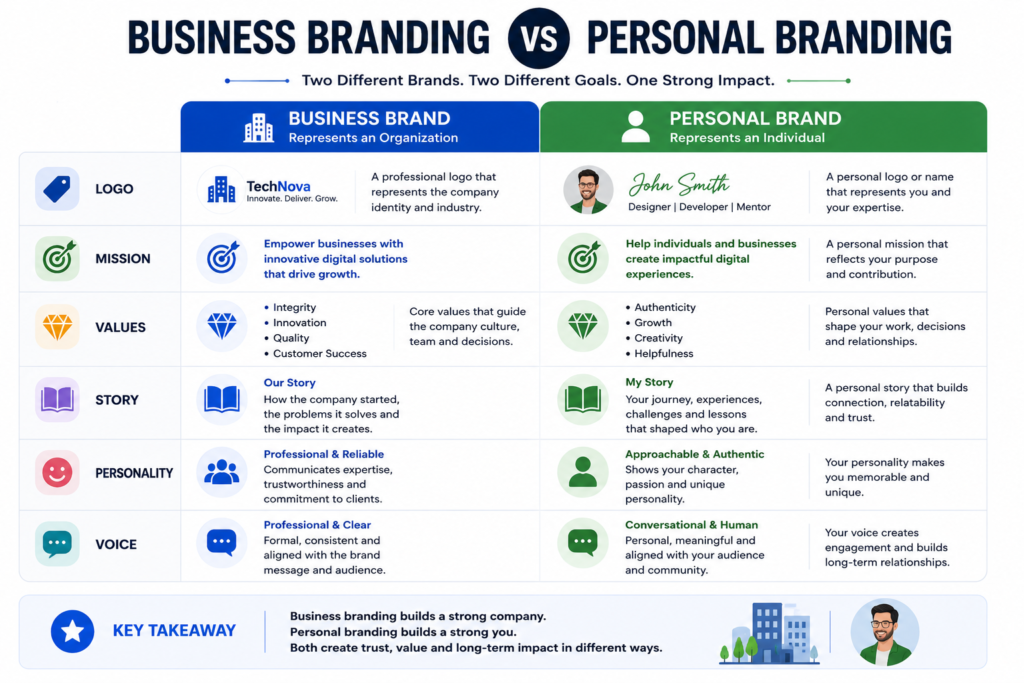
Personal Branding
Personal branding represents an individual’s expertise, values, experience, and personality.
Strong personal branding often includes:
- Professional biography.
- Personal story.
- Professional photograph.
- Areas of expertise.
- Career achievements.
- Certifications.
- Publications.
- Speaking engagements.
People often remember individuals more easily than company names, making personal branding particularly valuable for consultants, freelancers, coaches, and creators.
Which Branding Strategy Is Better?
Neither approach is universally better.
Choose business branding if:
- You plan to build a scalable company.
- Multiple employees represent the business.
- Products are more important than the founder.
Choose personal branding if:
- Your expertise is the product.
- You work independently.
- Trust in the individual drives purchasing decisions.
Many successful professionals combine both approaches by positioning themselves as the public face of their business.
Website Structure Comparison
Typical Business Website Structure
Business websites usually include:
- Home
- About Us
- Services
- Products
- Portfolio
- Case Studies
- Pricing
- Blog
- FAQ
- Contact
- Privacy Policy
- Terms & Conditions
Each page supports customer acquisition or business operations.
Typical Personal Website Structure
Personal websites commonly include:
- Home
- About Me
- Portfolio
- Resume
- Projects
- Blog
- Certifications
- Publications
- Speaking
- Testimonials
- Contact
These pages emphasize expertise rather than commercial transactions.
Navigation Differences
Business navigation focuses on helping customers reach purchasing decisions quickly.
Personal navigation focuses on helping visitors understand the individual’s background, experience, and achievements.
Simple navigation improves both user experience and search engine crawling.
User Experience (UX) Comparison
Business Website UX
Business websites prioritize efficiency.
Visitors should immediately find:
- Services.
- Pricing.
- Contact information.
- Calls-to-action.
- Trust signals.
Reducing friction often improves conversion rates.
Personal Website UX
Personal websites prioritize storytelling.
Visitors usually explore:
- Biography.
- Portfolio.
- Experience.
- Articles.
- Personal achievements.
The experience should feel informative, authentic, and easy to navigate.
Accessibility Considerations
Regardless of website type:
- Use readable fonts.
- Maintain strong color contrast.
- Provide descriptive image alt text.
- Ensure keyboard accessibility.
- Design for mobile devices.
- Use descriptive headings.
- Write in plain language.
Accessibility improves usability for everyone while supporting broader search visibility.
Content Strategy Comparison
Business Website Content
Business websites typically publish content that helps potential customers understand products, services, pricing considerations, and industry challenges.
Examples include:
- Service pages.
- Buying guides.
- Product comparisons.
- Customer success stories.
- Industry insights.
- FAQs.
The objective is to educate readers while encouraging meaningful actions.
Personal Website Content
Personal websites often focus on demonstrating expertise through:
- Professional articles.
- Tutorials.
- Research.
- Case studies.
- Speaking engagements.
- Portfolio updates.
- Personal insights.
Educational content strengthens credibility while increasing long-term visibility.
Expert Insight
One of the biggest mistakes organizations make is copying another website without understanding why its structure works.
A website should always be designed around the needs of its intended audience, business objectives, and long-term growth strategy—not simply current design trends.
Key Takeaway
Business websites and personal websites share many technical similarities, but their goals, audiences, branding strategies, and content approaches are fundamentally different. Choosing the right structure from the beginning creates a stronger foundation for search visibility, user experience, AI retrieval, and long-term digital success.
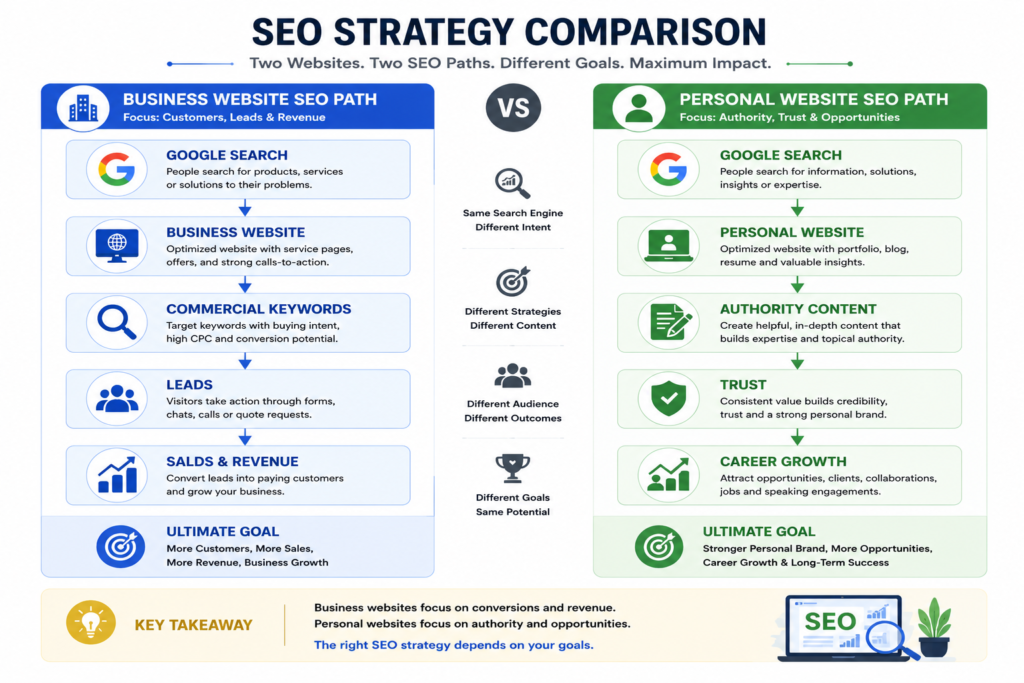
SEO Comparison
Quick Answer
Both business websites and personal websites can achieve strong search visibility when they provide helpful, accurate, and well-structured content. However, their SEO strategies differ because they target different audiences, search intents, and conversion goals. Business websites typically prioritize commercial and transactional keywords, while personal websites focus more on informational queries, topical authority, and personal branding.
AI Summary
Business websites optimize for customers and conversions, while personal websites optimize for expertise and authority. Both benefit from high-quality content, technical SEO, and a positive user experience.
Business Website SEO
The primary objective of SEO for a business website is to attract qualified visitors who are likely to become customers. The strategy combines commercial, informational, and transactional search intent to support every stage of the buyer journey.
A business website generally targets:
- Commercial keywords.
- Service-related searches.
- Local search queries.
- Product-focused searches.
- Comparison keywords.
- Buying guides.
- Pricing-related queries.
For example, a website development company may optimize pages for searches such as:
- Website Development Services
- Business Website Design
- Website Development Company
- Small Business Website Development
- Website Development Cost
Each page should focus on solving a specific customer problem while encouraging visitors to take the next logical action.
Personal Website SEO
Personal website SEO focuses less on selling products and more on establishing authority, expertise, and long-term visibility.
Common content includes:
- Educational articles.
- Professional insights.
- Tutorials.
- Case studies.
- Research.
- Portfolio projects.
- Industry opinions.
Instead of competing primarily for commercial keywords, personal websites often build topical authority by consistently publishing useful content within a defined area of expertise.
This approach strengthens visibility while also improving credibility among employers, collaborators, and potential clients.
Key SEO Differences
| SEO Factor | Business Website | Personal Website |
|---|---|---|
| Primary Intent | Commercial | Informational |
| Main Goal | Leads & Sales | Authority & Reputation |
| Keyword Focus | Services & Products | Expertise & Topics |
| Conversion Goal | Customer Acquisition | Professional Opportunities |
| Landing Pages | Essential | Optional |
| Portfolio | Secondary | Primary |
| Local SEO | Often Important | Usually Limited |
| Topical Authority | Important | Critical |
GEO (Generative Engine Optimization) Comparison
What Is GEO?
Generative Engine Optimization (GEO) is the practice of structuring content so that AI-powered search systems can accurately understand, retrieve, summarize, and cite it.
Unlike traditional SEO, which aims to improve rankings in search engine results, GEO focuses on increasing the likelihood that content will appear in AI-generated answers.
GEO for Business Websites
Business websites benefit from GEO when they:
- Answer customer questions clearly.
- Explain services in plain language.
- Provide well-structured comparison tables.
- Include concise definitions.
- Organize content into logical sections.
- Demonstrate expertise with practical examples.
These elements help AI systems retrieve accurate information while reducing ambiguity.
GEO for Personal Websites
Personal websites benefit from GEO by demonstrating subject-matter expertise.
Publishing original insights, educational resources, technical explanations, and portfolio examples helps AI systems recognize the individual as a knowledgeable source within a specific topic.
Clear authorship, consistent terminology, and well-organized content further strengthen retrieval potential.
GEO Best Practices
Regardless of website type:
- Begin each major section with a direct answer.
- Use descriptive headings.
- Explain technical terms clearly.
- Organize information logically.
- Include comparison tables where appropriate.
- Avoid vague or unsupported claims.
- Keep paragraphs focused on one primary idea.
These practices improve both readability and AI retrieval.
AEO (Answer Engine Optimization)
What Is AEO?
Answer Engine Optimization (AEO) focuses on creating content that directly answers user questions in a concise and structured format.
Instead of encouraging users to browse multiple pages, answer engines aim to provide the most relevant response immediately.
Optimizing for AEO increases the likelihood of appearing in featured snippets, voice search, and AI-generated summaries.
Business Website AEO
Business websites should answer questions such as:
- What services do you offer?
- Who are your services for?
- How much does it cost?
- Why should customers choose your company?
- How can someone get started?
Providing concise answers before expanding into detailed explanations improves both usability and answer engine visibility.
Personal Website AEO
Personal websites should answer questions such as:
- Who are you?
- What do you specialize in?
- What experience do you have?
- Which industries do you work with?
- How can people contact you?
Direct, factual answers help establish trust and improve discoverability.
AI Search Optimization
Modern search experiences increasingly rely on artificial intelligence to summarize and present information.
Examples include:
- Google AI Overviews.
- ChatGPT Search.
- Gemini.
- Claude.
- Perplexity AI.
- Microsoft Bing Copilot.
Although each platform uses different retrieval methods, they generally favor content that is:
- Accurate.
- Well-organized.
- Easy to understand.
- Supported by trustworthy information.
- Structured with clear headings.
- Focused on answering user intent.
AI Citation Readiness
To improve the likelihood of being referenced by AI systems:
- Use clear definitions.
- Write self-contained paragraphs.
- Maintain factual consistency.
- Explain concepts before introducing technical terminology.
- Include meaningful examples.
- Avoid unnecessary repetition.
- Clearly distinguish facts from opinions or hypothetical scenarios.
Content that is easy to interpret is more likely to be summarized accurately.
Lead Generation Comparison
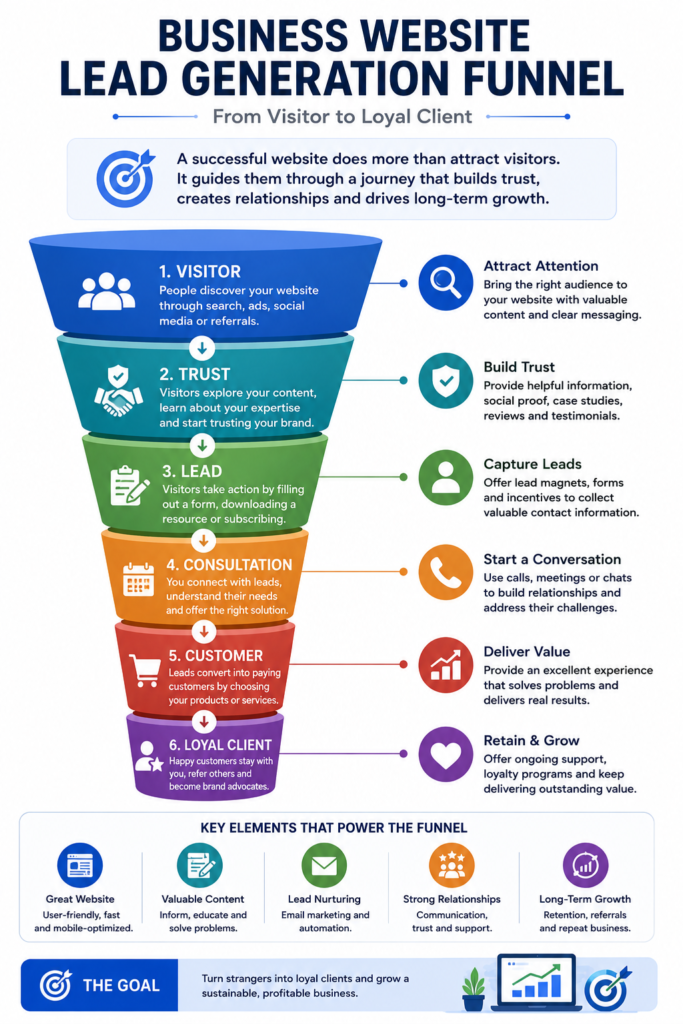
Business Website Lead Generation
Generating leads is one of the primary responsibilities of a business website.
Common lead generation elements include:
- Contact forms.
- Quote request forms.
- Appointment booking.
- Free consultations.
- Newsletter subscriptions.
- Downloadable resources.
- Product demonstrations.
Each interaction helps move visitors closer to becoming customers.
Personal Website Lead Generation
Personal websites also generate opportunities, although the objectives differ.
Examples include:
- Freelance enquiries.
- Speaking invitations.
- Collaboration requests.
- Consulting projects.
- Recruitment opportunities.
- Partnership discussions.
Rather than focusing solely on sales, personal websites often generate professional relationships.
Marketing Strategy Comparison
Business Website Marketing
Business websites support multiple marketing channels, including:
- Search engine optimization.
- Pay-per-click advertising.
- Email marketing.
- Content marketing.
- Social media campaigns.
- Local SEO.
- Referral marketing.
The website acts as the central destination where all campaigns ultimately direct visitors.
Personal Website Marketing
Personal website marketing typically focuses on:
- Thought leadership.
- Educational content.
- Professional networking.
- Speaking engagements.
- Community participation.
- Portfolio promotion.
The objective is long-term authority rather than immediate sales.
Conversion Optimization (CRO)
Business Website CRO
Business websites continuously optimize elements such as:
- Headlines.
- Calls-to-action.
- Contact forms.
- Landing pages.
- Navigation.
- Trust signals.
- Testimonials.
Small improvements in user experience can significantly increase enquiry rates.
Personal Website CRO
For personal websites, conversions may include:
- Resume downloads.
- Portfolio views.
- Contact requests.
- Newsletter signups.
- Consultation bookings.
- Speaking enquiries.
The definition of a “conversion” depends on the individual’s professional goals.
Customer Journey Comparison
Business Website Journey
Typical customer journey:
Awareness → Research → Comparison → Trust → Enquiry → Purchase → Retention
The website supports every stage by providing relevant information and clear next steps.
Personal Website Journey
Typical visitor journey:
Discovery → Learn About the Individual → Review Portfolio → Build Trust → Contact → Collaboration
This journey emphasizes credibility and professional relationships.
Expert Recommendation
Rather than asking which website type is “better,” ask which one better supports your objectives.
If success is measured by revenue, customer acquisition, and business growth, prioritize a business website.
If success is measured by authority, reputation, career development, or personal branding, prioritize a personal website.
Many consultants, founders, educators, and freelancers achieve the best results by combining both approaches into a unified website that clearly separates personal expertise from commercial services.
Key Takeaway
Search optimization has evolved beyond traditional SEO. Successful websites now combine SEO, GEO, AEO, and user-centered content strategies to improve visibility across search engines, AI-powered search platforms, and answer engines. Regardless of website type, long-term success depends on publishing accurate, helpful, trustworthy, and well-structured content that genuinely serves the needs of its audience.
Security Comparison
Quick Answer
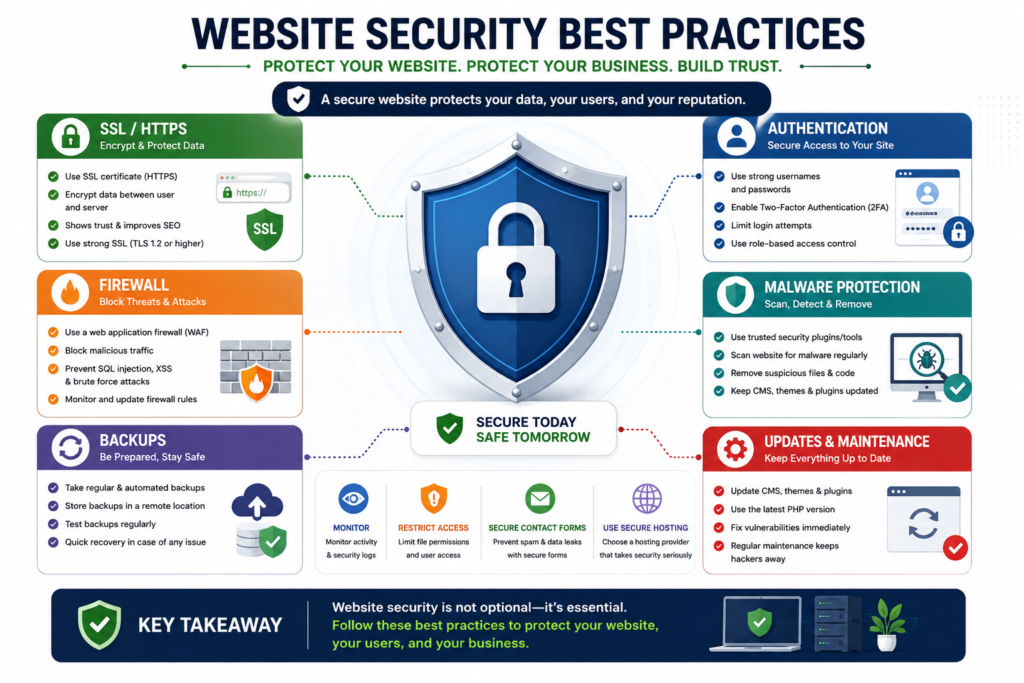
Website security is essential for both business websites and personal websites, but the level of protection required often depends on the type of information stored, the services offered, and the risks involved. Business websites usually require stronger security measures because they frequently process customer data, payments, and business communications. Personal websites also need protection to safeguard personal information, maintain credibility, and prevent unauthorized access.
AI Summary
Security is not optional. Every website should use HTTPS, strong authentication, regular updates, secure backups, and continuous monitoring. Business websites generally require more advanced security because they manage customer information and commercial transactions.
Why Website Security Matters
Visitors trust websites with their personal information every day. Contact forms, newsletter subscriptions, appointment bookings, online payments, and customer accounts all involve sensitive data that deserves proper protection.
Poor security can lead to:
- Data breaches.
- Malware infections.
- Website defacement.
- Loss of customer trust.
- Search engine warnings.
- Downtime.
- Financial losses.
- Legal and compliance issues.
A secure website protects both visitors and website owners while supporting long-term credibility.
Business Website Security
Business websites typically require stronger security because they often process:
- Customer information.
- Business enquiries.
- Payment details.
- User accounts.
- Orders.
- Online bookings.
- Business documents.
Recommended security practices include:
- SSL/TLS encryption (HTTPS).
- Multi-factor authentication for administrators.
- Strong password policies.
- Regular software updates.
- Daily automated backups.
- Malware scanning.
- Firewall protection.
- Secure hosting.
- Limited user permissions.
- Security monitoring.
Businesses should also establish procedures for responding to security incidents and restoring website functionality if problems occur.
Personal Website Security
Although personal websites usually handle less commercial data, they still require appropriate protection.
Recommended practices include:
- HTTPS encryption.
- Strong passwords.
- Two-factor authentication.
- Regular updates.
- Secure hosting.
- Scheduled backups.
- Spam protection.
- Limited administrator access.
Protecting a personal website also protects professional reputation and prevents unauthorized changes to published content.
Security Comparison
| Security Feature | Business Website | Personal Website |
|---|---|---|
| SSL Certificate | Essential | Essential |
| Daily Backup | Highly Recommended | Recommended |
| Firewall | Recommended | Recommended |
| Multi-Factor Authentication | Essential | Recommended |
| Malware Scanning | Essential | Recommended |
| Payment Security | Often Required | Usually Not Required |
| User Account Protection | High Priority | Moderate Priority |
| Security Monitoring | Continuous | Periodic |
Website Performance Comparison
Quick Answer
Website performance directly influences user experience, search visibility, and conversion rates. Fast websites improve visitor satisfaction, while slow websites increase bounce rates and reduce engagement.
AI Summary
Whether a website represents a business or an individual, performance should always be a priority. Faster websites generally provide a better user experience and make it easier for visitors to complete their goals.
Business Website Performance
Business websites often contain:
- Service pages.
- Landing pages.
- Product images.
- Videos.
- Forms.
- Interactive features.
- Third-party integrations.
Without proper optimization, these elements can reduce loading speed.
Performance optimization should include:
- Image compression.
- Browser caching.
- Content Delivery Networks (CDNs).
- Minified CSS and JavaScript.
- Optimized databases.
- Lazy loading.
- Reliable hosting infrastructure.
Personal Website Performance
Personal websites usually contain fewer interactive components, making them easier to optimize.
Performance improvements include:
- Optimized images.
- Lightweight themes.
- Efficient hosting.
- Minimal plugins.
- Clean code.
- Compressed media.
Maintaining simplicity often results in faster loading times.
Core Web Vitals
Google evaluates user experience through Core Web Vitals, which focus on loading performance, responsiveness, and visual stability.
Key metrics include:
- Largest Contentful Paint (LCP).
- Interaction to Next Paint (INP).
- Cumulative Layout Shift (CLS).
Improving these metrics benefits both search visibility and user satisfaction.
Scalability Comparison
Business Website Scalability
Business websites are often expected to grow alongside the organization.
Future expansion may include:
- Additional services.
- New product categories.
- Multiple office locations.
- Customer portals.
- Online payments.
- Membership systems.
- Multilingual content.
- International SEO.
Planning for scalability from the beginning reduces the need for costly redesigns later.
Personal Website Scalability
Personal websites also evolve.
Growth may include:
- Larger portfolios.
- More publications.
- Online courses.
- Consulting services.
- Digital products.
- Community features.
- Membership content.
Many successful personal websites eventually transition into business websites as professional opportunities expand.
Website Maintenance Comparison
Business Website Maintenance
Business websites require continuous maintenance to ensure reliability and security.
Typical maintenance activities include:
- Updating content.
- Installing software updates.
- Monitoring security.
- Checking forms.
- Reviewing analytics.
- Testing page speed.
- Fixing broken links.
- Updating legal pages.
- Performing backups.
Maintenance should be scheduled regularly rather than performed only when problems occur.
Personal Website Maintenance
Personal websites generally require less frequent maintenance, but regular updates remain important.
Recommended activities include:
- Refreshing portfolio projects.
- Updating biographies.
- Publishing new articles.
- Renewing certifications.
- Reviewing contact information.
- Installing software updates.
- Creating backups.
An outdated personal website can create the impression that professional activity has stopped.
Cost Comparison
Quick Answer
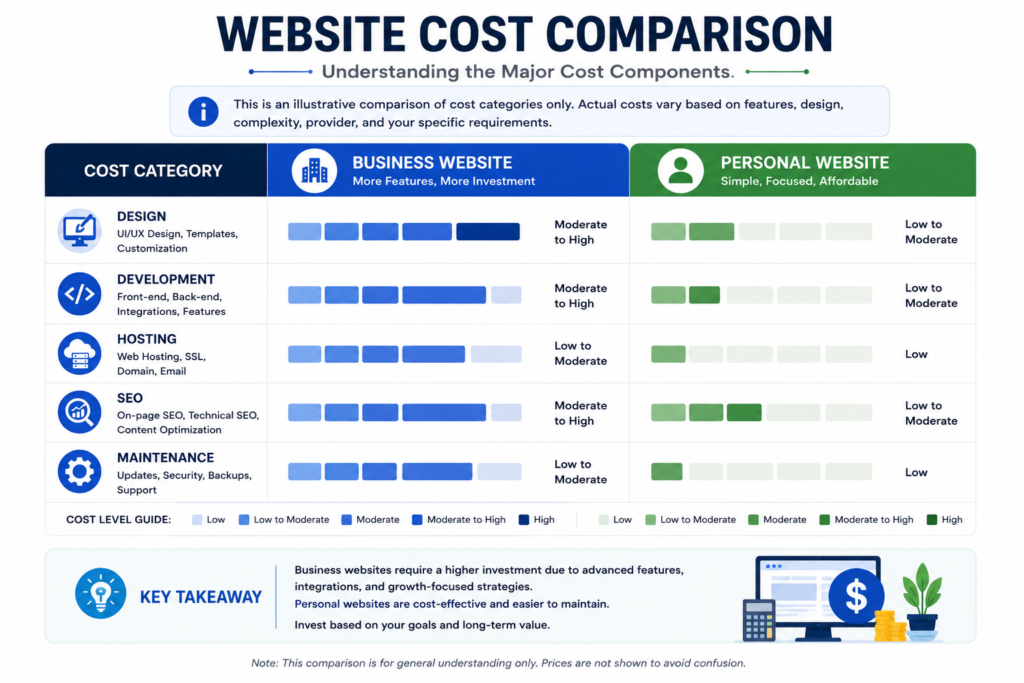
The total cost of a website depends on its complexity, functionality, hosting requirements, maintenance needs, and design approach. Business websites generally involve higher investment because they support more advanced features and commercial objectives.
Main Cost Factors
Costs commonly depend on:
- Domain registration.
- Web hosting.
- Website design.
- Development.
- Premium plugins.
- Security tools.
- Content creation.
- SEO.
- Maintenance.
- Marketing.
Exact pricing varies significantly by country, provider, project scope, and ongoing requirements. Readers should request current quotations before making financial decisions.
Business Website Investment
Business websites may require investment in:
- Professional design.
- Custom development.
- CRM integration.
- Booking systems.
- E-commerce functionality.
- Marketing tools.
- Ongoing optimization.
Although the initial investment is often higher, these features support long-term business growth.
Personal Website Investment
Personal websites are frequently less expensive because they focus on showcasing expertise rather than supporting complex business operations.
Many professionals begin with a simple personal website and expand functionality as their careers progress.
Return on Investment (ROI)
Business Website ROI
Business website success is commonly measured through:
- Qualified leads.
- Sales revenue.
- Customer acquisition.
- Conversion rates.
- Repeat business.
- Brand awareness.
A website becomes increasingly valuable when it consistently supports business objectives.
Personal Website ROI
Personal website success is often measured by:
- Career opportunities.
- Freelance enquiries.
- Consulting projects.
- Speaking invitations.
- Professional recognition.
- Portfolio visibility.
- Industry authority.
The return may not always be financial but can significantly influence long-term career development.
Advantages and Disadvantages
Business Website Advantages
- Supports lead generation.
- Builds customer trust.
- Strengthens brand identity.
- Supports marketing campaigns.
- Improves search visibility.
- Scales with business growth.
Business Website Limitations
- Higher development costs.
- Greater maintenance requirements.
- Increased security responsibilities.
- More complex content management.
Personal Website Advantages
- Builds personal authority.
- Supports career growth.
- Showcases expertise.
- Demonstrates credibility.
- Provides complete ownership of professional identity.
- Flexible and relatively easy to maintain.
Personal Website Limitations
- Limited commercial functionality.
- Lower emphasis on direct sales.
- May require transition as business grows.
- Personal reputation becomes closely tied to website quality.
Business Website vs Personal Website Decision Matrix
| Situation | Recommended Website |
|---|---|
| Launching a company | Business Website |
| Selling products or services | Business Website |
| Building a professional portfolio | Personal Website |
| Applying for jobs | Personal Website |
| Freelance consulting | Hybrid or Personal Website |
| Personal branding | Personal Website |
| Agency growth | Business Website |
| Local service business | Business Website |
| Public speaking career | Personal Website |
| Entrepreneur building a personal brand | Hybrid Website |
Expert Recommendation
Instead of choosing based on current trends, choose based on your long-term objectives.
If your success depends on attracting customers, generating revenue, and expanding operations, invest in a professional business website.
If your success depends on demonstrating expertise, building authority, and creating professional opportunities, a personal website is often the stronger foundation.
For many entrepreneurs, consultants, educators, and freelancers, a hybrid website that combines personal branding with business services offers the greatest flexibility and long-term value.
Summary
Business websites and personal websites share many technical foundations, including responsive design, SEO, security, and user experience. Their primary differences lie in purpose, branding, audience, content strategy, and conversion goals.
The most successful websites are those that align their structure, messaging, and functionality with the needs of their intended audience while remaining secure, fast, accessible, and easy to maintain.
This alignment not only improves user satisfaction but also supports stronger visibility in search engines, AI-powered search systems, and future web technologies.
Choosing the Right Website for Your Goals
Which Website Should You Choose?
Quick Answer
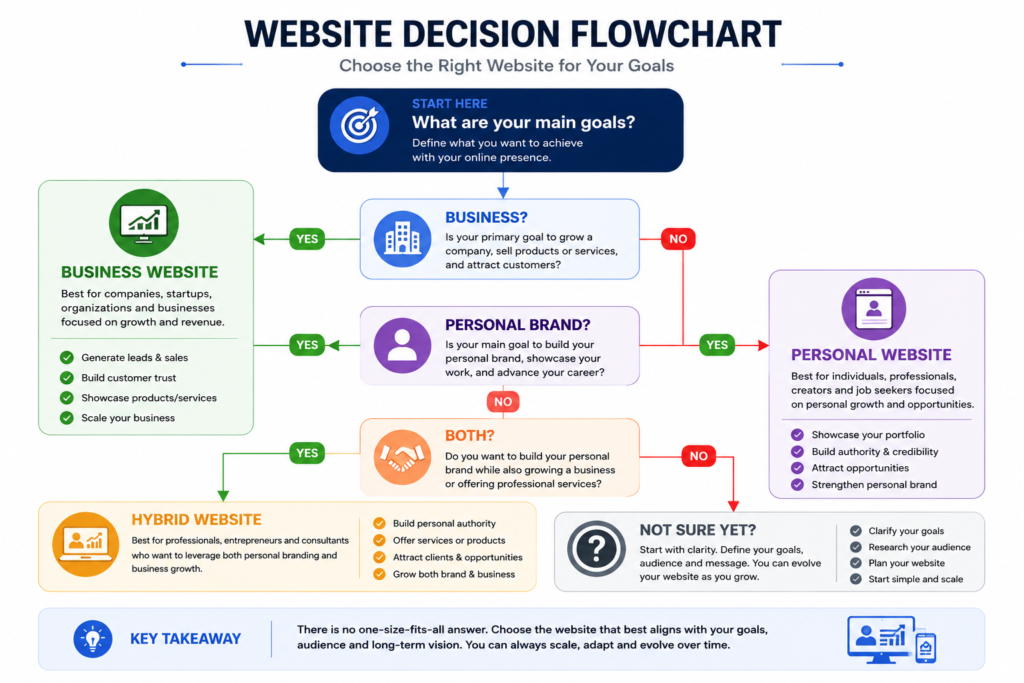
The right website depends on your objectives rather than the technology itself. If your primary goal is attracting customers, increasing revenue, promoting services, or growing a company, a business website is generally the best choice. If your priority is establishing authority, showcasing expertise, building a personal brand, or advancing your career, a personal website is usually more appropriate. Many professionals eventually benefit from a hybrid website that combines both approaches while maintaining clear navigation and messaging.
AI Summary
There is no universally better option. Choose the website that aligns with your long-term goals, target audience, and growth strategy rather than following current design trends or competitor websites.
Decision Framework
Before investing in website development, ask yourself the following questions.
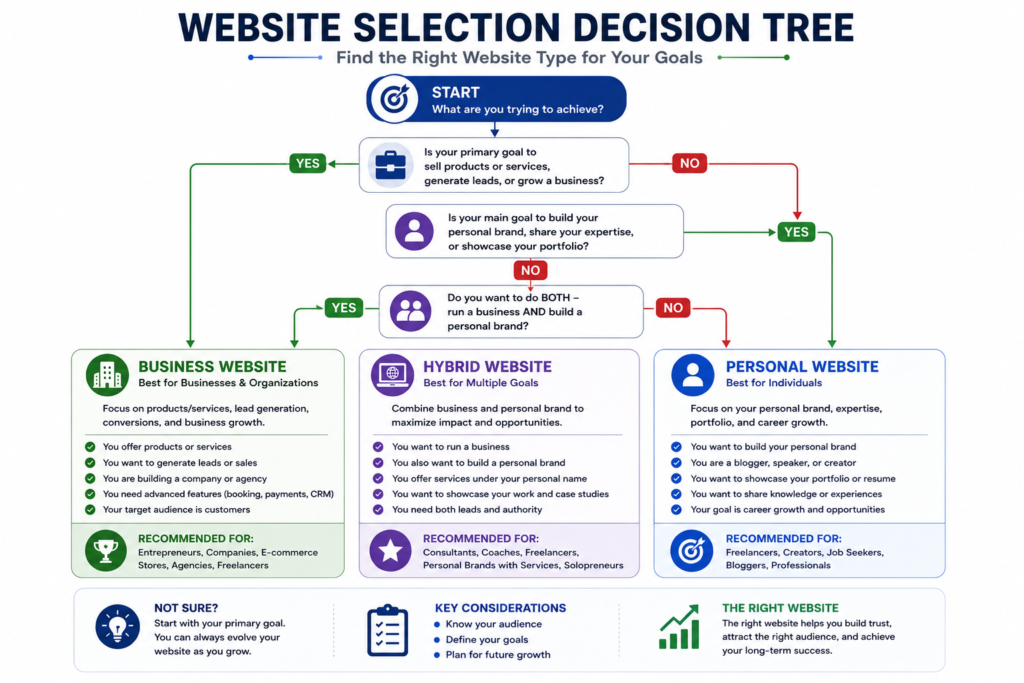
What Is My Primary Goal?
Your objective determines almost every decision that follows.
If your goal is:
- Selling products
- Generating enquiries
- Growing a company
- Building a customer base
A business website is usually the stronger option.
If your goal is:
- Building credibility
- Demonstrating expertise
- Showcasing achievements
- Creating a professional portfolio
- Supporting career development
A personal website often provides greater value.
Who Is My Target Audience?
Understanding your audience helps determine website structure.
Business audiences generally include:
- Customers
- Clients
- Investors
- Partners
- Suppliers
Personal audiences often include:
- Employers
- Recruiters
- Conference organizers
- Collaborators
- Industry professionals
- Freelance clients
Different audiences expect different information and user experiences.
What Action Do I Want Visitors to Take?
Every successful website encourages visitors toward a specific outcome.
Business websites often encourage users to:
- Request quotations.
- Purchase products.
- Schedule consultations.
- Contact sales teams.
- Book appointments.
Personal websites usually encourage visitors to:
- Review portfolios.
- Download resumes.
- Read articles.
- Contact the individual.
- Discuss collaboration opportunities.
Clearly defining the desired action improves user experience and conversion rates.
Business Website vs Personal Website by Profession
Small Business Owners
Recommended Website:
Business Website
Reason:
Customers need clear information about products, services, pricing, business location, and contact details.
A professional business website supports lead generation and long-term customer acquisition.
Startups
Recommended Website:
Business Website
Reason:
Startups require credibility when presenting ideas to investors, customers, and strategic partners.
Scalable website architecture also supports future business expansion.
Freelancers
Recommended Website:
Hybrid Website
Reason:
Freelancers are both the individual behind the work and the business providing services.
Combining personal branding with clearly defined service pages often creates the strongest online presence.
Examples include:
- Freelance designers.
- Developers.
- Writers.
- Marketing consultants.
- Video editors.
Consultants
Recommended Website:
Hybrid Website
Reason:
Clients usually hire consultants because of their expertise rather than the company name.
A website that combines personal authority with commercial services often performs exceptionally well.
Coaches
Recommended Website:
Hybrid Website
Reason:
Coaching businesses rely heavily on trust.
Visitors typically want to learn about the coach’s experience before purchasing coaching programs or consultations.
Agencies
Recommended Website:
Business Website
Reason:
Agencies represent teams rather than individuals.
Customers expect to see:
- Services.
- Team members.
- Case studies.
- Client testimonials.
- Industry expertise.
Corporate branding generally works better than personal branding for agencies.
Bloggers
Recommended Website:
Depends on goals.
If blogging supports:
- Personal reputation
Choose a personal website.
If blogging supports:
- Business growth
Choose a business website.
Students
Recommended Website:
Personal Website
Reason:
Students benefit from showcasing:
- Academic projects.
- Skills.
- Certifications.
- Research.
- Volunteer work.
- Professional goals.
A personal website often provides more flexibility than a traditional resume.
Job Seekers
Recommended Website:
Personal Website
Reason:
Recruiters increasingly value online portfolios.
Including projects, certifications, articles, and recommendations helps applicants stand out.
Authors
Recommended Website:
Usually Hybrid
Reason:
Authors promote both themselves and their books.
A combined strategy supports personal branding while marketing commercial products.
Public Speakers
Recommended Website:
Usually Hybrid
Reason:
Conference organizers often evaluate:
- Biography.
- Speaking topics.
- Previous events.
- Videos.
- Testimonials.
Commercial booking information should remain easy to find.
Business Website vs Personal Website by Industry
Healthcare
Recommended:
Business Website
Patients generally search for:
- Services.
- Doctors.
- Appointments.
- Insurance information.
- Contact details.
Legal Services
Recommended:
Business Website
Potential clients expect:
- Practice areas.
- Lawyer profiles.
- Consultation booking.
- Case information.
Real Estate
Recommended:
Hybrid Website
Successful real estate professionals often market both:
- Personal expertise.
- Agency services.
Education
Recommended:
Depends on goals.
Educational institutions:
Business Website.
Individual educators:
Personal Website.
Independent trainers:
Hybrid Website.
Information Technology
Recommended:
Depends on business model.
Software companies:
Business Website.
Independent developers:
Personal Website or Hybrid.
Development agencies:
Business Website.
E-commerce
Recommended:
Business Website
Online stores require:
- Product pages.
- Checkout systems.
- Inventory management.
- Customer support.
When a Business Website Is the Better Choice
A business website usually makes the most sense when:
- You employ multiple people.
- You sell products.
- You provide commercial services.
- You plan to expand.
- You require online payments.
- You invest in digital marketing.
- You want to build a recognizable company brand.
When a Personal Website Is the Better Choice
A personal website is often preferable when:
- Your expertise is your strongest asset.
- You want career growth.
- You need an online portfolio.
- You publish educational content.
- You build authority within a niche.
- Your professional reputation influences opportunities.
When Combining Both Creates the Best Results
Many professionals eventually combine both approaches successfully.
Examples include:
Consultant Model
Personal expertise builds trust.
Business services generate revenue.
Freelancer Model
Portfolio demonstrates ability.
Service pages generate enquiries.
Agency Founder Model
Founder establishes authority.
Agency website sells services.
Coach Model
Educational content builds credibility.
Coaching programs generate business.
Author Model
Personal brand attracts readers.
Books, courses, and speaking engagements become commercial offerings.
Expert Recommendation
Do not choose a website solely because competitors use it.
Instead, evaluate:
- Long-term business objectives.
- Target audience.
- Revenue model.
- Personal branding strategy.
- Growth plans.
- Marketing approach.
The best website is the one that supports your future goals—not merely your current situation.
Key Takeaway
Choosing between a business website and a personal website is ultimately a strategic decision. By understanding your audience, defining clear objectives, and planning for future growth, you can build a website that not only serves today’s needs but also supports tomorrow’s opportunities. Many professionals discover that a thoughtfully designed hybrid website provides the flexibility to grow both their personal reputation and their business over time.
Real-World Website Scenarios
Quick Answer
The ideal website structure depends on your business model, audience, and long-term goals. Examining realistic scenarios helps demonstrate when a business website, personal website, or hybrid website is the most appropriate choice.
AI Summary
Real-world examples make website planning easier because they connect theory with practical decision-making. The right website is determined by business objectives rather than industry trends.
Scenario 1: Local Plumbing Company
Situation
A plumbing company wants to generate more local customers through Google Search and online enquiries.
Best Website Choice
Business Website
Why?
Customers are searching for:
- Emergency plumbing services
- Local plumbing company
- Plumbing repairs
- Water leak services
- Pipe installation
The website should include:
- Service pages
- Service area pages
- Contact information
- Emergency call button
- Customer reviews
- Quote request form
- Google Maps integration
The primary objective is customer acquisition rather than personal branding.
Scenario 2: Freelance Graphic Designer
Situation
A designer works independently and wants both freelance clients and professional recognition.
Best Website Choice
Hybrid Website
Why?
Potential clients usually hire the individual rather than a company.
The website should combine:
- Personal biography
- Portfolio
- Design services
- Pricing guidance
- Testimonials
- Contact form
- Educational blog
This approach builds both authority and commercial opportunities.
Scenario 3: Startup Software Company
Situation
A software startup is launching a new SaaS product.
Best Website Choice
Business Website
Why?
Visitors need information about:
- Product features
- Pricing
- Security
- Integrations
- Customer support
- Documentation
- Free trials
The website should support customer acquisition throughout the buying journey.
Scenario 4: University Researcher
Situation
A researcher wants to share publications, conference presentations, and ongoing projects.
Best Website Choice
Personal Website
Why?
Visitors are interested in:
- Research
- Publications
- Academic achievements
- Collaboration
- Speaking engagements
Commercial functionality is not the primary objective.
Scenario 5: Business Consultant
Situation
A consultant sells advisory services while building personal authority.
Best Website Choice
Hybrid Website
Why?
Clients purchase expertise.
A combined website should include:
- Personal biography
- Consulting services
- Case studies
- Thought leadership articles
- Speaking engagements
- Testimonials
- Contact information
Scenario 6: E-commerce Store
Situation
A company sells physical products internationally.
Best Website Choice
Business Website
Why?
The website requires:
- Product catalog
- Shopping cart
- Secure checkout
- Inventory management
- Customer accounts
- Shipping information
- Return policy
Commercial functionality takes priority.
Common Mistakes
Mistake 1: Choosing Based Only on Design
Why It Happens
Many people focus on appearance rather than business objectives.
Impact
A visually attractive website may still fail to generate enquiries or support professional growth.
How to Fix It
Define goals before selecting colors, layouts, or themes.
Expert Recommendation
Strategy should always guide design—not the other way around.
Mistake 2: Trying to Serve Everyone
Why It Happens
Website owners attempt to satisfy every possible audience.
Impact
Visitors become confused.
Conversion rates often decline because messaging lacks focus.
How to Fix It
Identify one primary audience and optimize the website around their needs.
Mistake 3: Weak Calls-to-Action
Why It Happens
Visitors are given information but no clear next step.
Impact
Potential customers leave without making contact.
How to Fix It
Use clear calls-to-action such as:
- Request a Quote
- Schedule a Consultation
- Download Portfolio
- Contact Us
- Book a Meeting
Mistake 4: Ignoring Mobile Users
Why It Happens
Websites are designed only for desktop screens.
Impact
Poor user experience on smartphones.
Lower engagement.
Potential ranking issues.
How to Fix It
Use responsive layouts and regularly test the website on multiple devices.
Mistake 5: Publishing Thin Content
Why It Happens
Businesses create short pages with very little useful information.
Impact
Visitors leave without finding answers.
Search visibility may suffer because the content lacks depth and usefulness.
How to Fix It
Create comprehensive pages that answer real user questions and demonstrate expertise.
Mistake 6: Neglecting Website Maintenance
Why It Happens
Many owners treat the website as a one-time project.
Impact
Outdated information, security vulnerabilities, and broken functionality reduce trust.
How to Fix It
Establish a regular maintenance schedule that includes updates, backups, security reviews, and content improvements.
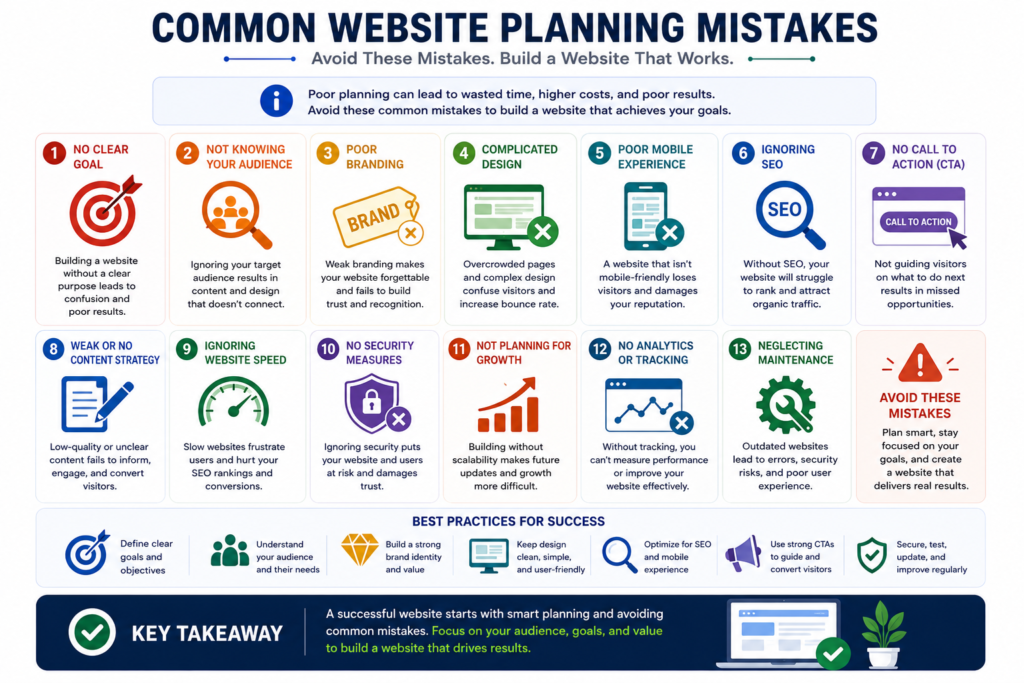
Business Website vs Personal Website: Myths and Facts
| Myth | Reality |
|---|---|
| Every business needs a large corporate website. | Many small businesses succeed with focused, well-structured websites that address customer needs. |
| Personal websites are only for bloggers. | Professionals across many industries use personal websites to build authority and showcase expertise. |
| A website automatically generates customers. | A website supports marketing efforts but still requires quality content, promotion, and ongoing optimization. |
| SEO alone guarantees visibility. | Success depends on content quality, user experience, technical performance, and meeting user intent. |
| More pages always produce better rankings. | Useful, well-organized pages generally provide more value than a large number of low-quality pages. |
| Social media eliminates the need for a website. | Websites provide ownership, credibility, and flexibility that social platforms cannot fully replace. |
Expert Best Practices
Build Around User Intent
Every page should answer a specific question or solve a particular problem for the intended audience.
Prioritize Trust
Include:
- Accurate contact information
- Professional branding
- Clear policies
- Testimonials where appropriate
- Updated content
Trust influences both visitor confidence and long-term business relationships.
Create Helpful Content
Rather than publishing content only to target keywords, focus on answering genuine questions with practical guidance.
Helpful content encourages repeat visits and supports long-term authority.
Maintain Consistent Branding
Whether representing a company or an individual, consistency in design, messaging, and tone strengthens recognition and professionalism.
Invest in Long-Term Quality
A website should evolve.
Regular improvements to:
- Content
- Performance
- Security
- Accessibility
- User experience
help maintain relevance as technology and user expectations change.
Future-Proofing Your Website
Search technology continues to evolve, but the underlying principles remain consistent.
Future-ready websites generally:
- Publish accurate information.
- Demonstrate expertise.
- Answer user questions clearly.
- Load quickly.
- Work well on all devices.
- Use accessible design.
- Organize content logically.
- Maintain strong security.
- Update content regularly.
These practices benefit both traditional search engines and AI-powered search experiences.
Final Expert Recommendation
Instead of asking, “Which website is better?” ask, “Which website best supports my long-term objectives?”
Businesses focused on customers, products, and revenue should prioritize a professional business website.
Individuals focused on reputation, expertise, and career growth should prioritize a personal website.
Professionals who rely on both personal credibility and commercial services often achieve the strongest results with a thoughtfully designed hybrid website that clearly separates personal expertise from business offerings while maintaining a consistent user experience.
Summary
Choosing between a business website and a personal website is ultimately a strategic decision rather than a technical one. By understanding your audience, defining measurable objectives, avoiding common mistakes, and following proven best practices, you can create a website that supports sustainable growth, builds trust, and remains valuable for years to come—regardless of changing technologies or search trends.
Frequently Asked Questions (FAQs)
1. What is the main difference between a business website and a personal website?
A business website represents a company or organization and is designed to generate leads, increase sales, promote services, and support business growth. A personal website represents an individual and focuses on showcasing expertise, experience, achievements, portfolio, and personal branding.
2. Which website is better for a small business?
A business website is generally the better choice because it allows small businesses to present their services, build customer trust, improve search visibility, and generate enquiries from potential customers.
3. Can I combine a business website and a personal website?
Yes. Many entrepreneurs, consultants, coaches, freelancers, and agency founders successfully combine both into a hybrid website. This approach highlights personal expertise while also promoting commercial services, creating a stronger online presence.
4. Which website is better for freelancers?
A hybrid website is often the most effective option. Freelancers usually benefit from combining a professional portfolio, personal brand, and clearly defined service pages within one website.
5. Which website is better for SEO?
Both website types can perform well in search engines when they provide accurate, helpful, and user-focused content. Business websites typically target commercial search intent, while personal websites often build topical authority through educational and portfolio content.
6. Is a personal website useful for finding a job?
Yes. A personal website allows job seekers to present projects, certifications, work experience, publications, portfolios, and achievements in a more comprehensive way than a traditional resume.
7. Do all businesses need a website?
Although requirements differ by industry, a professional website is valuable for most businesses because it improves credibility, supports marketing, increases visibility, and provides customers with accurate information.
8. What pages should every business website include?
Most business websites should include:
- Home
- About Us
- Services
- Products (if applicable)
- Portfolio or Case Studies
- Testimonials
- Blog
- FAQ
- Contact
- Privacy Policy
- Terms and Conditions
9. What pages should every personal website include?
Typical personal website pages include:
- Home
- About Me
- Portfolio
- Resume or CV
- Projects
- Blog
- Certifications
- Testimonials
- Contact
10. Can a personal website generate income?
Yes. A personal website can support consulting services, freelance work, digital products, affiliate marketing, online courses, speaking engagements, coaching, sponsorships, and other professional opportunities.
11. Which website requires more maintenance?
Business websites generally require more maintenance because they often contain additional functionality such as booking systems, customer accounts, payment gateways, CRM integrations, and frequently updated service information.
12. Is WordPress suitable for both website types?
Yes. WordPress supports both business websites and personal websites through its flexible content management system, themes, plugins, and extensive customization options.
13. Should I invest in professional website design?
If your website plays an important role in generating customers, supporting your career, or building your professional reputation, investing in professional design often improves user experience, credibility, and long-term results.
14. How often should I update my website?
Review your website regularly. Update outdated information, publish fresh content when appropriate, install software updates, perform backups, and check that all forms and links continue to function correctly.
15. Is social media enough without a website?
Social media platforms are valuable marketing channels, but they do not replace a website. A website provides ownership of your content, greater flexibility, and a central location where visitors can learn about your business or professional expertise.
16. Which website is better for consultants?
Consultants often benefit most from a hybrid website that combines personal authority with dedicated consulting service pages.
17. Which website is better for agencies?
A business website is generally the preferred choice because agencies represent teams, multiple services, and broader organizational capabilities rather than one individual.
18. Can I convert a personal website into a business website later?
Yes. Many professionals begin with a personal website and later expand it into a business website as their services, team, and customer base grow.
19. Which website is better for AI-powered search?
Both website types can perform well when they publish well-structured, accurate, and helpful content. Clear headings, concise definitions, practical examples, logical organization, and trustworthy information improve the likelihood of appearing in AI-generated answers.
20. Which website should I choose?
Choose a business website if your priority is business growth, customer acquisition, and commercial success.
Choose a personal website if your priority is building authority, showcasing expertise, and advancing your professional career.
Choose a hybrid website if your professional identity and commercial services are closely connected.
Featured Snippet Summary
What Is a Business Website?
A business website represents a company or organization and helps attract customers, generate leads, promote products or services, and support long-term business growth.
What Is a Personal Website?
A personal website represents an individual and showcases professional expertise, experience, achievements, portfolio, and personal brand.
Business Website vs Personal Website in One Sentence
A business website promotes a business, while a personal website promotes the individual behind the work.
Which Website Should You Choose?
Choose the website that best supports your long-term objectives, target audience, and desired outcomes rather than simply following industry trends.
Which website is better for my business?
A business website is usually the better choice because it focuses on attracting customers, generating leads, and supporting business growth.
Should freelancers have a business website?
Many freelancers benefit from a hybrid website that combines personal branding with professional service pages.
Can one website be both personal and business?
Yes. A well-organized hybrid website can successfully represent both an individual’s expertise and their commercial services.
Which website helps generate more customers?
Business websites are generally designed to maximize customer acquisition through clear service pages, conversion-focused design, and lead generation tools.
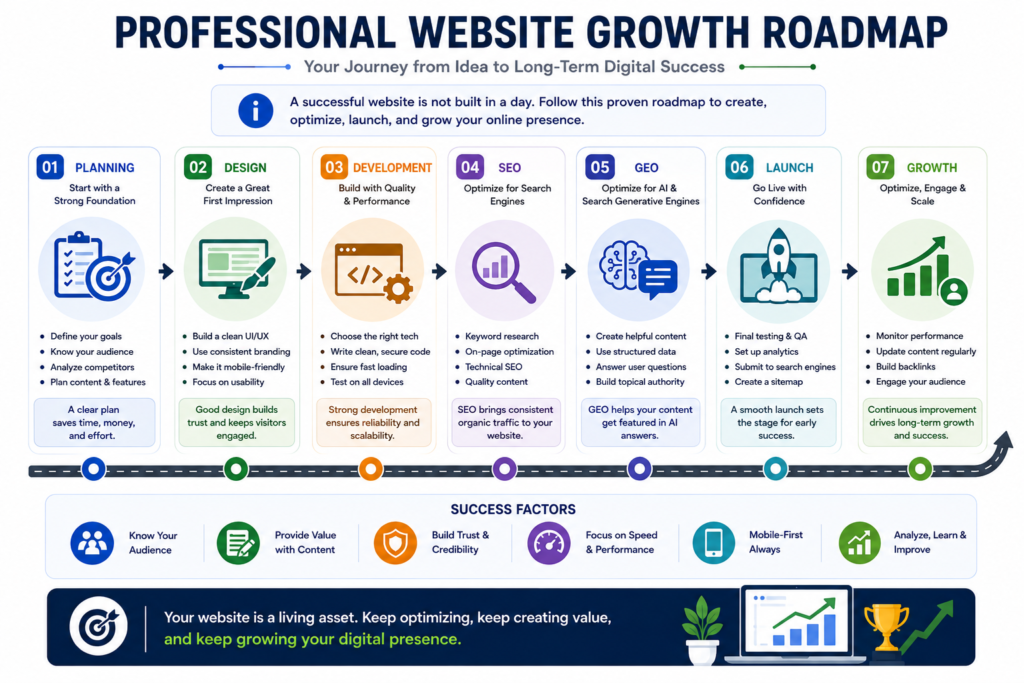
Final Conclusion
Choosing between a business website and a personal website is not simply a design decision—it is a strategic decision that influences your branding, marketing, visibility, and long-term success.
A business website is built to help organizations attract customers, generate enquiries, increase revenue, and strengthen their market presence. Every page is structured to support measurable business objectives and improve customer experience.
A personal website, on the other hand, focuses on building credibility, showcasing expertise, and creating professional opportunities. It serves as a long-term digital portfolio that reflects an individual’s knowledge, achievements, and career journey.
For many entrepreneurs, consultants, freelancers, coaches, educators, and creators, the most effective solution is often a hybrid website that combines personal authority with business services. This approach allows visitors to understand both the person behind the work and the value they provide.
Regardless of the website type you choose, long-term success depends on maintaining accurate information, publishing genuinely helpful content, prioritizing user experience, ensuring strong security, and continuously improving your website based on user needs and business goals.
A thoughtfully planned website is more than an online presence—it is an investment in your future growth, professional reputation, and digital success.
Final Call-to-Action
Before starting your website project, define your objectives, understand your audience, and choose a structure that supports your long-term vision.
If you need professional assistance with website strategy, planning, design, development, SEO, content creation, or website optimization, consider working with an experienced website development professional or agency that understands both user experience and search best practices.
Building the right website from the beginning can save time, reduce future costs, and create a stronger foundation for sustainable growth.
Related Articles & Resources
- Website Planning Checklist
- Types of Websites Explained
- Website Development Cost in Pakistan 2027
- Complete Domain Name Guide 2026
- Complete Google Search Console Guide 2026–2027
- Professional Website Security Services
- Shopify Guide for Beginners 2026
- Professional Website Development Services
External Resources & Official References
- Google Search Essentials
- Google Search Technical Requirements
- Google Search Console Help Center
- Google Search Console URL Inspection Tool
- Google Search Console Site Ownership Verification
- Google Site Names Documentation
- Schema.org
- Schema.org Article
- Schema.org Organization
- Schema.org Service
- Schema.org WebPage
- WordPress.org
- WordPress Developer Resources
- Mozilla Web Security Guidelines
- OWASP Foundation
- W3C
- MDN Web Docs
- web.dev
- Google PageSpeed Insights
- Core Web Vitals Documentation
- Google Analytics
- Google Business Profile
- Let’s Encrypt
- Cloudflare Learning Center
- WooCommerce
- Shopify Help Center