Table of Contents
Direct Answer (Optimized for Google Featured Snippet, AI Overviews, ChatGPT, Gemini, Claude, and Perplexity)
The website development cost in Pakistan typically depends on your business goals, website type, features, technology stack, design complexity, and ongoing maintenance requirements. A simple business website generally costs significantly less than a custom eCommerce platform or enterprise web application. Besides development, businesses should also budget for domain registration, hosting, SSL certificates, maintenance, SEO, content creation, and future upgrades to ensure long-term performance and growth.
Website Development Cost in Pakistan
Building a professional website is no longer optional. Whether you own a small business, startup, educational institute, healthcare organization, real estate agency, law firm, restaurant, or multinational company, your website often becomes the first impression customers have of your business.
One of the most common questions people ask before starting a project is:
“How much does website development cost in Pakistan?”
The answer is not as straightforward as a single price because every website is different.
Several factors determine the final investment, including:
- Website purpose
- Number of pages
- Design quality
- Required features
- CMS or custom development
- Security requirements
- Search Engine Optimization
- Future scalability
- Maintenance requirements
Rather than focusing only on the initial price, businesses should consider the total cost of ownership, which includes development, hosting, security, optimization, updates, and long-term maintenance.
A professionally developed website should be viewed as a long-term business investment rather than an expense.
Search Intent Analysis
This topic satisfies mixed search intent, making it valuable for both traditional search engines and AI-powered answer engines.
| Search Intent | Why Users Search |
|---|---|
| Informational | Learn website pricing |
| Commercial | Compare agencies and freelancers |
| Transactional | Hire a website development company |
| Comparative | Compare WordPress vs Shopify vs Custom |
| Problem Solving | Understand why website prices vary |
Because it addresses multiple user needs, this topic has strong potential to rank for both informational and commercial queries.
Why Website Development Costs Vary So Much
Quick Answer
No two websites are identical.
A personal portfolio website may require only a few static pages, while an enterprise eCommerce platform may include thousands of products, customer accounts, payment gateways, inventory management, advanced search, API integrations, analytics dashboards, multilingual support, and custom business logic.
As project complexity increases, development time, testing, infrastructure, and maintenance requirements also increase.
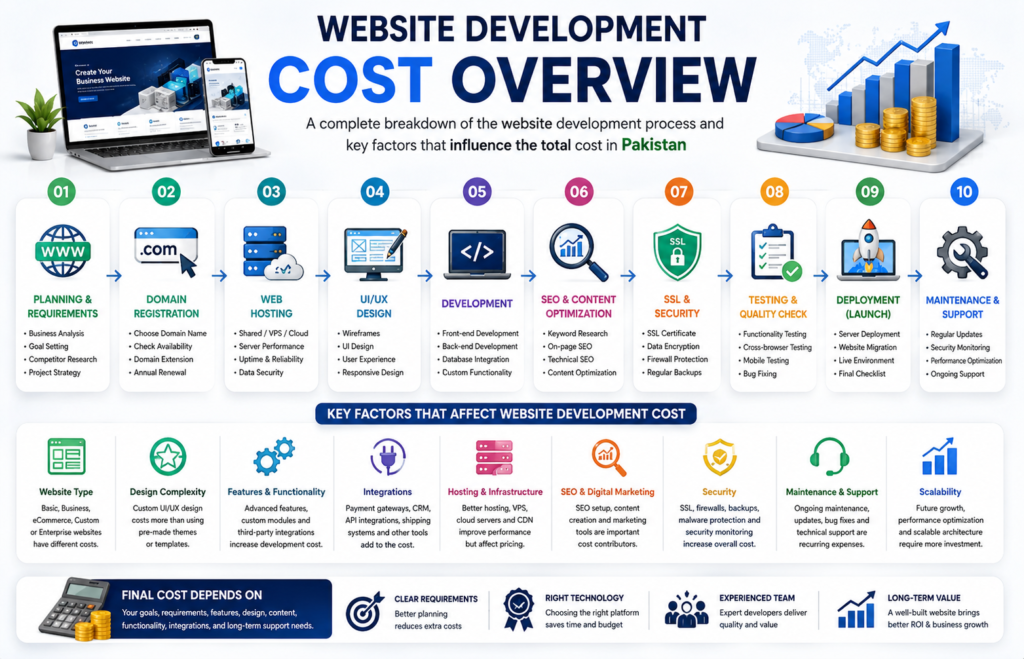
Major Factors Affecting Website Development Cost
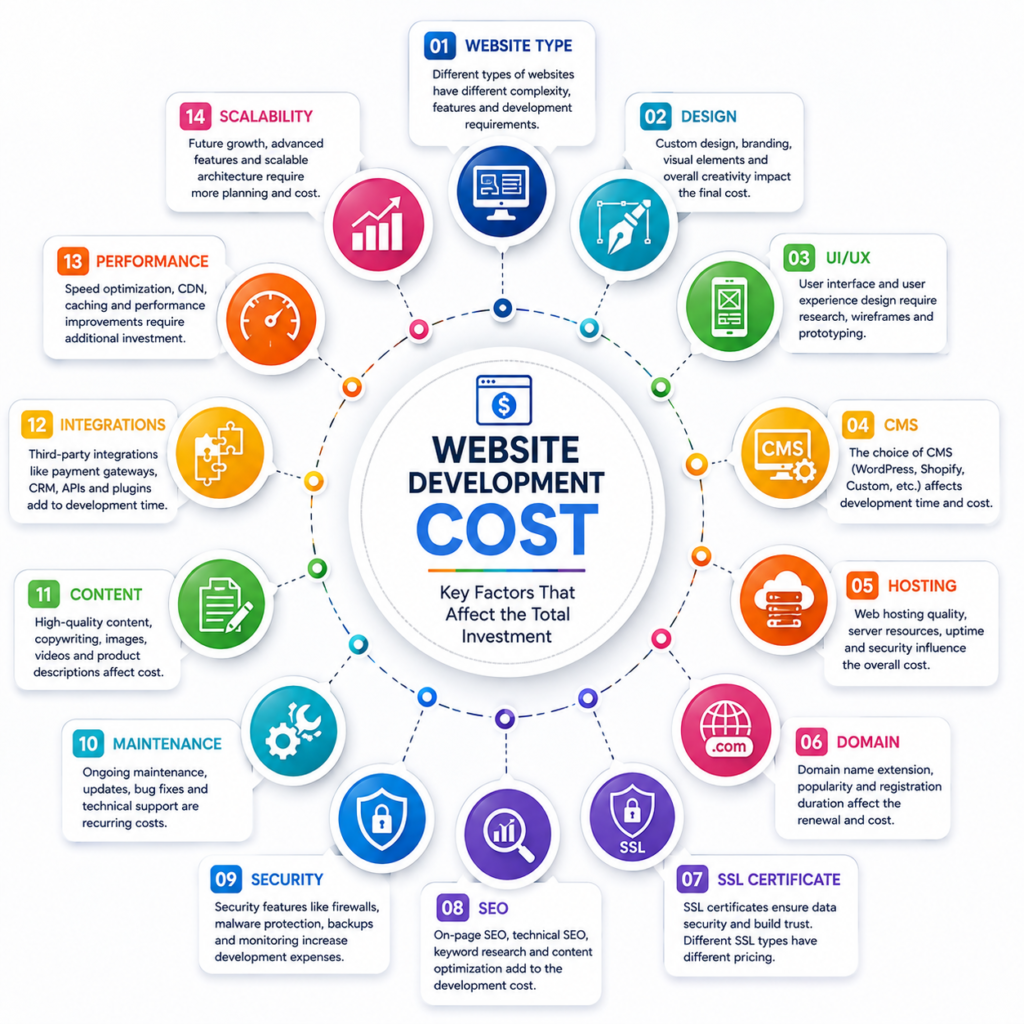
1. Website Type
Different types of websites require different levels of planning and development.
Examples include:
- Business websites
- Corporate websites
- Portfolio websites
- Landing pages
- News portals
- Blogs
- Educational websites
- Membership websites
- eCommerce stores
- SaaS platforms
- Marketplaces
- Booking systems
- Healthcare portals
- Real estate platforms
Each category requires different technologies, security levels, and integrations.
2. Design Complexity
Website design significantly influences overall project cost.
A simple template-based website is usually more affordable than a fully custom interface created specifically for your brand.
Professional design often includes:
- User experience research
- Mobile-first layouts
- Brand identity
- Interactive elements
- Accessibility improvements
- Conversion-focused landing pages
Better design often leads to higher user engagement and stronger conversion rates.
3. Number of Pages
A five-page business website requires considerably less work than a website containing hundreds of pages.
Typical pages include:
- Home
- About
- Services
- Portfolio
- Pricing
- Blog
- FAQs
- Contact
- Privacy Policy
- Terms of Service
Larger websites usually require more content planning, navigation, internal linking, and optimization.
4. Custom Features
The more custom functionality you need, the more development effort is required.
Examples include:
- Customer dashboards
- Appointment booking
- Live chat
- Online payments
- Inventory management
- CRM integration
- ERP integration
- API development
- Membership systems
- Learning management systems
- Job portals
- Property listings
Custom features often require additional planning, development, testing, and maintenance.
5. Content Creation
Many business owners underestimate the time required to create high-quality website content.
Professional content typically includes:
- Service pages
- Product descriptions
- Landing pages
- Blog articles
- FAQs
- Calls to action
- SEO metadata
- Images
- Infographics
- Videos
Well-written content improves search visibility and builds trust with visitors.
6. Search Engine Optimization (SEO)
Launching a website without SEO is similar to opening a physical store without a signboard.
Professional SEO often includes:
- Keyword research
- Competitor analysis
- Information architecture
- Internal linking
- Schema markup
- Metadata optimization
- Technical SEO
- Core Web Vitals optimization
- Mobile optimization
- Content optimization
7. Website Security
Security should be considered from the beginning of every project.
Essential security measures include:
- HTTPS encryption
- SSL/TLS certificates
- Secure authentication
- Firewall protection
- Malware monitoring
- Backup systems
- Security updates
- Access controls
8. Hosting Infrastructure
The choice of hosting affects website speed, reliability, and scalability.
Common hosting options include:
- Shared hosting
- Managed WordPress hosting
- VPS hosting
- Cloud hosting
- Dedicated servers
9. Maintenance Requirements
Website development does not end after launch.
Ongoing maintenance commonly includes:
- Plugin updates
- CMS updates
- Security patches
- Performance optimization
- Content updates
- Bug fixes
- Backup management
- Monitoring
- Technical support
Website Development Cost Components
| Component | Purpose |
|---|---|
| Domain Name | Website address |
| Web Hosting | Stores website files |
| SSL Certificate | Encrypts website traffic |
| UI/UX Design | User interface and experience |
| Front-End Development | Visual implementation |
| Back-End Development | Server-side functionality |
| Database | Data storage |
| CMS | Content management |
| SEO | Organic search optimization |
| Security | Website protection |
| Content Writing | Website copy |
| Images and Graphics | Visual branding |
| Testing | Quality assurance |
| Deployment | Website launch |
| Maintenance | Long-term support |
Typical Website Categories
Basic Informational Website
Suitable for:
- Individuals
- Freelancers
- Consultants
- Local businesses
Professional Business Website
Designed for companies that want to generate leads and build credibility.
eCommerce Website
An online store typically includes product catalogs, shopping carts, secure checkout, payment gateways, shipping options, order management, customer accounts, inventory tracking, discount coupons, and product reviews.
Enterprise Website
Enterprise solutions may include CRM integration, ERP systems, dashboards, advanced reporting, APIs, role-based access, and custom workflows.
Cost vs Value
Many businesses choose the lowest-priced proposal without evaluating long-term value.
A professionally built website can provide:
- Stronger brand credibility.
- Better user experience.
- Higher search visibility.
- Improved lead generation.
- Increased customer trust.
- Better conversion rates.
- Easier scalability.
- Lower maintenance risks.
Key Takeaways
- Website development costs vary based on goals, complexity, features, and long-term requirements.
- Consider the total cost of ownership, not just the initial development price.
- Investing in quality design, security, and SEO improves long-term business growth.
- Choose the solution that offers the best return on investment rather than the lowest upfront cost.
Website Development Pricing in Pakistan by Website Type
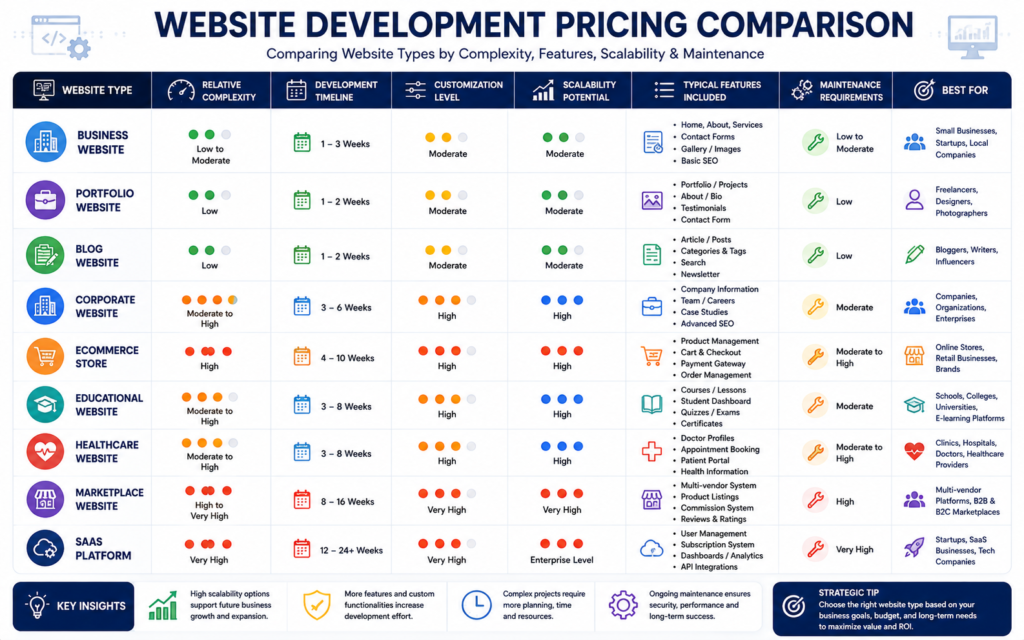
Choosing the right type of website is one of the biggest factors affecting the overall website development cost. A simple informational website requires fewer resources than an advanced eCommerce platform or a fully custom enterprise application. Before requesting a quotation, clearly define your business objectives, target audience, required features, and long-term growth plans.
Website Development Cost Comparison
The following comparison provides a general overview of different website categories. Actual pricing varies depending on project scope, design complexity, integrations, functionality, and maintenance requirements.
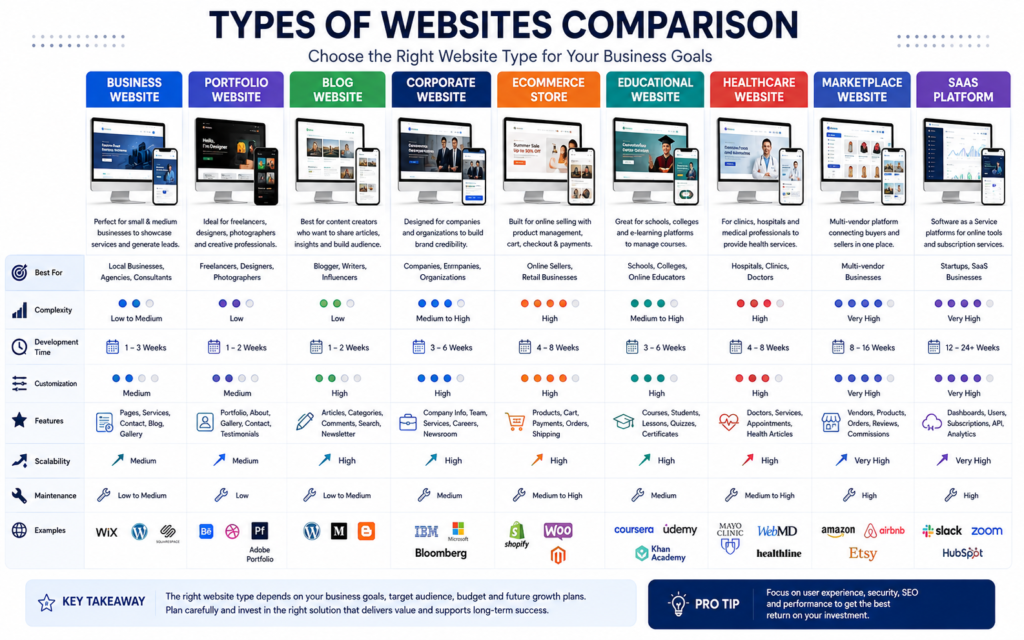
| Website Type | Best For | Complexity | Development Time |
|---|---|---|---|
| Landing Page | Marketing Campaigns | Low | Short |
| Portfolio Website | Freelancers & Creatives | Low | Short |
| Personal Website | Individuals | Low | Short |
| Small Business Website | Local Businesses | Medium | Moderate |
| Corporate Website | Medium & Large Companies | Medium to High | Moderate |
| Blog or News Website | Publishers | Medium | Moderate |
| Educational Website | Schools & Institutes | Medium to High | Moderate |
| Healthcare Website | Clinics & Hospitals | High | Moderate to Long |
| Real Estate Website | Property Businesses | High | Long |
| Restaurant Website | Restaurants & Cafés | Medium | Moderate |
| Membership Website | Subscription Businesses | High | Long |
| Booking Website | Hotels & Services | High | Long |
| Marketplace Website | Multi-vendor Businesses | Very High | Long |
| eCommerce Website | Online Stores | High | Long |
| SaaS Platform | Software Businesses | Very High | Extended |
| Enterprise Web Application | Large Organizations | Enterprise | Extended |
Business Website Development Cost
Who Needs a Business Website?
A business website is ideal for:
- Small businesses
- Startups
- Consultants
- Law firms
- Healthcare providers
- Marketing agencies
- Manufacturing companies
- Service providers
- Educational institutes
The primary goal of a business website is to establish credibility, generate leads, and provide information about products or services.
Typical Features
- Homepage
- About Us
- Services
- Portfolio
- Testimonials
- Contact Page
- Inquiry Forms
- Google Maps
- Social Media Integration
- Mobile Responsive Design
- Basic SEO Setup
- SSL Security
- Analytics Integration
Best Choice When
A business website is the right option if your primary objective is to generate inquiries, showcase your expertise, and build trust with potential customers.
WordPress Website Development Cost
Why WordPress Is So Popular
WordPress powers a significant portion of websites worldwide because it offers flexibility, scalability, and an extensive ecosystem of themes and plugins.
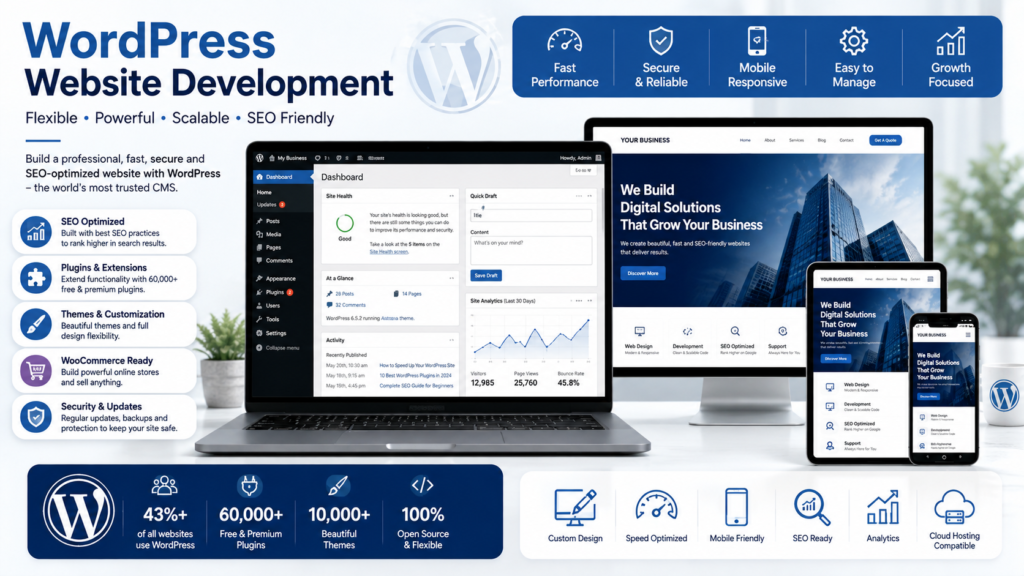
It is suitable for:
- Business websites
- Blogs
- Corporate websites
- News portals
- Educational websites
- Portfolio websites
- Online stores
- Membership websites
Advantages of WordPress
- Easy content management
- Excellent SEO capabilities
- Thousands of plugins
- Highly customizable
- Scalable architecture
- Strong community support
- Cost-effective maintenance
- Flexible design options
Consider Before Choosing
WordPress is an excellent solution for most businesses, but premium themes, plugins, ongoing updates, and security management should be included in your long-term planning.
Shopify Website Development Cost
Best For
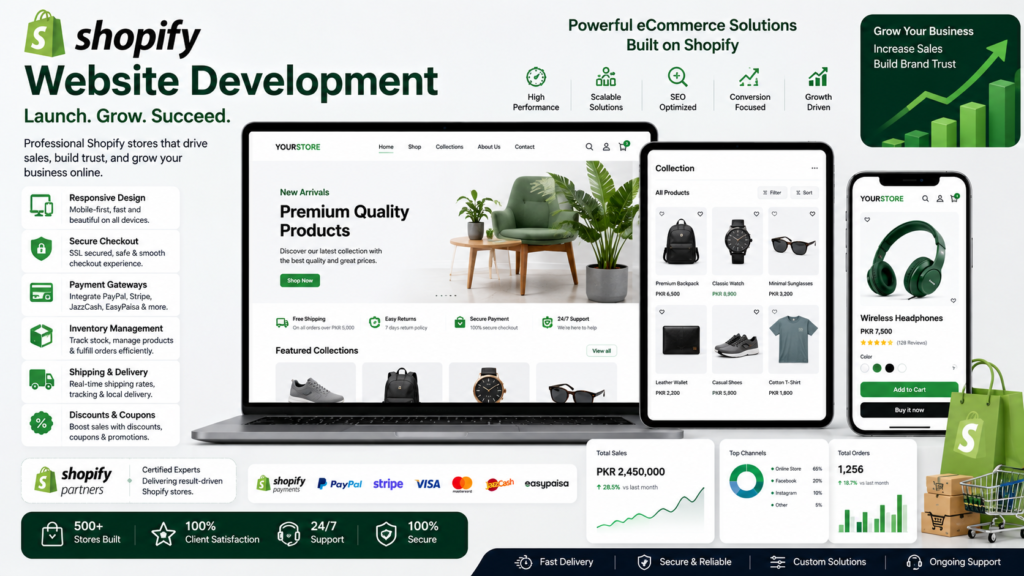
Shopify is designed primarily for businesses that want to sell products online with minimal technical complexity.
Ideal for:
- Retail stores
- Fashion brands
- Electronics stores
- Beauty products
- Furniture businesses
- Dropshipping stores
- Subscription products
Common Features
- Product management
- Inventory control
- Secure checkout
- Shipping integration
- Discount codes
- Customer accounts
- Analytics
- Marketing tools
- Mobile optimization
Advantages
- Easy management
- Reliable hosting
- Strong security
- Excellent scalability
- Fast deployment
- Built-in commerce tools
Businesses focused exclusively on eCommerce often choose Shopify because it reduces technical maintenance responsibilities.
Custom Website Development Cost
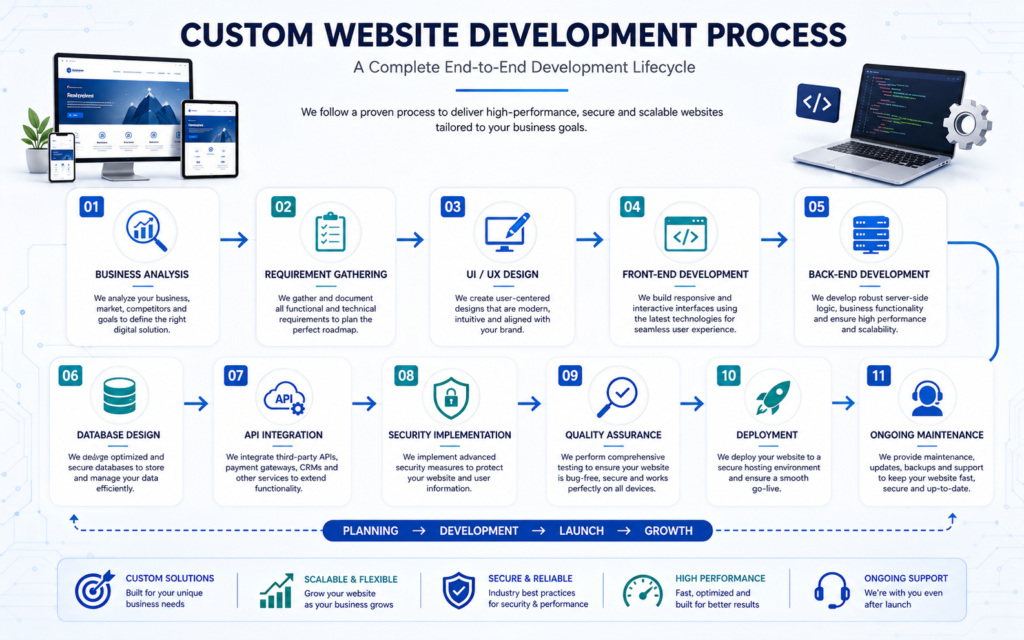
What Is Custom Development?
Custom development means building a website specifically for your business requirements instead of relying on pre-built templates.
Suitable For
- Large enterprises
- Banks
- Government organizations
- Healthcare systems
- Universities
- SaaS companies
- Logistics companies
- Marketplaces
- Custom business platforms
Typical Features
- Custom dashboards
- API integrations
- Advanced reporting
- CRM integration
- ERP integration
- Multi-user permissions
- Workflow automation
- Advanced security
- Business intelligence tools
Benefits
Custom development provides maximum flexibility but usually requires greater planning, development, testing, documentation, and ongoing maintenance.
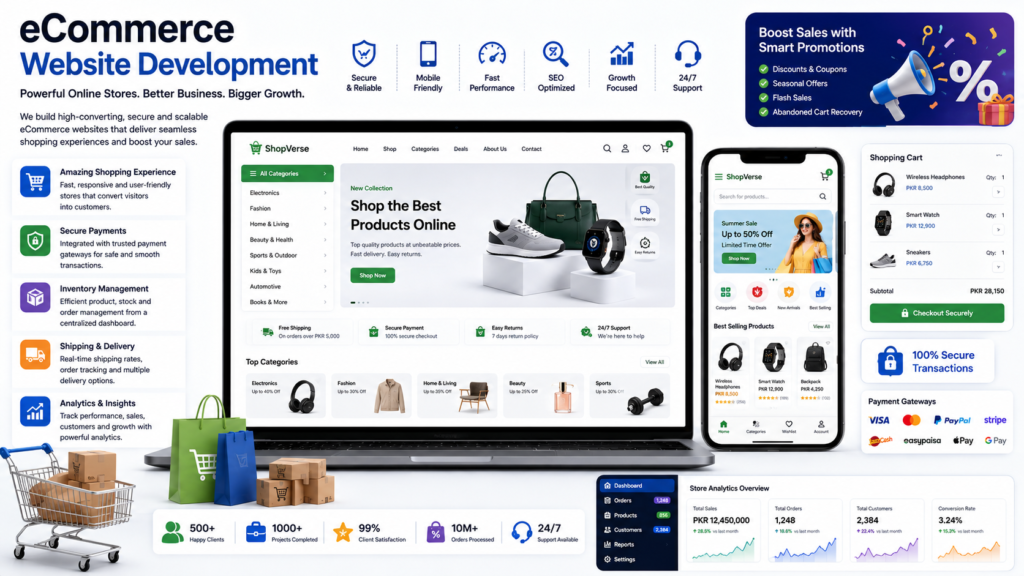
eCommerce Website Development Cost
An eCommerce website involves much more than displaying products online.
Modern online stores generally include:
- Product catalog
- Categories
- Product search
- Filters
- Wishlist
- Shopping cart
- Secure checkout
- Payment gateways
- Shipping calculators
- Inventory management
- Customer accounts
- Order tracking
- Reviews
- Coupons
- Email notifications
- Sales reports
Additional Considerations
As product catalogs grow, businesses should also plan for performance optimization, database management, search functionality, image optimization, and security monitoring.
Portfolio Website Development Cost
Portfolio websites help professionals demonstrate their expertise and previous work.
Popular among:
- Graphic designers
- Photographers
- Architects
- Engineers
- Developers
- Content writers
- Marketing consultants
- Interior designers
Common Pages
- Home
- About
- Portfolio
- Services
- Testimonials
- Blog
- Contact
A clean design, fast loading speed, and high-quality visuals are especially important for portfolio websites.
Corporate Website Development Cost
Corporate websites are typically larger than standard business websites and are designed to represent established organizations.
Frequently Included Sections
- Company Overview
- Leadership Team
- Investor Relations
- Sustainability
- Careers
- Newsroom
- Multiple Service Pages
- Regional Offices
- Contact Centers
- Legal Pages
Enterprise-Level Features
- Multi-language support
- Advanced search
- Document management
- Department-specific pages
- Secure client portals
- Enterprise security
- Accessibility compliance
Corporate websites often require ongoing collaboration between marketing teams, developers, designers, and IT departments.
CMS Comparison
Choosing the right Content Management System (CMS) has a direct impact on flexibility, maintenance, scalability, and future costs.
| Platform | Best For | Ease of Use | Scalability | SEO Friendly |
|---|---|---|---|---|
| WordPress | Business Websites | Excellent | Excellent | Excellent |
| Shopify | Online Stores | Excellent | Excellent | Very Good |
| Webflow | Designers | Very Good | Very Good | Very Good |
| Wix | Beginners | Excellent | Moderate | Good |
| Squarespace | Portfolios | Excellent | Moderate | Good |
| Custom CMS | Enterprises | Advanced | Excellent | Excellent |
No single platform is ideal for every project. The best choice depends on your business objectives, technical requirements, available resources, and future expansion plans.
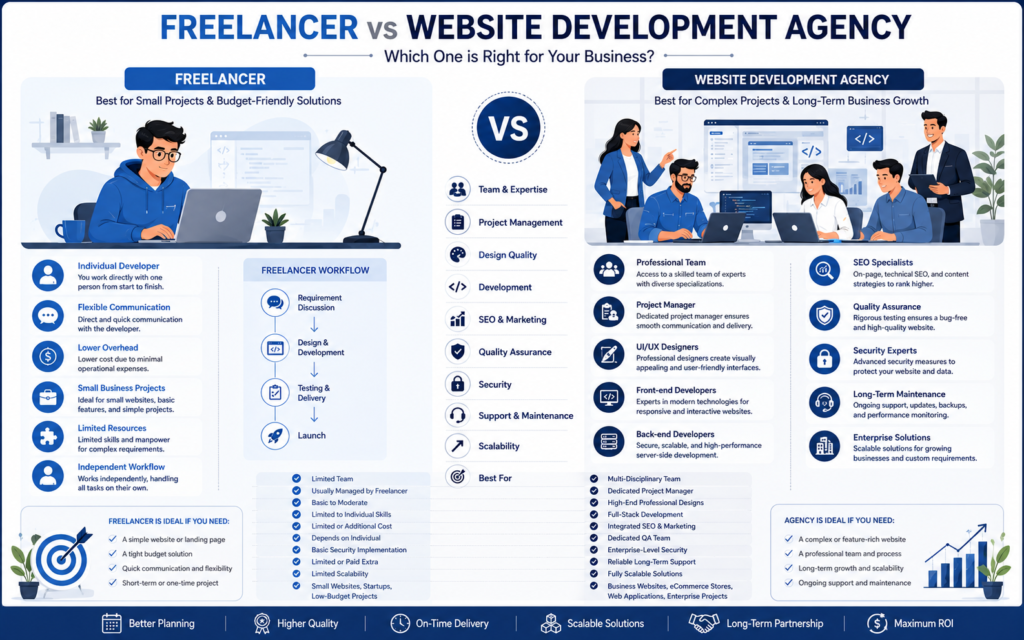
Freelancer vs Website Development Agency
Many businesses struggle to decide whether to hire an independent freelancer or a professional website development agency.
Freelancer Advantages
- Lower overhead
- Direct communication
- Flexible working arrangements
- Suitable for smaller projects
Freelancer Limitations
- Limited team capacity
- Availability may vary
- Specialized expertise may be limited
- Longer timelines for complex projects
Agency Advantages
- Dedicated project management
- Professional designers
- Front-end developers
- Back-end developers
- SEO specialists
- Quality assurance
- Security expertise
- Long-term technical support
Agency Considerations
Professional agencies generally follow structured development processes, documentation standards, testing procedures, and ongoing maintenance practices, making them well suited for medium-sized and enterprise projects.
Which Website Type Offers the Best Return on Investment?
The answer depends entirely on your business model.
| Business Type | Recommended Website |
|---|---|
| Local Business | Business Website |
| Consultant | Professional Website |
| Online Store | Shopify or WooCommerce |
| Large Company | Corporate Website |
| Startup | WordPress Business Website |
| Educational Institute | Educational Portal |
| Hospital | Healthcare Website |
| Real Estate Company | Property Listing Website |
| Software Company | SaaS Platform |
| Marketplace Business | Multi-vendor Marketplace |
Instead of selecting the most affordable solution, choose the platform that aligns with your current objectives while allowing room for future growth. A scalable, secure, and user-focused website is more likely to deliver long-term value, improve customer experience, and support sustainable business expansion.
Factors That Affect Website Development Cost in Pakistan
Many people assume that website pricing depends only on the number of pages or the visual design. In reality, professional website development involves numerous technical, creative, and business considerations that influence the final project cost. Understanding these factors helps businesses plan realistic budgets and choose solutions that provide long-term value.
Domain Name Registration
What Is a Domain Name?
A domain name is your website’s unique address on the internet. It represents your brand identity and makes it easier for customers to find your business online.
Examples include:
- yourbusiness.com
- yourbrand.pk
- company.net
A memorable, easy-to-spell domain name can strengthen brand recognition and improve customer trust.
Factors That Affect Domain Costs
- Domain extension (.com, .pk, .org, etc.)
- Domain registrar
- Premium domain availability
- Renewal fees
- Multi-year registration
- Domain privacy protection
Best Practices
- Choose a short and memorable domain.
- Avoid numbers and hyphens where possible.
- Register your domain under your own business account.
- Renew your domain before it expires.
- Secure similar domain extensions to protect your brand.
Web Hosting
Why Hosting Matters
Web hosting stores your website files and makes them accessible to visitors around the world.
The quality of your hosting directly affects:
- Website speed
- Uptime
- Security
- Scalability
- User experience
- Search engine performance
Types of Hosting
Shared Hosting
Best for:
- Personal websites
- Small businesses
- Beginners
Advantages:
- Affordable
- Easy to manage
Limitations:
- Shared resources
- Lower performance during traffic spikes
VPS Hosting
Suitable for growing businesses that require better performance and more control.
Benefits include:
- Dedicated resources
- Better performance
- Greater flexibility
- Improved security
Cloud Hosting
Cloud hosting distributes website resources across multiple servers, providing improved reliability and scalability.
Ideal for:
- Growing businesses
- High-traffic websites
- eCommerce stores
- SaaS platforms
Dedicated Servers
Dedicated hosting provides an entire physical server for one organization.
Typically used by:
- Enterprise businesses
- Large eCommerce platforms
- Financial organizations
- High-security applications
SSL Certificate
Why SSL Is Essential
An SSL certificate encrypts data transferred between a visitor’s browser and your website.
Benefits include:
- Secure data transmission
- Customer trust
- HTTPS encryption
- Better browser compatibility
- Improved online credibility
Most modern websites should use HTTPS from the first day of launch.
Website Design (UI and UX)
User Interface (UI)
UI focuses on the visual appearance of your website, including:
- Colors
- Typography
- Buttons
- Icons
- Layout
- Branding
User Experience (UX)
UX focuses on how visitors interact with your website.
Good UX improves:
- Navigation
- Readability
- Accessibility
- Conversion rates
- Customer satisfaction
A well-designed website encourages visitors to stay longer, explore more pages, and complete desired actions such as making inquiries or purchases.
Responsive Design
Today’s users browse websites using desktops, laptops, tablets, and smartphones.
A responsive website automatically adapts to different screen sizes and devices, ensuring a consistent user experience.
Benefits include:
- Better mobile usability
- Improved search visibility
- Higher engagement
- Lower bounce rates
Website Content
Content is one of the most valuable parts of any website.
Professional content typically includes:
- Homepage copy
- Service pages
- Product descriptions
- Blog articles
- FAQs
- Calls to action
- Company information
- Privacy policies
- Terms and conditions
High-quality content helps users understand your services while supporting SEO and improving conversions.
Professional Copywriting
Many businesses underestimate the importance of professionally written content.
Effective copywriting should:
- Answer customer questions
- Explain services clearly
- Highlight business benefits
- Build trust
- Encourage conversions
- Support search visibility
Rather than filling pages with unnecessary text, focus on creating useful, people-first content.
Search Engine Optimization (SEO)
SEO should be integrated into website development from the beginning instead of being treated as an afterthought.
Professional SEO often includes:
- Keyword research
- Site architecture
- Metadata optimization
- Internal linking
- Image optimization
- Schema markup
- Technical SEO
- XML sitemap
- Robots.txt configuration
- Core Web Vitals optimization
A technically optimized website has a stronger foundation for long-term organic visibility.
Local SEO
Businesses serving specific cities or regions should optimize for local searches.
Examples include:
- Google Business Profile optimization
- Local landing pages
- Business citations
- Local schema
- Customer reviews
- Geographic keywords
Local SEO helps businesses appear in map results and location-based searches.
Website Security
Cybersecurity is becoming increasingly important for businesses of all sizes.
Essential security measures include:
- SSL certificates
- Firewalls
- Malware scanning
- Login protection
- Security monitoring
- Strong passwords
- Two-factor authentication
- Regular backups
Security investments help protect customer data and reduce the risk of downtime.
Performance Optimization
Website speed directly influences user satisfaction and search performance.
Performance improvements may include:
- Image optimization
- Browser caching
- CDN integration
- Code optimization
- Lazy loading
- Database optimization
- Minified CSS and JavaScript
- Faster hosting infrastructure
Fast websites generally provide a better experience for both users and search engines.
Content Management System (CMS)
Selecting the right CMS influences future flexibility and maintenance.
Popular choices include:
| CMS | Best For |
|---|---|
| WordPress | Business websites and blogs |
| Shopify | Online stores |
| Webflow | Designers and agencies |
| Drupal | Large organizations |
| Joomla | Complex business websites |
| Custom CMS | Enterprise applications |
The right CMS should match your technical requirements and long-term business goals.
Third-Party Integrations
Modern websites often connect with external services.
Examples include:
- Payment gateways
- CRM software
- Email marketing tools
- Live chat
- WhatsApp integration
- Social media platforms
- Booking systems
- Shipping providers
- Accounting software
- Marketing automation
Each integration adds development and testing requirements.
Payment Gateway Integration
Online businesses frequently require secure payment processing.
Common payment features include:
- Debit cards
- Credit cards
- Bank transfers
- Digital wallets
- Mobile payments
Payment integrations should prioritize security, compliance, and user convenience.
API Development
APIs allow websites to communicate with external applications.
Common API integrations include:
- Inventory systems
- CRM software
- ERP platforms
- Maps
- Shipping providers
- SMS gateways
- Authentication services
- Analytics tools
Custom APIs increase flexibility but usually require additional development and maintenance.
Website Testing
Every professional website should undergo thorough testing before launch.
Testing includes:
- Functionality testing
- Browser compatibility
- Mobile responsiveness
- Performance testing
- Security testing
- Accessibility testing
- Form validation
- Link verification
Comprehensive testing reduces the likelihood of post-launch issues.
Website Maintenance
Launching a website is only the beginning.
Regular maintenance helps ensure long-term performance and security.
Typical maintenance tasks include:
- CMS updates
- Plugin updates
- Security monitoring
- Malware scanning
- Performance optimization
- Broken link checks
- Content updates
- Backup management
- Technical support
Businesses should include maintenance in their long-term digital strategy.
Hidden Website Development Costs
Some expenses are often overlooked during project planning.
Examples include:
- Premium plugins
- Premium themes
- Stock photography
- Custom illustrations
- Copywriting
- Translation services
- Third-party subscriptions
- Email services
- Backup solutions
- Security tools
- Performance optimization
- Ongoing SEO
- Technical support
- Future redesigns
Understanding these costs early helps avoid unexpected expenses later.
How to Reduce Website Development Costs Without Sacrificing Quality
Reducing costs does not necessarily mean choosing the cheapest option.
Consider these strategies:
- Define project requirements clearly.
- Prioritize essential features first.
- Choose scalable technology.
- Avoid unnecessary custom development.
- Use professional planning before development begins.
- Invest in quality hosting from the start.
- Maintain your website regularly to prevent costly repairs.
- Create high-quality content that remains valuable over time.
- Focus on user experience rather than excessive visual effects.
- Select experienced professionals who understand your business goals.
A well-planned website is often more cost-effective over its lifetime than a cheaper solution that requires frequent redesigns or major repairs.
Expert Recommendation
The true cost of a website is not determined by its launch price alone. Long-term success depends on performance, security, maintainability, scalability, search visibility, and the ability to support your business objectives. Businesses that invest in thoughtful planning, quality development, and ongoing optimization are generally better positioned to generate sustainable returns from their online presence.
Website Development Cost by Industry
Different industries have unique website requirements. A healthcare provider, for example, needs different functionality than a restaurant or an online fashion store. Understanding industry-specific needs helps businesses invest in the right features instead of paying for unnecessary functionality.
Small Business Website Development
Small businesses often require a professional online presence that builds trust, generates leads, and showcases products or services.
Common Features
- Homepage
- About Us
- Services
- Contact Form
- Google Maps
- Testimonials
- Blog
- FAQ
- WhatsApp Integration
- Social Media Links
Best For
- Local businesses
- Consultants
- Agencies
- Accountants
- Electricians
- Plumbers
- Beauty salons
- Auto workshops
Recommended Features
- Mobile-friendly design
- Local SEO optimization
- Contact forms
- Fast-loading pages
- Google Business Profile integration
- SSL security
- Conversion-focused call-to-action buttons
Startup Website Development
Startups require websites that can grow with their business.
Instead of focusing only on launch, startups should plan for future scalability.
Essential Features
- Modern branding
- Landing pages
- Investor information
- Product pages
- Lead generation forms
- Newsletter subscription
- Analytics
- CRM integration
- SEO-ready architecture
Why It Matters
A scalable startup website minimizes redevelopment costs as the business expands.
Corporate Website Development
Corporate websites require stronger branding, security, accessibility, and information architecture.
Common Sections
- Company Profile
- Leadership Team
- Investor Relations
- Press Releases
- Sustainability
- Careers
- Compliance
- Office Locations
- Contact Centers
Enterprise Features
- Role-based access
- Advanced search
- Multi-language support
- Document management
- Enterprise hosting
- API integration
- High availability
eCommerce Website Development
Online stores require much more than attractive product pages.
Core Features
- Product catalog
- Product filtering
- Search functionality
- Shopping cart
- Secure checkout
- Customer accounts
- Order history
- Inventory management
- Coupons
- Shipping integration
- Payment gateways
- Product reviews
Growth Features
- Upselling
- Cross-selling
- Abandoned cart recovery
- Loyalty programs
- Product recommendations
- Email marketing automation
Educational Website Development
Educational institutions require websites that provide information while supporting students, teachers, and administrators.
Common Features
- Course listings
- Admissions
- Faculty profiles
- Student portal
- Event calendar
- Online learning
- Download center
- Examination information
- Contact departments
Healthcare Website Development
Healthcare websites require greater attention to privacy, accessibility, and patient communication.
Frequently Included Features
- Doctor profiles
- Appointment booking
- Department pages
- Medical services
- Health articles
- Emergency contacts
- Patient inquiries
- Location maps
- Insurance information
Important Considerations
Healthcare websites should prioritize user privacy, secure communication, and clear medical information.
Real Estate Website Development
Property businesses require dynamic search functionality and media-rich listings.
Common Features
- Property listings
- Search filters
- Interactive maps
- Property galleries
- Virtual tours
- Inquiry forms
- Agent profiles
- Mortgage calculator
- Saved favorites
Restaurant Website Development
Restaurants need websites that encourage reservations and online ordering.
Typical Features
- Digital menu
- Reservation system
- Online ordering
- Gallery
- Customer reviews
- Google Maps
- Opening hours
- Contact information
- Event promotions
Travel and Tourism Website Development
Travel websites often require complex integrations and booking systems.
Common Features
- Tour packages
- Destination pages
- Hotel booking
- Flight information
- Travel guides
- Reviews
- Maps
- Booking engine
- Payment processing
Law Firm Website Development
Professional legal websites focus on trust, expertise, and consultation requests.
Standard Pages
- Practice Areas
- Lawyer Profiles
- Success Stories
- Legal Articles
- FAQs
- Consultation Form
- Office Locations
- Contact Information
NGO and Nonprofit Website Development
Nonprofit organizations require websites that encourage donations and community engagement.
Typical Features
- Mission
- Programs
- Donations
- Volunteer Registration
- Events
- Success Stories
- Annual Reports
- Media Gallery
Website Development Timeline
The development timeline varies depending on project complexity, content availability, revisions, and testing requirements.
| Website Type | Typical Timeline |
|---|---|
| Landing Page | Short |
| Portfolio Website | Short |
| Business Website | Moderate |
| Corporate Website | Moderate |
| eCommerce Website | Moderate to Long |
| Marketplace | Long |
| SaaS Platform | Long |
| Enterprise Application | Extended |
Project planning, stakeholder approvals, and custom functionality can significantly influence the overall timeline.
Return on Investment (ROI)
A website should be evaluated based on the value it generates rather than the initial development investment.
Ways a Professional Website Creates Value
- Builds brand credibility
- Generates qualified leads
- Supports online sales
- Improves customer communication
- Reduces manual inquiries
- Strengthens digital marketing
- Supports SEO
- Enhances customer trust
- Increases conversion opportunities
Businesses that continuously improve their websites often experience better long-term performance than those that treat a website as a one-time project.
Website Budget Planning Checklist
Before requesting quotations, answer the following questions:
Business Goals
- What is the primary purpose of the website?
- Who is the target audience?
- What actions should visitors take?
Technical Requirements
- Which platform is most suitable?
- Do you require custom development?
- Are third-party integrations needed?
- Is multilingual support required?
Marketing Requirements
- Is SEO included?
- Will you publish blog content?
- Do you need landing pages?
- Is analytics configured?
- Will you run advertising campaigns?
Security Requirements
- SSL certificate
- Daily backups
- Firewall
- Security monitoring
- Malware protection
- User permissions
Future Growth
- Can additional features be added later?
- Can the website handle increasing traffic?
- Is the platform scalable?
- Are ongoing updates supported?
Planning these requirements helps reduce unexpected expenses and ensures the website remains useful as the business grows.
Common Website Development Mistakes
Many businesses increase costs by making avoidable mistakes during planning or development.
Most Common Mistakes
- Choosing the cheapest provider without evaluating quality.
- Ignoring SEO during development.
- Prioritizing appearance over usability.
- Not planning future scalability.
- Using poor-quality hosting.
- Skipping security measures.
- Publishing low-quality content.
- Ignoring mobile responsiveness.
- Delaying maintenance and updates.
- Failing to measure website performance.
Avoiding these mistakes can save significant time and resources over the life of a website.
Expert Insights
Professional website development is not simply about creating attractive pages. Successful websites combine strategic planning, user experience, technical performance, security, accessibility, search optimization, and ongoing maintenance. Businesses that invest in these areas are more likely to achieve sustainable online growth, stronger customer trust, and a higher return on investment.
Quick Summary
A website’s overall cost depends on far more than its design. Industry requirements, functionality, integrations, security, SEO, scalability, content quality, and long-term maintenance all influence the total investment. Rather than choosing the lowest-priced option, businesses should focus on selecting a solution that aligns with their objectives and supports future growth.
Frequently Asked Questions (FAQs)
The following questions address the most common concerns businesses have before investing in a professional website. These concise, direct answers are optimized for Featured Snippets, AI Overviews, voice search, and answer engines while providing practical guidance for readers.
How much does website development cost in Pakistan?
The website development cost in Pakistan depends on several factors, including the type of website, required features, design complexity, technology stack, integrations, content requirements, and ongoing maintenance. A basic informational website generally requires a lower investment than a custom business portal, eCommerce platform, or enterprise web application.
Why do website development prices vary so much?
Every website is unique. Pricing changes based on project scope, custom functionality, design quality, security requirements, SEO implementation, integrations, content creation, and the experience of the development team.
Is WordPress a good choice for business websites?
Yes. WordPress is one of the world’s most widely used content management systems because it is flexible, scalable, SEO-friendly, and suitable for businesses of all sizes. It supports everything from simple business websites to complex online stores and membership platforms.
Which platform is better: WordPress or Shopify?
The best platform depends on your goals.
- WordPress is ideal for business websites, blogs, service companies, and content-driven projects.
- Shopify is designed specifically for online stores and provides built-in eCommerce tools with minimal technical maintenance.
How long does website development take?
Project timelines vary depending on complexity, revisions, content availability, and required functionality. A simple business website may be completed relatively quickly, while enterprise applications, marketplaces, and custom software platforms require significantly more planning and development.
Is SEO included in website development?
Not always. Some agencies include basic on-page SEO, while comprehensive SEO services may be offered separately. Before starting a project, ask exactly which SEO activities are included.
What ongoing costs should I expect after launching a website?
Common ongoing costs include:
- Domain renewal
- Hosting
- SSL certificates
- Website maintenance
- Security monitoring
- Content updates
- Technical support
- SEO
- Performance optimization
- Premium software subscriptions
Planning for these recurring expenses helps ensure long-term website stability.
Should I hire a freelancer or a website development agency?
Freelancers are often suitable for smaller projects with limited functionality. Agencies typically provide larger multidisciplinary teams, structured project management, long-term support, quality assurance, and specialized expertise for more complex business requirements.
Can my website be upgraded in the future?
Yes. A professionally planned website should be scalable, allowing additional features, integrations, and content to be added as your business grows.
How do I choose the right website development company?
Look for companies that demonstrate:
- Relevant experience
- Strong portfolio
- Transparent communication
- Proven technical expertise
- Search optimization knowledge
- Security best practices
- Long-term support
- Positive client feedback
Selecting the right development partner often has a greater impact on project success than choosing the lowest quotation.
Website Development Myths vs Facts
Many misconceptions influence purchasing decisions. Understanding the facts helps businesses make informed investments.
| Myth | Reality |
|---|---|
| The cheapest website is always the best option. | Long-term value matters more than the lowest initial price. |
| Every business needs custom development. | Many businesses succeed with scalable CMS platforms such as WordPress. |
| A beautiful design guarantees success. | User experience, content quality, SEO, and performance are equally important. |
| SEO can be added later without consequences. | SEO should be incorporated during planning and development whenever possible. |
| Website development ends after launch. | Successful websites require continuous maintenance, monitoring, and improvement. |
| Mobile optimization is optional. | Mobile usability is essential for modern users and search engines. |
| Fast hosting alone guarantees high rankings. | Performance is only one part of an effective SEO strategy. |
| More features always create a better website. | Only implement features that provide genuine value to users and the business. |
Professional Website Development Checklist
Use the following checklist before starting your project.
Business Planning
- Define clear business objectives.
- Identify your target audience.
- Research competitors.
- Determine your conversion goals.
- Prepare branding assets.
Technical Planning
- Register your domain.
- Choose reliable hosting.
- Select the appropriate CMS or technology stack.
- Plan future scalability.
- Identify required integrations.
Content Preparation
- Homepage content
- About page
- Service pages
- Product information
- Frequently Asked Questions
- Contact information
- Privacy Policy
- Terms and Conditions
SEO Preparation
- Keyword research
- Information architecture
- URL structure
- Internal linking strategy
- Schema markup
- XML sitemap
- Robots.txt
- Metadata optimization
- Image optimization
Security Preparation
- HTTPS
- SSL certificate
- Firewall
- Malware protection
- Daily backups
- Strong authentication
- Access control
Performance Optimization
- Image compression
- Browser caching
- CDN implementation
- Code optimization
- Core Web Vitals improvements
- Database optimization
Website Launch Checklist
Before launching your website, verify that:
- All pages function correctly.
- Forms are tested.
- Mobile responsiveness is confirmed.
- Internal links work properly.
- External links are valid.
- Analytics is configured.
- Search Console is connected.
- XML sitemap is submitted.
- Security measures are active.
- Website speed is optimized.
A structured launch process reduces post-launch issues and provides a better experience for users.
Final Thoughts
A professional website is far more than an online brochure. It is a long-term business asset that supports marketing, customer engagement, lead generation, sales, and brand credibility.
The total website development cost should be evaluated based on business value rather than the initial development price alone. Investing in strategic planning, high-quality design, technical excellence, search optimization, security, and ongoing maintenance helps businesses create websites that continue delivering results for years.
Whether you are launching a startup, expanding a growing business, or modernizing an established organization, choosing the right development approach today can significantly influence your future digital success.
Key Takeaways
- Website development costs vary according to business requirements rather than a fixed pricing model.
- Careful planning reduces unnecessary expenses and supports future growth.
- High-quality design, user experience, security, and SEO provide long-term value.
- Ongoing maintenance is essential for performance, reliability, and protection.
- Selecting an experienced development partner is one of the most important decisions in any website project.
Conclusion
Understanding the cost of website development in Pakistan requires more than just comparing quotations. Businesses should evaluate project requirements, technology choices, long-term maintenance, security, SEO, scalability, and user experience before making a decision.
A well-planned website is an investment that supports business growth, improves customer trust, strengthens online visibility, and delivers measurable value over time. By focusing on quality, strategy, and long-term performance rather than simply choosing the lowest price, organizations can build a website that continues to generate leads, support marketing efforts, and create meaningful business opportunities for years to come.
Ready to Build Your Professional Website?
Whether you need a business website, corporate portal, eCommerce store, portfolio, or custom web application, start with a clear strategy, realistic planning, and experienced professionals who understand your business goals. Investing in a secure, scalable, SEO-friendly, and user-focused website today can help your organization achieve stronger digital growth tomorrow.
Recommended Internal Links
- Website Planning Checklist
- 18 Best Types of Websites Explained
- Business Website vs Personal Website
- Website Development Cost Worldwide
- Complete Domain Name Guide
- Honest Hostinger Review 2026
- Complete SSL Certificate Guide
- Professional Website Security Guide
- Technical SEO Guide 2026
- Google Search Console Guide
- Shopify Guide for Beginners 2026
- Website Mistakes to Avoid
- Website Development Packages and Pricing
- Professional Website Development Services
- About Marjan Web Studio
5 Comments