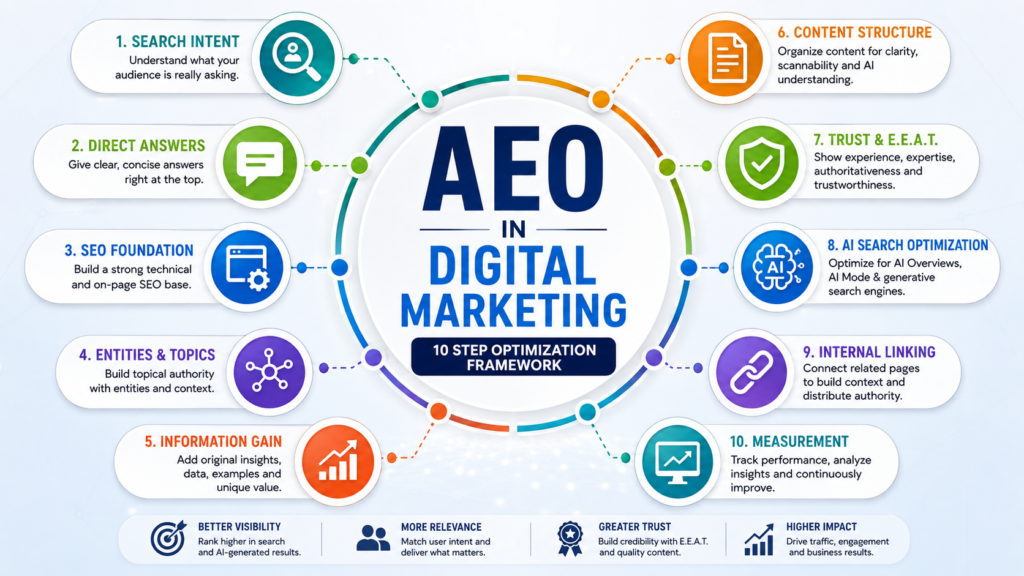
Table of Contents
Answer Engine Optimization, or AEO, is the practice of making useful website content easier for search andAI-poweredd answer systems to understand, retrieve, and surface when responding to relevant questions. In digital marketing, AEO builds on SEO through direct answers, strong topical context, reliable evidence, clear structure, and original information.
AEO does not replace SEO. For Google Search, foundational SEO remains essential for visibility in traditional results as well as generative AI experiences such as AI Overviews and AI Mode.
This practical guide explains how to use AEO in digital marketing through a 10-step process covering search intent, content optimization, information gain, entity relationships, technical SEO, structured data, E.E.A.T., internal linking, AI search visibility, and performance measurement.
If you are completely new to Answer Engine Optimization, start with our complete AEO basics guide to understand the core concepts first. This article focuses specifically on how to use AEO in digital marketing through a practical implementation process, rather than repeating beginner-level definitions.
Reading time: Approximately 92 minutes
Difficulty: Intermediate
Process: 10 steps
Best for: Digital marketers, website owners, SEO professionals, bloggers, small businesses, ecommerce websites, SaaS businesses, and content publishers
Quick Answer: How Do You Use AEO in Digital Marketing?
To use AEO in digital marketing, identify the questions your audience actually asks, understand their search intent, answer important questions directly, support those answers with evidence and original information, strengthen technical SEO, connect relevant entities and topics, implement appropriate structured data, build trustworthy author and source signals, create useful internal links, and measure search and AI visibility over time.
The objective is not to write for an AI system.
The objective is to create an exceptionally useful source that people can understand and search systems can discover, interpret, retrieve, and potentially surface.
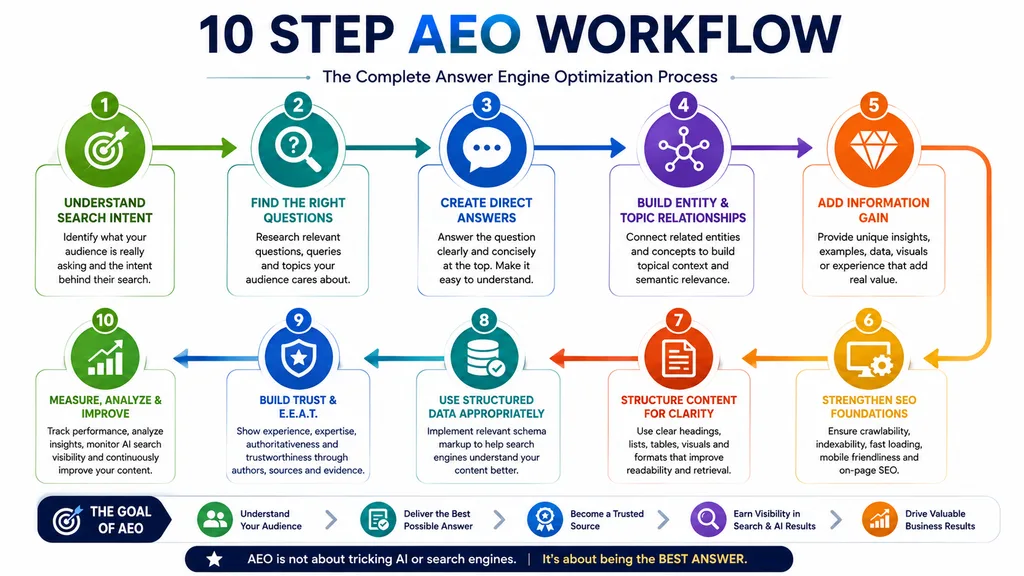
The 10 Step AEO Process at a Glance
| Step | Action | Primary Outcome |
|---|---|---|
| 1 | Understand AEO | Establish the correct strategy |
| 2 | Identify search intent | Match content with user needs |
| 3 | Provide direct answers | Improve clarity and answer readiness |
| 4 | Build entity relationships | Strengthen topical context |
| 5 | Add information gain | Differentiate the page |
| 6 | Strengthen SEO foundations | Maintain search eligibility |
| 7 | Structure content clearly | Improve usability and retrieval |
| 8 | Use structured data appropriately | Clarify supported page information |
| 9 | Strengthen evidence and trust | Improve credibility |
| 10 | Build contextual internal links | Develop topical architecture |
Time and Difficulty
A basic AEO audit of one important page can often be completed in approximately 60 to 120 minutes, depending on the complexity of the page.
A complete website-level AEO strategy takes considerably longer because content quality, technical SEO, internal linking, topical coverage, evidence, multimedia, authority, and ongoing measurement may all require attention.
Difficulty: Intermediate.
You do not need advanced programming skills. Familiarity with SEO, website editing, content marketing, analytics, and Google Search Console is useful.
Requirements Before Starting AEO
Prepare the following before beginning:
- A crawlable and indexable website.
- Access to your content management system.
- Google Search Console.
- Web analytics where available.
- A clearly defined audience.
- Search intent and topic research.
- Existing content inventory.
- Relevant internal pages.
- Reliable primary or authoritative sources.
- Original screenshots, examples, tests, data, or professional experience where available.
- A process for reviewing and updating important content.
Paid keyword research and SEO platforms can provide useful additional data, but they are not required to understand or implement the core AEO process.
The most important requirement is the ability to provide information that genuinely improves the user’s understanding or decision.
Step 1. Audit Your Current Search and AEO Baseline
Before changing your content for AEO, establish a baseline. You need to know how the page currently performs so you can evaluate whether future changes are associated with meaningful improvements.
Start with one important page rather than trying to optimize your entire website at once.
Record its current:
- Google Search impressions
- Organic clicks
- Click-through rate (CTR)
- Average search position
- Queries generating impressions
- Indexed status
- Internal links pointing to the page
- Current title and meta description
- Main headings and content structure
- Conversions or qualified leads, where measurable
- Generative AI search visibility, where reliable data is available
Use Google Search Console to document the page’s existing organic search performance. If analytics and conversion tracking are configured, record those results as well.
Create a Before-Optimization Record
Save the baseline in a spreadsheet or document with the date of measurement.
For example:
| Metric | Before AEO Optimization |
|---|---|
| Search impressions | Record current data |
| Organic clicks | Record current data |
| CTR | Record current data |
| Average position | Record current data |
| Relevant queries | Record current data |
| Indexed status | Yes / No |
| Qualified leads | Record if available |
| Generative AI visibility | Record only where reliably measurable |
Take original screenshots of important Search Console reports where appropriate. These can later support a transparent before-and-after comparison.
Do not invent baseline numbers if the page is new or does not yet have enough data. Mark unavailable metrics as “Not enough data yet” and begin collecting them from the publication or optimization date.
The purpose of this first step is simple:
Measure before you optimize.
Without a documented baseline, it becomes much harder to determine whether subsequent AEO, SEO, content, or technical changes were associated with improved performance.
Step 2. Map Search Intent and Define One Primary Page Purpose
Before optimizing a page for AEO, define exactly what the searcher is trying to accomplish.
Do not begin by asking:
“How many keywords can I target on this page?”
Instead, ask:
“What is the primary problem this page should solve?”
A page becomes easier to structure when it has one clearly defined dominant intent.
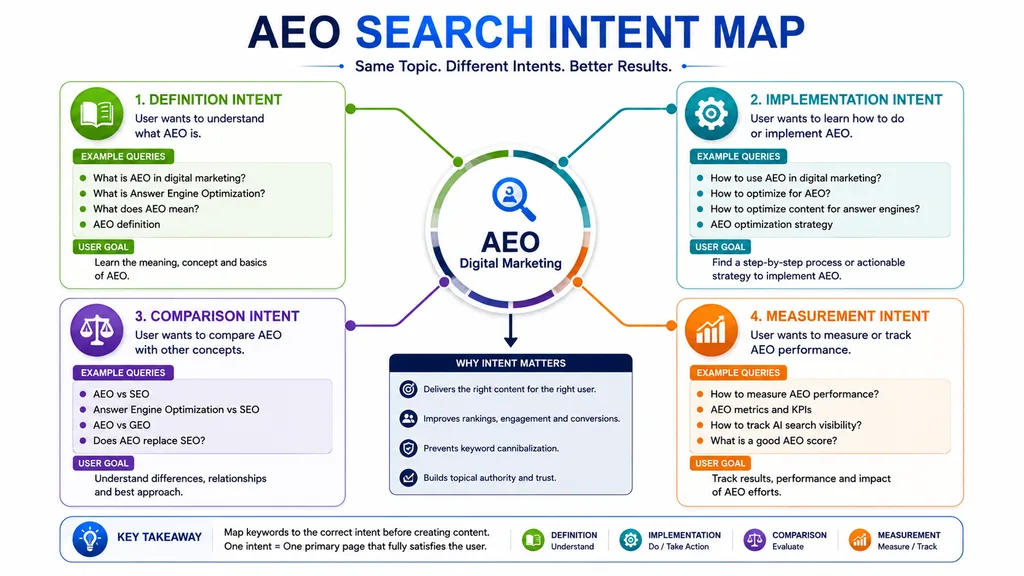
For example, AEO-related searches can represent very different needs:
| Search Query | Likely Intent | Recommended Page Purpose |
|---|---|---|
| what is AEO in digital marketing | Definition | Explain AEO clearly |
| how to use AEO in digital marketing | Implementation | Provide a practical process |
| AEO vs SEO | Comparison | Compare the two approaches |
| AEO checklist | Task completion | Provide an actionable checklist |
| AEO tools | Commercial investigation | Help users evaluate tools |
| How to measure AEO performance | Measurement | Explain metrics and methodology |
These queries belong to the same broader topic, but they should not automatically be treated as the same search intent.
Create an Intent Map Before Writing
For the page you want to optimize, record:
Primary query:
The main search need the page should satisfy.
Dominant intent:
Definition, implementation, comparison, evaluation, troubleshooting, measurement, or another clearly identified purpose.
Primary audience:
Who is searching and what level of knowledge are they likely to have?
Main problem:
What should the visitor be able to understand, decide, or accomplish after reading the page?
Supporting questions:
Which closely related questions help complete that task?
Topics that belong elsewhere:
Which questions have sufficiently different intent to justify another page?
For this guide, the intent map would look like this:
Primary query: how to use AEO in digital marketing
Dominant intent: implementation
Primary audience: digital marketers, website owners, content publishers, SEO professionals, and businesses implementing AEO
Main outcome: the reader should be able to apply an AEO workflow to an actual webpage
Supporting topics: search intent, direct answers, information gain, entities, technical SEO, evidence, internal linking, structured data, and measurement
Separate intents: beginner definitions, detailed AEO vs SEO comparisons, dedicated tool reviews, and other topics that deserve their own focused resources
Avoid Creating Multiple Pages for the Same Intent
Do not create a separate article for every keyword variation.
For example, these searches may often represent substantially similar implementation intent:
- how to use AEO
- how to implement AEO
- how to optimize for AEO
- AEO optimization process
Instead of publishing several repetitive articles, consider creating one authoritative implementation resource that naturally addresses these variations.
Create another URL only when the new page serves a meaningfully different audience need.
This approach helps reduce unnecessary content duplication and keyword cannibalization while creating a clearer topical architecture.
Build the Page Around the Intended Outcome
Once the dominant intent is established, evaluate every planned section against one question:
“Does this section help the reader complete the primary task?”
If the answer is yes, keep and strengthen it.
If the section mainly serves a different search intent, summarize it and direct readers to a more appropriate supporting resource.
For this article, that means prioritizing implementation over lengthy beginner definitions.
The page should teach readers how to apply AEO—not simply explain what AEO means.
Step 3. Use an Answer-First Content Structure
Once you know the page’s primary intent, structure important sections so readers can understand the essential answer quickly.
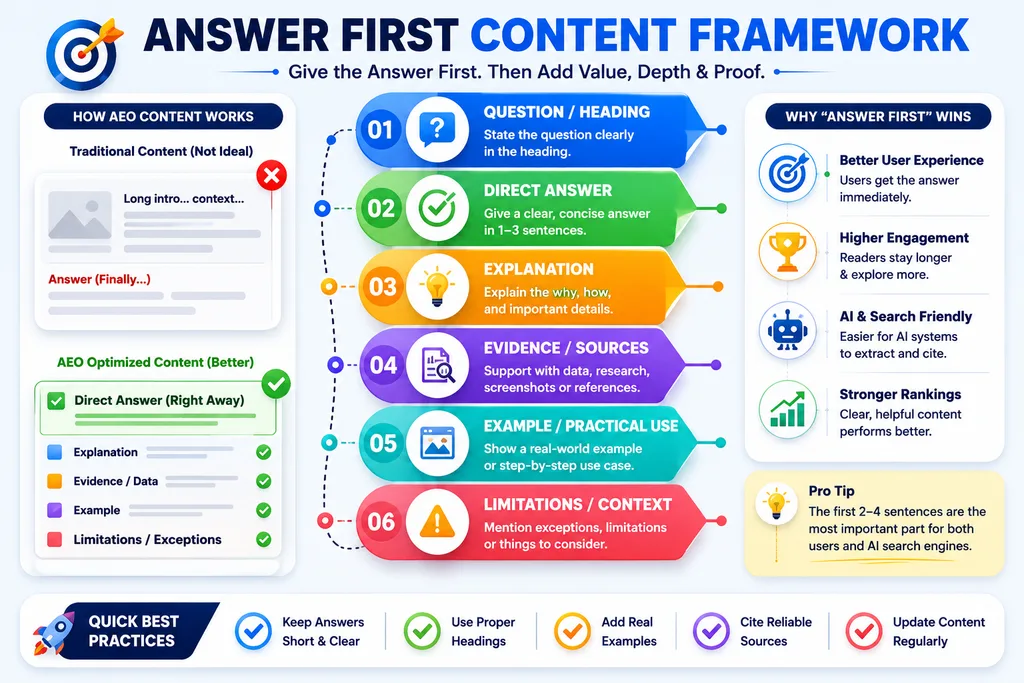
A practical AEO section often follows this pattern:
Question or descriptive heading → direct answer → explanation → evidence → next action
The goal is not to make every answer extremely short. The goal is to make the main point easy to identify before adding the depth required to support it.
Start With the Direct Answer
When a heading represents a clear question or task, answer it as early as possible.
For example:
How Do You Optimize a Page for AEO?
To optimize a page for AEO, identify its primary search intent, provide a clear answer near the beginning of the relevant section, support important claims with reliable evidence, improve technical search eligibility, use structured data where appropriate, strengthen entity clarity, and measure the results over time.
After providing that direct answer, expand on each component where additional explanation is useful.
This creates a clearer hierarchy:
- Direct answer — gives the reader the essential information.
- Explanation — adds context and reasoning.
- Evidence — supports factual or consequential claims.
- Example — demonstrates how the recommendation works.
- Next action — helps the reader apply the information.
Match the Format to the Question
Different questions require different answer formats.
Use:
- Short paragraphs for definitions and direct explanations.
- Numbered steps for processes.
- Bullet points for requirements, features, or checklists.
- Tables for meaningful comparisons.
- Examples when a concept may otherwise remain abstract.
- Original screenshots or diagrams when visual evidence improves understanding.
Do not force every section into the same format simply because a particular structure is associated with SEO or AEO.
Choose the format that communicates the answer most clearly.
Keep the Answer and Its Evidence Close Together
If a statement requires evidence, place the supporting source, data, screenshot, test result, or explanation close to the claim.
For example, instead of writing:
“This AEO change will increase your AI visibility.”
use a more defensible formulation:
“This change can make the page clearer and easier to interpret, but inclusion or citation in generative search experiences is not guaranteed.”
Then explain what was changed and how you plan to measure the result.
This distinction matters because AEO should improve content quality and machine interpretability without making guarantees that cannot be independently verified.
Avoid Writing for Extraction Alone
Answer-first writing does not mean producing dozens of disconnected one-sentence answers.
A page still needs:
- context,
- reasoning,
- supporting evidence,
- useful examples,
- clear transitions,
- and enough depth to satisfy the reader’s actual task.
The direct answer should act as the entry point to the explanation—not as a replacement for useful content.
Practical Answer-First Template
For important sections, use this reusable structure:
H2 or H3: State the question or task clearly.
Direct answer: Answer the question immediately in one concise paragraph where appropriate.
Explanation: Explain how or why the answer applies.
Evidence: Add reliable sources, original data, screenshots, or first-hand observations where needed.
Example: Demonstrate the concept with a realistic example.
Action: Tell the reader what to do next when the query has an actionable outcome.
This structure improves readability for human visitors while also making the relationship between a question, its answer, and its supporting information clearer.
Use Self-Contained Answer Blocks
For important questions, try this editorial structure:
Question or descriptive heading
Direct answer: Two to four concise sentences.
Explanation: Why the answer is correct or useful.
Evidence: Primary source, original data, screenshot, experiment, or reliable reference.
Example: Demonstrate the principle.
Limitation: Explain exceptions where necessary.
Do not force every paragraph into this format. Use it where it improves comprehension.
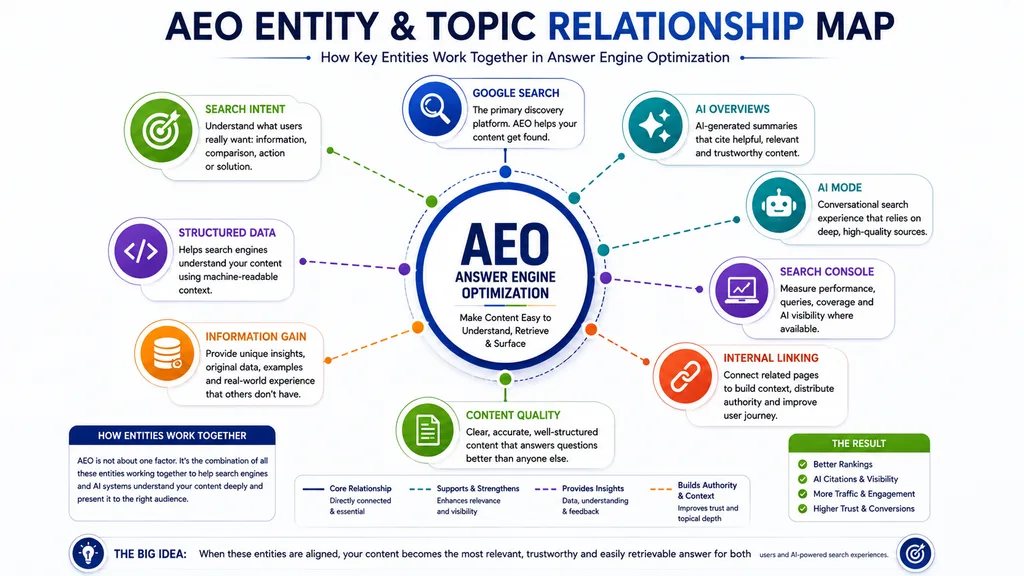
Step 4. Strengthen Entity Clarity and Relationships
After structuring your answers clearly, review whether the people, organizations, products, services, places, tools, and concepts mentioned on the page are easy to identify and understand.
In practical AEO, entity optimization is not about repeating names unnaturally. It is about reducing ambiguity and making important relationships explicit.
Identify the Main Entities on the Page
Start by listing the entities that are essential to the topic.
Depending on the page, these may include:
- your business or organization,
- the author,
- products or services,
- software or platforms,
- locations,
- industry terms,
- standards or frameworks,
- and authoritative organizations referenced as sources.
Then ask:
Would a reader unfamiliar with this page understand what each important entity is and how it relates to the topic?
If not, add the missing context.
Replace Ambiguous References With Clear Context
Avoid assuming that readers—or search systems—already understand every abbreviation, brand, organization, or technical term.
For example, instead of introducing an acronym without context:
“GSC can help you measure search performance.”
write:
“Google Search Console (GSC) can help you measure organic search impressions, clicks, queries, and other search-performance data.”
After the entity has been clearly introduced, using the abbreviation naturally is fine.
The objective is clarity, not repetition.
Make Relationships Explicit
Important entities should not appear as isolated names.
Explain their relationship to the topic.
For example:
Google Search Console → search-performance measurement
Schema.org vocabulary → structured data
Google Search → organic search visibility
AEO → answer-oriented content and search optimization
Your organization → publisher or service provider
Author → creator or reviewer of the content
These relationships provide more useful context than simply mentioning the entities repeatedly.
Check Entity Consistency Across the Website
Important business and author information should also be consistent across relevant pages.
Review:
- organization name,
- author name,
- author biography,
- service names,
- location information where relevant,
- About page information,
- Contact page information,
- author profile pages,
- and corresponding structured data.
Do not create false credentials, fake expertise, fabricated locations, or unsupported organizational relationships simply to make an entity appear more authoritative.
Entity clarity should reflect real information.
Connect Entities With Relevant Internal Links
When an entity has a useful dedicated page on your website, link to it contextually.
For example:
- a service mention can link to the relevant service page,
- an author name can link to a genuine author profile,
- a methodology can link to its detailed guide,
- and a related AEO concept can link to the appropriate supporting article.
Do not link every repeated mention.
Add an internal link where it genuinely helps the reader understand or explore the entity.
Use External Sources Where They Add Verification
For standards, official product features, technical requirements, statistics, regulations, or other verifiable claims, prefer authoritative primary sources where practical.
An external citation should support a claim or help the reader verify it.
It should not be added merely to increase the number of outbound links.
Align Visible Content and Structured Data
Where structured data is appropriate, the entities represented in the markup should accurately reflect the visible page.
For example, if Article structured data identifies an author and publisher, those relationships should correspond with information users can actually see or verify on the website.
Structured data should describe real page content rather than introduce claims that the page itself does not support.
Practical Entity Audit
Before moving to the next step, check the page for these questions:
- Is the primary organization clearly identified?
- Is the author clearly identified where authorship is relevant?
- Are important acronyms explained on first meaningful use?
- Are products, services, tools, and concepts described clearly enough to remove ambiguity?
- Are important relationships between entities explicit?
- Are relevant internal links available?
- Are factual claims connected to appropriate authoritative sources?
- Does structured data accurately represent visible content?
- Is important entity information consistent across the website?
Fix genuine ambiguities first.
Do not turn entity optimization into keyword stuffing or unnecessary repetition.
The goal is to make the page’s people, organizations, concepts, and relationships understandable, consistent, and verifiable.
Step 5. Add Original Information Gain, Not Just More Words
AEO content should do more than reorganize information that already appears across dozens of competing pages.
Before expanding an article, ask:
“What useful information can this page contribute that a reader cannot easily get from every other result?”
The answer may come from original experience, testing, analysis, examples, screenshots, data, frameworks, templates, or a clearer synthesis of reliable evidence.
The objective is not simply to make the article longer.
The objective is to make it more useful.
Audit the Existing Search Results First
Before writing or substantially updating an important page, review the leading results for the primary query.
Record:
- questions competitors already answer,
- recurring recommendations,
- commonly cited sources,
- examples they provide,
- important subtopics they overlook,
- claims that lack supporting evidence,
- outdated information,
- and areas where the explanations remain vague.
Do not copy competitor wording, structure, tables, or examples.
Use the review to understand what information is already widely available and where your page can contribute something genuinely useful.
Look for an Information Gap
An information gap exists when the reader still has an important unanswered question after reviewing the existing material.
For example, many AEO articles may explain that content should provide clear answers.
A more useful implementation guide could go further by showing:
- how to map a query to its dominant intent,
- how to record a pre-optimization baseline,
- how to structure an answer-first section,
- how to audit entity clarity,
- how to document an AEO experiment,
- and how to measure the outcome after implementation.
That additional practical layer creates more value than simply repeating another definition of AEO.
Add First-Hand Evidence Where Possible
Original information can come from your own legitimate work.
Useful examples include:
- original screenshots,
- anonymized Search Console observations,
- website audit findings,
- controlled content experiments,
- original comparison tables,
- implementation notes,
- before-and-after page structures,
- custom diagrams,
- and documented lessons from real projects.
If you publish first-hand observations, explain enough of the methodology for readers to understand what was actually tested or observed.
Do not present assumptions as experimental results.
Create Original Frameworks
A useful framework can also provide information gain when it organizes a complex task in a genuinely practical way.
For example, this guide uses an implementation sequence that moves from:
baseline measurement → intent mapping → answer structure → entity clarity → information gain → technical eligibility → page structure → structured data → evidence → topical architecture → measurement
A framework is most useful when it helps the reader perform the task.
Simply renaming a commonly known process does not automatically make it original or valuable.
Use Original Visuals to Explain Complex Ideas
Custom diagrams, screenshots, workflows, decision trees, and comparison graphics can make difficult concepts easier to understand.
For every visual, ask:
“Does this image teach something that the surrounding text cannot communicate as efficiently?”
If the answer is no, the image may be decorative rather than useful.
Prioritize visuals that:
- explain a process,
- show relationships,
- demonstrate real interfaces,
- summarize original frameworks,
- compare meaningful alternatives,
- or document evidence.
Separate Evidence From Opinion
Not every useful observation requires an external citation, but readers should be able to distinguish between:
verified fact,
first-hand observation,
interpretation,
and
recommendation.
For example:
Verified fact: support it with an appropriate authoritative source.
First-hand observation: explain what you observed and under what conditions.
Interpretation: make clear that you are interpreting the available evidence.
Recommendation: explain why you recommend the action rather than presenting it as a universal rule.
This distinction strengthens credibility and reduces unsupported claims.
Do Not Manufacture Information Gain
Avoid creating artificial originality through:
- invented statistics,
- fabricated case studies,
- fake customer results,
- unsupported percentages,
- fictional experiments presented as real,
- made-up expert quotes,
- or AI-generated claims presented as first-hand experience.
If original data is unavailable, say so.
A transparent synthesis of reliable information is more useful than fabricated evidence.
Practical Information-Gain Test
Before publishing an important article, answer these questions:
- What does this page explain better than competing pages?
- What original example, framework, screenshot, analysis, or evidence does it provide?
- Which important reader question does it answer that competing pages often leave unresolved?
- Can factual claims be verified?
- Can first-hand claims be demonstrated?
- Have unnecessary repetitions been removed?
- Would the page still be useful if search engines did not exist?
If you cannot identify a meaningful advantage, do not solve the problem by adding another 1,000 generic words.
Improve the substance instead.
Information Gain Example for This AEO Guide
For this article, information gain should come from implementation assets such as:
- a documented AEO baseline template,
- an intent-mapping framework,
- an answer-first content model,
- an entity-audit process,
- an original AEO experiment framework,
- a measurement model,
- and custom diagrams that explain each stage.
These elements give the reader something practical to apply rather than another generic explanation of Answer Engine Optimization.
The goal is not maximum word count. The goal is maximum useful information per section.
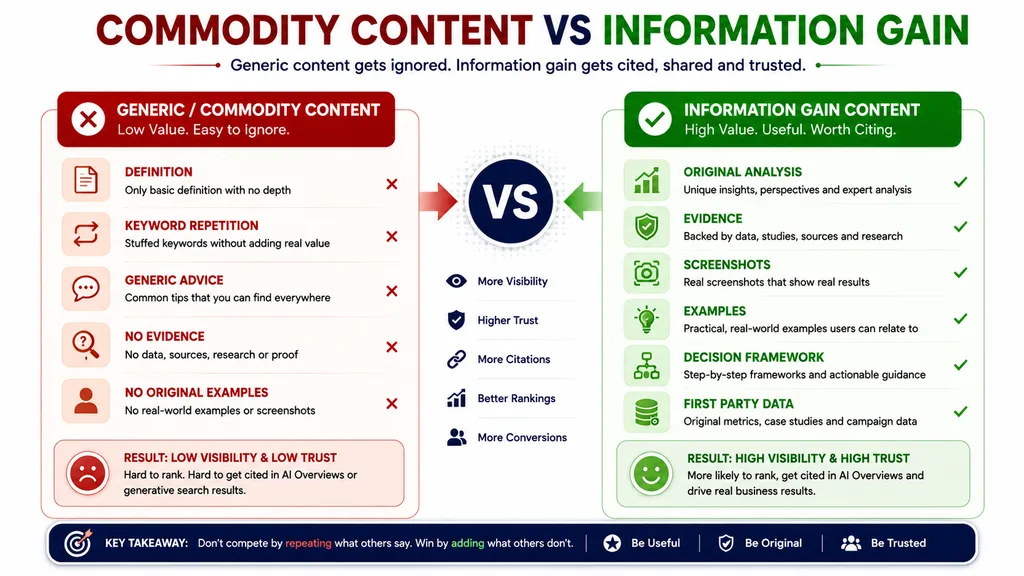
Commodity Content vs Information Gain
Commodity statement:
“AEO is important because AI is changing search.”
This tells the reader very little.
Higher value explanation:
“A practical AEO workflow begins with search intent rather than keyword repetition. Identify the question, answer it directly, support the answer with evidence, connect related concepts, provide original information where possible, and ensure the page remains technically eligible for organic search.”
The second version gives the reader an actionable model.
Information Gain Rule
Never fabricate:
Campaigns.
Clients.
Search traffic.
Conversions.
Revenue.
Certifications.
Experiments.
Screenshots.
Professional experience.
Case study results.
If original evidence is unavailable, state what evidence should be collected instead of pretending that it exists.
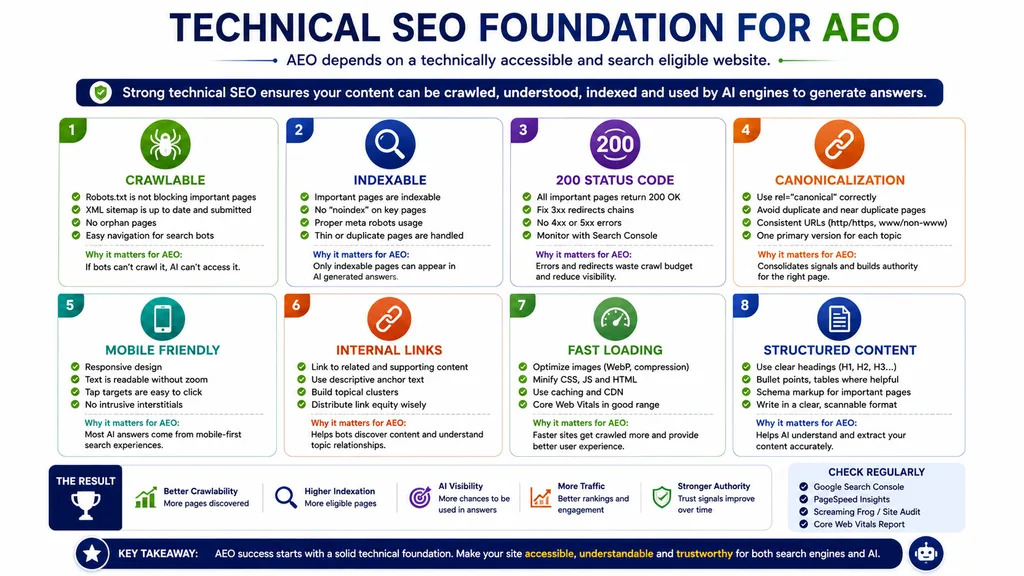
Step 6. Verify Technical Search Eligibility Before AEO Optimization
Clear answers and useful content cannot compensate for a page that search engines cannot reliably crawl, index, render, or understand.
Before spending more time on advanced AEO improvements, verify that the page has a sound technical search foundation.
AEO should therefore be implemented on top of technical SEO—not instead of it.
Check Whether the Page Can Be Crawled and Indexed
Start with the basics.
Confirm that:
- the page returns the expected HTTP status,
- important content is accessible to search crawlers,
- the page is not unintentionally blocked by robots directives,
- a
noindexdirective has not been added by mistake, - the canonical URL points to the intended version,
- the page is internally linked from relevant parts of the website,
- and the URL is included in the appropriate XML sitemap where applicable.
For an important page, inspect the URL in Google Search Console and verify its indexing status.
If the page is not indexed, investigate the underlying reason before assuming that additional AEO formatting will solve the problem.
Confirm the Correct Canonical Version
Duplicate and near-duplicate URLs can create unnecessary ambiguity.
Check for variations caused by:
- HTTP and HTTPS,
- www and non-www versions,
- URL parameters,
- trailing-slash inconsistencies,
- category or tag archives,
- pagination,
- duplicate content paths,
- and accidental copies of the same article.
The canonical setup should accurately represent the preferred URL.
Do not use canonical tags to hide a weak content architecture. If two pages target substantially the same intent, evaluate whether they should be differentiated, consolidated, redirected, or otherwise reorganized.
Make Important Content Accessible
The primary answer and supporting content should be available in a form that can be reliably rendered and understood.
Avoid placing essential information exclusively inside:
- images,
- decorative graphics,
- inaccessible interface elements,
- or interactions that unnecessarily hide the main content.
Visuals can support the answer, but the essential information should also be available as meaningful page content where appropriate.
Review Mobile Usability and Page Experience
Test the page on a mobile device or responsive preview.
Check:
- readable text,
- usable navigation,
- appropriate spacing,
- responsive tables,
- image scaling,
- intrusive overlays,
- layout shifts,
- and whether important content remains easy to access on a smaller screen.
A technically accessible page can still provide a poor experience if users struggle to read or interact with it.
Optimize Images Without Removing Their Value
Original diagrams and screenshots can strengthen an AEO resource, but they should not unnecessarily increase page weight.
For each important image:
- use an appropriate modern image format,
- compress the file reasonably,
- use descriptive filenames,
- provide useful alt text where the image conveys information,
- specify dimensions where appropriate,
- and avoid uploading unnecessarily oversized assets.
Do not stuff keywords into filenames or alt text.
Describe what the image actually communicates.
Strengthen Internal Discoverability
An important AEO page should not exist as an isolated URL.
Link to it from relevant pages using natural, descriptive anchor text.
Also use the page to link to related resources when those links help readers complete the task.
For example, an AEO implementation guide may connect naturally to:
- an AEO basics guide,
- an AEO vs SEO comparison,
- an AEO audit resource,
- an entity optimization guide,
- or a measurement guide.
The objective is to create a logical topic structure rather than adding internal links merely to reach an arbitrary number.
Check HTTPS and Basic Security
Important public pages should load through HTTPS without avoidable mixed-content problems.
Also check for obvious technical problems such as:
- broken resources,
- redirect loops,
- malformed internal links,
- and unavailable scripts or styles that prevent the page from functioning correctly.
These issues are not unique to AEO, but they can undermine the accessibility and reliability of the page you are trying to optimize.
Technical AEO Pre-Publish Check
Before moving forward, verify:
| Technical Check | Status |
|---|---|
| URL returns the intended status | Pass / Fix |
| Crawl access is intentional | Pass / Fix |
| Indexing directives are correct | Pass / Fix |
| Canonical URL is correct | Pass / Fix |
| HTTPS works correctly | Pass / Fix |
| Important content is accessible | Pass / Fix |
| Mobile layout is usable | Pass / Fix |
| Images are reasonably optimized | Pass / Fix |
| Relevant internal links exist | Pass / Fix |
| XML sitemap inclusion is appropriate | Pass / Fix |
| Important structured data can be processed | Pass / Fix |
If a critical item fails, fix it before treating the page as technically ready for AEO.
AEO Does Not Bypass Search Eligibility
Do not assume that special formatting, schema markup, an llms.txt file, or repeated mentions of target keywords can compensate for fundamental crawling, indexing, content-quality, or accessibility problems.
Technical SEO establishes the foundation.
AEO then improves how clearly, usefully, and credibly the page answers the intended questions.
Build eligibility first. Optimize usefulness second. Measure the outcome afterward.
Step 7. Build a Clear Page and Heading Structure
Once the individual answers are clear, organize the entire page so readers can quickly understand where information is located and how each section relates to the main topic.
This step is different from answer-first writing.
Answer-first structure improves individual sections.
Page structure organizes the complete resource.
A strong AEO page should have a logical hierarchy rather than a collection of loosely connected keyword sections.
Start With One Clear Primary Topic
The page should have one dominant purpose.
For this guide, that purpose is:
How to use AEO in digital marketing.
Every major section should contribute to that implementation goal.
Before adding another H2, ask:
“Does this section help the reader implement, evaluate, or measure AEO?”
If not, consider removing it, shortening it, or moving the topic to a more appropriate supporting article.
Create a Logical Heading Hierarchy
Use headings to represent the actual structure of the information.
A practical hierarchy is:
H1 → primary page topic
H2 → major stages or major questions
H3 → supporting tasks, explanations, or subquestions
H4 → use only when a genuine additional level is necessary
Do not choose heading levels because of how large or bold they look.
Use CSS and your WordPress theme for visual styling while keeping the document hierarchy logical.
Make Headings Descriptive
A heading should help readers predict what the section contains.
Instead of vague headings such as:
“Important Things to Know”
prefer descriptive headings such as:
“Verify Technical Search Eligibility Before AEO Optimization”
Descriptive headings improve scanning and make the relationship between sections clearer.
Do not force the exact target keyword into every heading.
Natural topical variation is preferable to repetitive keyword insertion.
Break Long Sections Into Useful Subsections
Large uninterrupted text blocks can make an implementation guide difficult to use.
When a section covers several distinct tasks, divide it into descriptive H3 subsections.
For example, a technical AEO section may include:
- crawl and index checks,
- canonical verification,
- mobile usability,
- image optimization,
- and internal discoverability.
Each subsection should exist because it represents a meaningful part of the task—not simply to increase the number of headings.
Use Lists for Scannable Requirements
Bulleted lists work well for:
- requirements,
- characteristics,
- common mistakes,
- examples,
- audit checks,
- and groups of related recommendations.
Numbered lists work best when:
- sequence matters,
- the reader needs to complete steps in order,
- or the list represents a defined process.
Avoid converting every paragraph into bullet points.
Some ideas require explanation and context.
Use Tables When Comparison Is the Real Task
Tables can make structured information easier to evaluate.
Use them for information such as:
- query → intent → page purpose,
- metric → measurement method,
- issue → diagnosis → action,
- before → after comparisons,
- or feature → use case comparisons.
Do not create a table simply because tables appear visually optimized.
If a normal paragraph communicates the information more clearly, use the paragraph.
Keep Important Information in Text
Custom graphics can strengthen the page, but important instructions should not exist only inside an image.
For example, if a diagram shows an AEO workflow, summarize or explain that workflow in the surrounding text as well.
This helps:
- readers using assistive technologies,
- visitors whose images do not load,
- mobile users,
- and systems interpreting the page’s textual content.
Use Multimedia When It Adds Evidence or Understanding
Add images, diagrams, screenshots, video, or other media when they improve the page.
Useful multimedia may:
- demonstrate a real process,
- document an interface,
- visualize a framework,
- show an original result,
- simplify a complex relationship,
- or help the reader complete a task.
Avoid adding generic decorative images between sections merely to increase visual content.
Every important visual should have a clear purpose.
Add a Useful Table of Contents for Long Guides
For a long implementation resource, a table of contents can help readers move directly to the section they need.
Use descriptive anchor links that correspond with the actual headings.
After major heading changes, verify that:
- table-of-contents links still work,
- anchor IDs point to the correct sections,
- deleted headings are removed from the TOC,
- and new important sections are included.
This is especially important when updating an existing article rather than publishing a new page.
Keep the Introduction Focused
A long guide does not need a long introduction.
The opening should quickly establish:
- what the article will help the reader accomplish,
- who the guide is for,
- what approach the guide follows,
- and what the reader should do next.
Move detailed definitions, history, comparisons, and side topics to relevant supporting resources when they are not essential to the implementation task.
Review the Complete Page Flow
After editing, read only the H1, H2, and H3 headings from top to bottom.
Ask whether they tell a coherent story without reading the body copy.
For this implementation guide, the early workflow should communicate a progression similar to:
Audit the baseline
↓
Map search intent
↓
Structure the answer
↓
Clarify entities
↓
Add information gain
↓
Verify technical eligibility
↓
Organize the page
If the heading sequence feels random, reorganize the article before adding more content.
Page-Structure Checklist
Before moving to the next AEO step, verify:
- One dominant page purpose is clear.
- The H1 accurately represents that purpose.
- H2 headings represent major sections or tasks.
- H3 headings logically support their parent H2.
- Headings are descriptive rather than keyword-stuffed.
- Long sections are divided where useful.
- Lists are used for genuinely scannable information.
- Tables are used where structured comparison helps.
- Important information is available as text.
- Multimedia has a genuine purpose.
- The table of contents matches the current article structure.
- The article progresses logically from one task to the next.
Good AEO structure should not make an article feel mechanical.
It should make a complex topic easier to navigate, understand, verify, and apply.
Step 8. Add Accurate Structured Data Where It Genuinely Applies
Structured data can help search systems understand specific information about a page in a standardized format.
However, schema markup should be treated as a way to describe eligible page content—not as a shortcut to AEO rankings, AI citations, featured answers, or generative search visibility.
Use structured data only when it accurately represents content that genuinely exists on the page.
Start With the Actual Page Type
Before adding schema, identify what the page really is.
Depending on the website and content, relevant structured data may include:
- Article,
- BlogPosting,
- Organization,
- Person,
- BreadcrumbList,
- Product,
- LocalBusiness,
- Event,
- VideoObject,
- or other applicable types.
Do not select a schema type simply because you believe it may provide an SEO advantage.
The markup should accurately describe the page and its visible content.
Keep Article Information Consistent
For an editorial guide such as this one, review important article-related properties where applicable, including:
- headline,
- author,
- date published,
- date modified,
- image,
- publisher,
- and canonical page information.
These details should correspond with the information available on the actual page and website.
For example, if the structured data identifies a particular author, the page should not attribute the article to someone else.
Connect Real Authors and Organizations
Where appropriate, structured data can help describe relationships between the article, its author, and its publisher.
Those entities should be genuine and verifiable.
Make sure relevant information is consistent across:
- the article,
- author profile,
- About page,
- organization information,
- and structured data.
Do not create fake author credentials, awards, expertise, organizations, locations, or professional relationships for schema markup.
Structured data should represent reality.
Use Breadcrumb Markup Where Appropriate
If your website uses a meaningful breadcrumb hierarchy, BreadcrumbList structured data can describe that navigation structure.
For example:
Home → Blog → AEO → How to Use AEO in Digital Marketing
The visible site architecture and structured data should remain consistent.
Do not create artificial breadcrumb categories solely to insert additional keywords.
Be Careful With FAQ Content and FAQ Markup
An article can contain a useful FAQ section when those questions genuinely help readers.
However, the presence of questions and answers does not mean you should automatically add FAQ structured data or expect a special search appearance.
Treat FAQ content primarily as a user-helpfulness decision.
If you use any structured data type, verify that the page meets the current requirements and that the markup accurately reflects the visible content.
Do Not Add Schema for Invisible Content
Avoid adding structured data for information that users cannot find on the page.
For example, do not mark up:
- reviews that are not actually displayed,
- ratings that do not exist,
- products the page does not offer,
- fictional FAQs,
- fake authors,
- fabricated prices,
- unsupported business information,
- or services that are not genuinely provided.
Markup should describe the content—not manufacture it.
Validate the Implementation
After adding or changing structured data:
- Test the relevant markup with an appropriate validation tool.
- Review syntax errors and warnings.
- Confirm that important properties contain the intended information.
- Compare the markup with the visible page.
- Check that author, publisher, URLs, images, dates, and other important entities are accurate.
- Re-test after major theme, SEO-plugin, or template changes.
A technically valid schema implementation can still be misleading if the information itself is inaccurate.
Validation therefore requires both:
technical correctness
and
content accuracy.
Avoid Duplicate or Conflicting Schema
WordPress themes and SEO plugins may already generate structured data automatically.
Before adding custom schema, inspect what the page currently outputs.
Check whether:
- your SEO plugin generates Article markup,
- the theme adds its own schema,
- another plugin creates Organization or Breadcrumb markup,
- or custom code duplicates existing entities.
Do not add another schema block simply because more markup appears better.
Conflicting or unnecessarily duplicated structured data can make the implementation harder to maintain.
Structured Data Is Not an AI Citation Guarantee
This distinction is important for AEO.
Do not claim:
“Add schema and your content will be cited by AI.”
A more accurate implementation principle is:
Use structured data to describe applicable page information clearly and consistently while continuing to focus on search eligibility, useful content, evidence, entity clarity, and overall page quality.
Structured data is one component of the implementation—not the complete AEO strategy.
Practical Structured Data Audit
Before publishing, check:
| Structured Data Check | Status |
|---|---|
| Schema matches the actual page type | Pass / Fix |
| Markup represents visible content | Pass / Fix |
| Author information is accurate | Pass / Fix |
| Publisher information is accurate | Pass / Fix |
| Dates are accurate | Pass / Fix |
| URLs and images are correct | Pass / Fix |
| Breadcrumb hierarchy is genuine | Pass / Fix |
| Existing plugin/theme schema was checked | Pass / Fix |
| Duplicate or conflicting markup was reviewed | Pass / Fix |
| Relevant markup was validated | Pass / Fix |
Do not judge the quality of an AEO page by the number of schema types it contains.
Use the minimum structured data needed to describe the real content accurately and maintain it correctly over time.
Step 9. Support Important Claims With Evidence and Clear Attribution
AEO content becomes more useful when important claims are easy to verify.
Do not add citations simply to make an article look authoritative. Identify which statements actually require evidence, use the strongest practical source for each claim, and clearly distinguish external facts from your own observations, interpretations, and recommendations.
A useful workflow is:
Claim → Evidence → Source → Attribution → Reader Verification
Identify Claims That Need Evidence
Not every sentence requires a citation.
Prioritize evidence for claims involving:
- statistics,
- research findings,
- product capabilities,
- search-engine requirements,
- technical specifications,
- policy statements,
- regulatory requirements,
- dates and announcements,
- pricing,
- performance claims,
- and other factual statements that readers may reasonably want to verify.
The more consequential or specific the claim, the stronger the supporting evidence should be.
Prefer Primary Sources Where Practical
When explaining how a search platform, standard, tool, or technology works, look for authoritative first-party documentation before relying on secondary commentary.
Depending on the claim, useful primary sources may include:
- official documentation,
- official help centers,
- standards organizations,
- original research,
- government or regulatory publications,
- company documentation for product-specific facts,
- and your own documented first-hand evidence for claims about your work.
Secondary sources can still be useful for analysis, interpretation, industry context, or independent evaluation.
The source should match the type of claim being made.
Keep Sources Close to the Claims They Support
Do not place a large collection of references at the bottom of an article without making it clear which claims they support.
Where practical, place the citation or contextual link close to the relevant statement.
For example:
Claim: A particular search feature has specific eligibility requirements.
Evidence: Link to the official documentation describing those requirements.
This makes verification easier for the reader.
Distinguish Facts From Recommendations
A recommendation should not be presented as though it were an official search-engine requirement.
For example:
Fact: A documented technical requirement can be verified through an official source.
Recommendation: “We recommend recording a pre-optimization baseline before making major AEO changes.”
The second statement may be a useful methodology, but it should not be described as an official requirement unless an authoritative source explicitly establishes it as one.
Use language that preserves this distinction.
Separate First-Hand Experience From General Claims
First-hand experience can strengthen an article when it is genuine and relevant.
If you tested a page, audited a website, changed a content structure, or measured performance, explain:
- what you changed,
- when you changed it,
- what you measured,
- which tools were used,
- how long the observation period lasted,
- and what limitations affected the result.
Do not turn a single observation into a universal rule.
For example:
Weak claim:
“Answer-first formatting increases rankings.”
Better first-hand reporting:
“After restructuring the tested page, we monitored its search performance over the defined observation period. The results should be interpreted as an observation from this test rather than proof that the same change will produce identical results on every website.”
This is more transparent and useful.
Document Original Experiments Properly
If this article eventually includes an AEO experiment, create a simple methodology record.
Document:
| Experiment Element | What to Record |
|---|---|
| Page tested | Exact URL |
| Baseline date | Date before changes |
| Change date | Date optimization was implemented |
| Changes made | Exact content or technical changes |
| Search queries | Queries being monitored |
| Search metrics | Impressions, clicks, CTR, and position where relevant |
| AI visibility observations | Record only where reliably observable |
| Observation period | Defined time range |
| Other major changes | Site, algorithm, technical or promotional changes |
| Result | What actually happened |
| Limitations | What the experiment cannot prove |
Do not publish fictional numbers simply to complete the table.
If the experiment is still running, label it accordingly.
Use Screenshots as Evidence Carefully
Original screenshots can support first-hand observations, tutorials, and implementation examples.
When using a screenshot:
- make sure it genuinely belongs to the described test or process,
- show enough context for the image to be meaningful,
- remove or obscure private information where necessary,
- add the relevant date when timing matters,
- explain what the reader should notice,
- and avoid manipulating the screenshot in a way that changes its meaning.
A screenshot is supporting evidence—not automatic proof of causation.
Strengthen Author Transparency
Readers should be able to understand who created or reviewed important content.
Where appropriate, provide:
- a real author name,
- a useful author biography,
- relevant experience,
- areas of expertise,
- links to genuine author information,
- publication date,
- and meaningful update information.
Do not manufacture credentials to make an article appear more authoritative.
If an article was substantially updated, make sure the modification date reflects a genuine meaningful update rather than changing automatically without substantive revisions.
Strengthen Publisher Transparency
The website itself should make important organizational information easy to find.
Depending on the type of site, this may include:
- About information,
- Contact information,
- editorial standards,
- correction practices,
- privacy information,
- terms or relevant policies,
- and clear descriptions of services or commercial relationships.
For affiliate or sponsored content, use appropriate disclosures.
Transparency is especially important when commercial interests could influence a recommendation.
Treat E-E-A-T as a Quality Framework, Not a Score
Do not write content as though E-E-A-T were a plugin score that can be increased by adding a biography, several external links, and an author box.
Instead, evaluate whether the page demonstrates appropriate:
Experience — genuine first-hand involvement where relevant.
Expertise — sufficient knowledge to explain the subject accurately.
Authoritativeness — credible recognition, sourcing, or topical depth where relevant.
Trust — accurate claims, transparent authorship, reliable sourcing, clear disclosures, and honest limitations.
Trust should remain the priority.
Avoid Unsupported AEO Guarantees
Be particularly careful with claims about AI-generated search experiences.
Avoid statements such as:
- “This guarantees an AI citation.”
- “Schema will make ChatGPT recommend your website.”
- “AEO guarantees Google AI Overview rankings.”
- “Following these steps will get your site cited by AI.”
Use appropriately qualified language instead.
For example:
“These practices can improve the clarity, usefulness, technical accessibility, and evidentiary quality of a page, but inclusion, ranking, citation, or selection by a search or generative system is not guaranteed.”
This protects the accuracy of the article while setting realistic expectations.
Run a Claim-Level Evidence Audit
Before publishing, review the article sentence by sentence and classify important claims as:
A. Externally verifiable fact
Add an appropriate source where needed.
B. First-hand observation
Provide methodology or supporting evidence.
C. Interpretation
Explain the reasoning and avoid presenting it as settled fact.
D. Recommendation
Make clear that it is practical guidance rather than an official requirement.
E. Common explanatory statement
A citation may not be necessary unless additional verification would materially help the reader.
This process is more useful than adding arbitrary external links throughout the article.
Final Evidence Checklist
Before considering the page publication-ready, verify:
- Important factual claims can be checked.
- Primary sources are used where practical.
- Citations appear close to the claims they support.
- Recommendations are not presented as official requirements.
- First-hand observations are labeled appropriately.
- Experiments include enough methodology to be understood.
- Screenshots are genuine and relevant.
- Author information is accurate.
- Publisher information is transparent.
- Commercial relationships are disclosed where necessary.
- Unsupported ranking or AI-citation guarantees have been removed.
- Limitations are acknowledged where they materially affect a conclusion.
A strong AEO resource should not merely sound confident.
It should make important claims understandable, attributable, and verifiable.
Step 10. Build an AEO Topic Cluster Without Creating Search-Intent Overlap
AEO should not be implemented by publishing a separate article for every keyword variation.
Instead, organize related topics into a deliberate content architecture in which each important page has a clearly defined purpose.
The objective is:
one dominant search intent → one primary URL
This does not mean a page can target only one keyword. A strong page can naturally satisfy many closely related queries when those queries represent substantially the same user need.
The problem begins when several URLs compete to satisfy the same dominant intent.
Define the Role of Every Important Page
Before creating another article, identify what role the new page will play in the topic cluster.
For an AEO content hub, the architecture might include:
| Page | Primary Purpose |
|---|---|
| AEO Basics Guide | Explain what AEO is and establish foundational concepts |
| How to Use AEO in Digital Marketing | Provide a practical implementation workflow |
| AEO vs SEO | Satisfy comparison intent |
| AEO for Small Businesses | Apply AEO to small-business needs and constraints |
| AEO for WordPress | Provide platform-specific implementation guidance |
| Local AEO Guide | Address local-business and location-based implementation |
| AEO Audit and Checklist | Help users evaluate an existing website |
| Best AEO Tools | Help readers evaluate relevant tools |
| AEO Measurement Guide | Explain how to monitor and evaluate AEO performance |
| AEO Services | Satisfy commercial service intent |
These pages belong to the same broader topic, but each should solve a meaningfully different problem.
Merge Keyword Variations That Share the Same Intent
Do not automatically create separate URLs for queries such as:
- how to use AEO,
- how to implement AEO,
- how to do AEO,
- AEO implementation guide,
- and AEO optimization process.
If the searcher behind these queries is essentially trying to complete the same task, one comprehensive implementation page may be the better content asset.
For example, this article can serve as the primary implementation resource for closely related “how to” AEO queries rather than creating several near-duplicate tutorials.
Separate Topics When the User’s Task Changes
A new page becomes easier to justify when the dominant user need changes.
For example:
“What is AEO?”
asks for understanding.
“How do I use AEO?”
asks for implementation.
“AEO vs SEO”
asks for comparison.
“How do I audit a website for AEO?”
asks for evaluation.
“What are the best AEO tools?”
asks for tool investigation.
“How much do AEO services cost?”
introduces commercial evaluation.
Although all of these queries relate to AEO, they do not necessarily require the same page.
Create a Primary URL for Each Intent Cluster
Maintain a simple content map before publishing.
For example:
| Intent Cluster | Primary URL Role | Supporting Variations |
|---|---|---|
| AEO definition | AEO Basics Guide | what is AEO, AEO meaning, AEO basics |
| AEO implementation | This guide | how to use AEO, implement AEO, AEO process |
| AEO comparison | AEO vs SEO | difference between AEO and SEO, SEO vs AEO |
| AEO audit | AEO Audit and Checklist | AEO audit, AEO checklist, audit website for AEO |
| AEO tools | Best AEO Tools | AEO software, tools for AEO |
| AEO measurement | AEO Measurement Guide | AEO metrics, AEO KPIs, measure AEO performance |
The exact keyword variations may change over time.
The important part is defining which URL owns the dominant intent.
Use Internal Links to Reinforce Page Relationships
Once the cluster is defined, connect related pages contextually.
For example:
AEO Basics Guide → How to Use AEO in Digital Marketing
A reader who understands the definition can continue to the implementation process.
How to Use AEO in Digital Marketing → AEO Basics Guide
A beginner who needs more foundational explanation can move to the basics resource.
How to Use AEO in Digital Marketing → AEO vs SEO
A reader who needs a detailed comparison can move to the dedicated comparison page instead of requiring this implementation guide to repeat the entire discussion.
How to Use AEO in Digital Marketing → AEO Audit and Checklist
A reader who wants to evaluate an existing site can move from implementation guidance to a dedicated audit workflow.
Internal links should help users move between different tasks in the topic cluster.
Do not add links merely to manipulate anchor-text frequency.
Use Descriptive but Natural Anchor Text
Internal anchor text should indicate what readers will find after clicking.
Useful examples include:
- AEO basics guide
- AEO vs SEO comparison
- AEO website audit
- AEO measurement guide
- AEO tools
- AEO for WordPress
Avoid forcing the same keyword-rich anchor text into every internal link.
Natural variation is appropriate when it remains descriptive.
Audit Existing Content Before Publishing a New URL
Before creating another AEO article, search your own website.
Check:
- existing article titles,
- URLs,
- H1 headings,
- primary topics,
- ranking queries,
- internal links,
- and whether another page already satisfies the proposed intent.
Then ask:
“Does this new article solve a genuinely different problem?”
If the answer is no, improve the existing page instead of publishing another overlapping URL.
What to Do When Two Existing Pages Overlap
If two pages already compete for substantially the same purpose, do not automatically delete one.
First evaluate:
- which page is more useful,
- which URL has stronger search visibility,
- which has better backlinks or internal links,
- which page best matches the intended query,
- whether the pages can be meaningfully differentiated,
- and whether consolidation would provide a better user experience.
Depending on the situation, the appropriate action may be to:
- differentiate the pages,
- merge useful content,
- consolidate into one stronger resource,
- update internal links,
- or redirect a redundant URL when consolidation genuinely warrants it.
Make the decision from actual page purpose and performance data rather than from keyword similarity alone.
Expand the Cluster Only When You Have Something Useful to Add
Topical authority does not require publishing hundreds of shallow pages.
A smaller cluster of differentiated, well-maintained resources can be more useful than a large collection of repetitive articles.
Create a new page when you can provide:
- a distinct search intent,
- substantial topic-specific information,
- original analysis or experience,
- a useful tool or template,
- a specialized audience perspective,
- or another meaningful reason for the page to exist independently.
If the proposed article would mostly repeat an existing resource with a different title, merge the idea instead.
Maintain a Content Ownership Map
As the website grows, keep a simple record containing:
Topic
Primary search intent
Primary URL
Supporting queries
Related articles
Internal links
Publication date
Last meaningful update
Current search performance
This becomes especially useful when your AEO, GEO, SEO, AI Search, and website-development content begins to overlap.
Practical Pre-Publish Cannibalization Check
Before publishing any new article, answer:
- What exact problem does this page solve?
- Which URL currently owns that intent?
- Does an existing page already solve substantially the same problem?
- Can the new material strengthen an existing page instead?
- If a separate page is justified, how is its intent different?
- Which existing pages should link to it?
- Which related pages should it link back to?
- Is the title differentiated from existing content?
- Is the H1 differentiated?
- Is the primary page purpose clear without looking at the target keyword?
If you cannot clearly explain why the new URL deserves to exist, do not publish it yet.
Build Clusters Around User Needs, Not Keyword Counts
The purpose of topical architecture is not to create the largest possible number of indexed URLs.
It is to create a connected information system in which each page has a clear responsibility.
For this AEO cluster:
AEO Basics should own the foundational definition.
This guide should own practical implementation.
AEO vs SEO should own detailed comparison intent.
AEO Audit and Checklist should own evaluation intent.
AEO Measurement should own performance measurement.
AEO Tools should own tool-selection intent.
Other supporting pages should be created only when they have an equally clear purpose.
This approach reduces unnecessary duplication while making the relationship between your resources easier for readers to understand.
Publish for distinct user needs—not for every keyword variation.
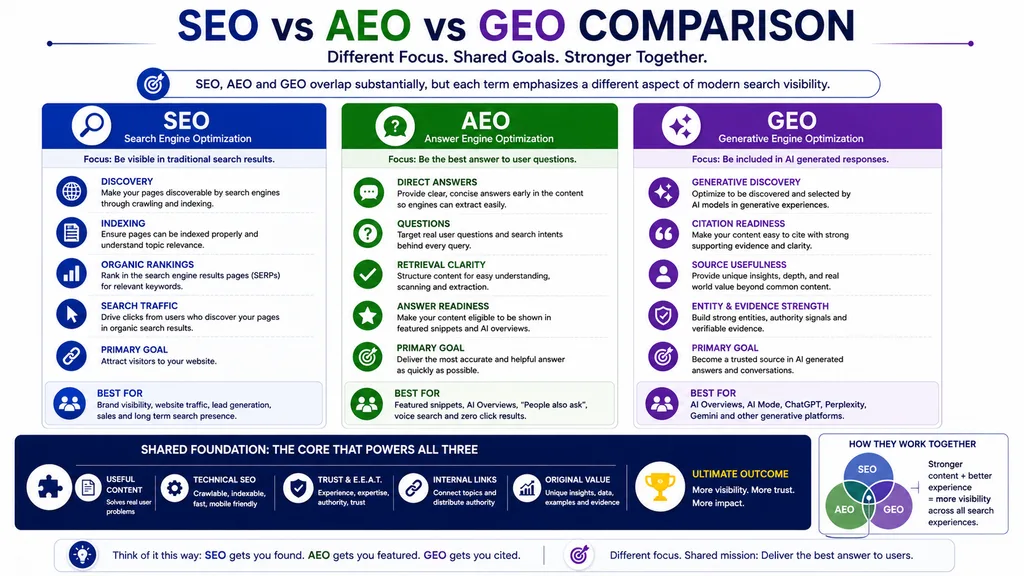
AEO vs GEO: Are They the Same?
AEO and Generative Engine Optimization (GEO) are closely related concepts, but they are not necessarily identical in emphasis.
AEO focuses on making content clear, useful, well-structured, and easy to interpret for answer-oriented search experiences.
GEO is commonly used to describe efforts to improve how a brand, entity, or content may be understood, represented, discovered, or referenced across generative AI search experiences.
In practice, the two approaches can overlap substantially.
Both may benefit from:
- technically accessible content,
- clear answers,
- strong entity relationships,
- reliable evidence,
- original information,
- authoritative sourcing,
- useful page structure,
- and consistent brand information.
The important point is not to treat AEO and GEO as replacements for SEO.
For this implementation guide, the focus remains specifically on how to apply AEO to digital marketing content and webpages.
Readers who need a detailed comparison of the terminology, goals, use cases, similarities, and differences should use our dedicated AEO vs GEO guide.
Internal linking note: Once the dedicated AEO vs GEO article is published, link the words “AEO vs GEO guide” above to that page. Until then, leave the text unlinked.
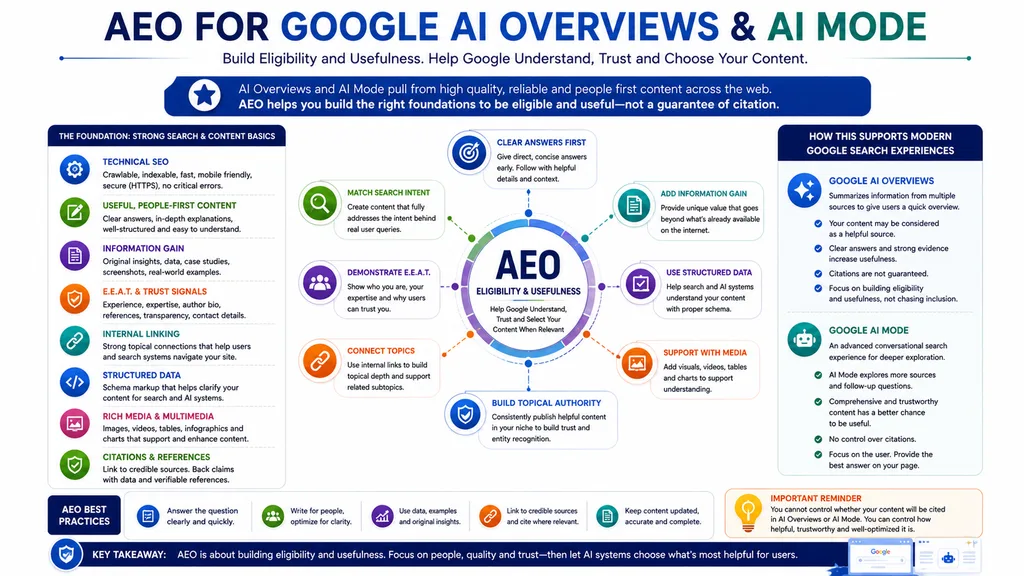
How AEO Relates to Google AI Overviews and AI Mode
AEO can support the same strong content and search foundations that matter across modern Google Search experiences, including AI Overviews and AI Mode.
However, these experiences should not be treated as systems that can be controlled through a special AEO trick or guaranteed optimization formula.
A practical approach is to focus on making important pages:
- technically accessible to search,
- useful for the intended query,
- clear and well structured,
- supported by appropriate evidence,
- rich in original information where possible,
- consistent about important entities,
- and easy for readers to understand and verify.
What Google Actually Requires for AI Overviews and AI Mode
Google does not require a separate technical optimization system for AI Overviews or AI Mode.
According to Google Search Central, the same foundational SEO practices that apply to Google Search also apply to these AI features. A page generally needs to meet Google’s technical Search requirements, comply with Search policies, be indexed, and be eligible to appear in Google Search with a snippet.
There are no additional technical requirements specifically for appearing as a supporting link in AI Overviews or AI Mode.
This distinction is important because AEO recommendations sometimes mix established Google requirements with experimental or unsupported tactics.
Google’s current guidance supports practices such as:
- allowing Googlebot to crawl important content,
- making important pages discoverable through internal links,
- providing a good page experience,
- keeping important information available in textual form,
- using useful images and videos where appropriate,
- and ensuring that structured data accurately represents the visible page content.
Google also states that publishers do not need a special AI text file, special machine-readable markup, or a dedicated schema.org type to qualify for AI Overviews or AI Mode.
Therefore, AEO should strengthen an already useful and technically eligible webpage rather than introduce artificial signals designed only for generative search.
Verified Requirement vs. AEO Recommendation
| Practice | Evidence Status |
|---|---|
| Allow Googlebot to crawl important content | Supported by Google |
| Keep important pages indexable | Required for Search eligibility |
| Make important content available as text | Supported by Google |
| Use descriptive internal links | Supported SEO practice |
| Use useful images and videos where relevant | Supported SEO practice |
| Keep structured data consistent with visible content | Supported requirement |
| Create special AEO schema | Not required by Google |
| Create special AI markup | Not required by Google |
| Create a special AI text file for Google AI features | Not required by Google |
| Achieve a specific keyword density | Not a Google requirement |
| Obtain a particular SEO-plugin score | Not a Google requirement |
| Guarantee an AI Overview citation through optimization | Unsupported |
The practical objective is therefore eligibility, usefulness, clarity, evidence, and discoverability rather than guaranteed inclusion.
Google also explains that AI Overviews and AI Mode may use a process called query fan-out. This can involve multiple related searches across subtopics and data sources while a response is generated.
That does not mean publishers should create a separate webpage for every possible query variation.
A better strategy is to cover genuinely necessary subtopics within a coherent content architecture and create separate URLs only when the underlying user intent materially changes.
AEO Does Not Guarantee Inclusion
Avoid claims such as:
“Follow these AEO steps to get ranked in AI Overviews.”
or:
“Add schema to guarantee visibility in AI Mode.”
A more defensible objective is:
Build eligibility and usefulness.
A page can be well optimized and still not be selected, cited, surfaced, or prominently displayed in a particular generative search experience.
For that reason, AEO should focus on improving the quality and clarity of the underlying page rather than promising a specific AI-generated placement.
Use the Same Evidence-First Approach
When creating content that may appear across modern search experiences, continue to apply the principles covered in this guide:
Search intent → clear answers → original information → entity clarity → technical eligibility → structured content → accurate markup → reliable evidence → measurement
These practices improve the overall quality and interpretability of the resource without requiring the publisher to predict exactly how a particular AI-generated result will select its sources.
Google Preferred Sources and AEO
Google Preferred Sources should be treated as an audience preference and publisher relationship feature rather than as a shortcut for AEO rankings.
The concept is important because readers may be able to express a preference for publications they trust within supported Google Search experiences.
For publishers, the strategic value is therefore different from conventional optimization.
Preferred Sources should not be described as:
- a guaranteed AI Overview ranking method,
- an AI Mode citation shortcut,
- a universal ranking factor,
- or a replacement for SEO and content quality.
A stronger interpretation is that a reader who already trusts a publication may be able to express that preference inside supported Google experiences.
This makes Preferred Sources more closely related to audience retention and publication trust than to a traditional ranking technique.
Where a Preferred Sources Call to Action Makes Sense
If Marjan Web Studio implements Google’s official Preferred Sources functionality, the strongest placements are likely to be around genuinely useful editorial content.
Suitable locations may include:
- near the end of substantial educational articles,
- within a blog or resources area,
- close to a publication trust or follow section.
It should not be repeated aggressively across the page merely to encourage additional clicks.
A visitor should first receive genuine value from the publication before being asked to express a source preference.
Preferred Sources Does Not Replace SEO or AEO
Preferred Sources does not replace the underlying foundations of search visibility.
Publishers should continue focusing on:
helpful content,
technical accessibility,
crawlability,
indexability,
original information,
reliable evidence,
clear authorship,
internal linking,
appropriate structured data,
and a useful page experience.
For an AEO strategy, Preferred Sources is best treated as an optional audience relationship layer rather than a mechanism that guarantees inclusion in an AI-generated answer.
Keep Google AI Search as a Separate Content Intent
This article focuses on implementing AEO across digital marketing content.
A detailed resource about Google AI Overviews and AI Mode should separately examine topics such as:
- how these Google Search experiences work,
- search eligibility,
- content and technical considerations,
- visibility measurement,
- limitations,
- and the official guidance available at the time of publication.
That deeper topic should live on its own dedicated page rather than turning this AEO implementation guide into a complete Google AI Search guide.
Once that resource is published, link the phrase “Google AI Overviews and AI Mode optimization guide” to the dedicated article.
Until then, leave the phrase unlinked.
The practical takeaway is simple:
Do not optimize for an assumed AI shortcut. Build a technically eligible, useful, original, well-supported resource that deserves to be found and understood.
AEO Practices That Can Undermine Your Strategy
AEO should improve the usefulness, clarity, accessibility, and trustworthiness of content—not introduce artificial techniques designed only to influence search or generative systems.
Be particularly cautious with the following practices.
Artificial Content Fragmentation
Do not break useful explanations into dozens of unnaturally short sections simply because of claims that AI systems prefer a particular paragraph length or content-chunk size.
Use headings, paragraphs, lists, tables, and answer blocks when they genuinely improve comprehension.
Structure content for the reader first.
Unsupported AI Optimization Files
Do not assume that creating a special file, tag, markup format, or AI-specific configuration automatically improves visibility in Google AI Overviews, AI Mode, or other generative search experiences.
Before implementing an optimization technique, ask:
- Is it supported by reliable documentation?
- Does it solve a genuine technical or user problem?
- Can its effect be measured?
- Would I still implement it if there were no promise of an AI citation?
If the strategy depends primarily on an unsupported ranking claim, treat it cautiously.
Manufactured Authority Signals
Do not attempt to create artificial authority through:
- fake brand mentions,
- fabricated citations,
- invented partnerships,
- fake reviews,
- misleading testimonials,
- nonexistent awards,
- or manufactured expert endorsements.
Authority should emerge from genuine expertise, useful work, accurate information, legitimate references, and real-world recognition where applicable.
Mass-Produced Question Pages
Do not publish a separate page for every minor variation of a question.
For example, these queries may represent substantially the same implementation intent:
- how to use AEO,
- how to implement AEO,
- how to do AEO,
- AEO implementation process,
- and how to optimize a page for AEO.
When the underlying user need is substantially the same, a stronger consolidated resource may be more useful than several repetitive URLs.
Create another page when the dominant search intent genuinely changes.
Keyword and Entity Stuffing
Adding repeated mentions of terms such as:
AEO, GEO, AI search, AI Overviews, SEO, entities, semantic SEO, and generative search
does not automatically make a page more authoritative or relevant.
Mention terminology where it helps explain the subject.
Do not insert entities merely to increase an assumed semantic or topical score.
Meaningful relationships are more useful than repetition.
Fake Experience or E-E-A-T Signals
Never invent:
- authors,
- qualifications,
- professional experience,
- clients,
- campaigns,
- case studies,
- revenue,
- traffic improvements,
- advertising spend,
- certifications,
- screenshots,
- awards,
- experiments,
- or results.
If first-hand evidence is unavailable, explain the recommended methodology or cite appropriate external evidence instead.
Transparency is stronger than fabricated experience.
Guaranteed AI Citation Claims
Avoid claims such as:
“This technique guarantees AI Overview citations.”
“This schema makes AI systems cite your website.”
“This AEO method guarantees ChatGPT recommendations.”
“Following these steps guarantees generative search rankings.”
Optimization can improve the underlying quality, accessibility, clarity, and usefulness of a resource.
It cannot guarantee how an independent search or generative system will select, rank, summarize, cite, or display information.
The Practical Rule
Before adopting an AEO technique, ask:
Does this improve the experience or information available to the actual user?
If the only justification is:
“We think an AI system might like it,”
the technique deserves additional scrutiny.
Sustainable AEO should strengthen the underlying resource rather than manufacture signals around it.
Illustrative AEO Campaign Examples
The following examples are hypothetical and are included to demonstrate how the AEO implementation process can be applied in different digital marketing situations.
They are not presented as actual Marjan Services client campaigns, measured case studies, traffic results, or revenue outcomes.
Example 1. Web Development Business
Suppose a web development company wants to reach small-business owners researching the cost of building a professional website.
Instead of publishing several thin pages targeting minor variations such as:
- small business website cost,
- website development price,
- how much does a business website cost,
- affordable website development,
- and website design cost,
The company first evaluates whether these searches share substantially the same intent.
It then creates one comprehensive resource:
How Much Does a Small Business Website Cost?
Search Intent
The primary user need is not immediately:
“Hire a web developer.”
The user first wants to understand:
- realistic cost ranges,
- what affects the price,
- what is normally included,
- potential additional expenses,
- which type of website they need,
- and how to evaluate a quotation.
Answer-First Approach
The page begins with a concise explanation of the major cost factors before expanding into detail.
It can then explain:
- website type,
- number of pages,
- custom design requirements,
- e-commerce functionality,
- domain and hosting,
- content creation,
- SEO requirements,
- maintenance,
- integrations,
- and other project-specific requirements.
Information Gain
Instead of repeating generic cost advice, the business could add genuine original value through:
- its own pricing methodology,
- a website cost calculator,
- realistic project scenarios,
- an original requirements checklist,
- screenshots of development workflows,
- a decision matrix,
- transparent explanations of optional costs,
- and examples based on genuine experience where available.
Internal Linking
The resource can contextually link to relevant supporting pages such as:
- website planning,
- types of websites,
- domain selection,
- hosting,
- website maintenance,
- SEO,
- and the company’s website development service.
The service should be introduced where it becomes relevant rather than dominating the informational content.
AEO principle: Solve the pricing and planning problem before asking the visitor to request a quotation.
Example 2. SaaS Business
Suppose a project-management software company identifies the question:
How do small teams manage multiple client projects efficiently?
A weak approach would immediately present a product pitch.
A stronger AEO approach begins with the workflow itself.
Search Intent
The user may need help organizing:
- incoming projects,
- priorities,
- responsibilities,
- deadlines,
- client communication,
- approvals,
- files,
- and progress reporting.
The page should solve that operational problem before assuming that software is the only answer.
Answer-First Approach
The resource could begin with a concise workflow:
Centralize project intake, assign clear ownership, define priorities and deadlines, maintain a shared project status, and create a consistent client communication process.
The article can then explain each stage.
Information Gain
The SaaS company could strengthen the resource with:
- an original project-intake template,
- a prioritization framework,
- a workflow diagram,
- sample project stages,
- an original reporting template,
- genuine product screenshots,
- a client communication checklist,
- and practical examples of how different team structures affect the workflow.
Product Integration
The software should appear where it genuinely supports the process.
For example:
After explaining task ownership, the article can demonstrate how task assignment works inside the platform.
After explaining progress reporting, it can show the relevant reporting interface.
This creates a logical relationship:
Problem → workflow → solution → product capability
rather than:
Question → immediate sales pitch
AEO principle: Teach the workflow first and demonstrate the product where it materially helps execute that workflow.
Example 3. Ecommerce Website
Suppose an ecommerce retailer wants to reach people researching:
How to choose running shoes for long-distance training
A weak commercial article might simply display a list of products.
A more useful resource would first help the shopper make an informed decision.
Search Intent
The user may be evaluating:
- fit,
- comfort,
- training distance,
- terrain,
- intended use,
- product characteristics,
- replacement considerations,
- and differences between available options.
The dominant intent is guidance before product selection.
Answer-First Approach
The guide should begin with the most important selection considerations and then explain how those considerations affect different runners and training situations.
Information Gain
Useful original additions could include:
- a product-selection framework,
- comparison tables based on verifiable specifications,
- original product photographs,
- original demonstrations,
- clearly documented testing where genuinely performed,
- a buyer checklist,
- and decision scenarios for different use cases.
If the retailer has not independently tested a product, it should not imply that it has.
Manufacturer specifications should also be distinguished from first-hand observations.
Contextual Product Recommendations
Products can be introduced after the selection criteria have been explained.
For example:
If a shopper prioritizes a particular verified characteristic, these products meet that criterion based on the specifications shown below.
This makes the commercial recommendation easier to understand and evaluate.
AEO principle: Help the shopper make the decision before presenting the products as the answer.
What These Examples Have in Common
The industries are different, but the implementation logic remains consistent:
1. Identify the real user task.
2. Define one clear page purpose.
3. Provide the essential answer early.
4. Expand with useful context.
5. Add original information where possible.
6. Support important factual claims with appropriate evidence.
7. Connect relevant entities and supporting pages.
8. Introduce products or services only where they genuinely fit the solution.
9. Avoid fabricated experience or performance claims.
10. Measure the actual search and business outcomes after publication.
This produces a more sustainable relationship between AEO and digital marketing:
User need → useful answer → evidence → original value → relevant solution → measurable outcome
The conversion opportunity should emerge naturally from solving the user’s problem.
Solve the information need first. Earn the conversion opportunity second.
How AEO Supports Different Search and Discovery Experiences
AEO should not be implemented as though traditional organic search, answer-oriented experiences, and generative search are completely separate marketing systems.
The same high-quality resource may support discovery across multiple surfaces when it is technically accessible, aligned with user intent, clearly written, original where possible, and supported by appropriate evidence.
However, the way users interact with each search or discovery experience can differ.
| Search or Discovery Experience | Typical User Need | Content Priority | Useful Measurement |
|---|---|---|---|
| Traditional organic search | Find a relevant page, website, product, service, or answer | Strong SEO foundation, intent alignment, useful content, internal links and clear page purpose | Impressions, clicks, CTR, queries, landing pages,ges and conversions |
| Answer-oriented search | Obtain a concise answer to a specific question | Direct answer supported by explanation, evidence, context and limitations | Search visibility, engagement and downstream actions |
| Google AI Overviews | Understand or explore a question through an AI-generated search experience | Technically eligible, useful, original and well-supported web content | Relevant Search performance and generative-search visibility where reliable reporting is available |
| Google AI Mode | Explore broader or more complex questions interactively | Deep supporting information, clear entities, useful evidence, multimedia and logical site architecture | Search visibility, qualified visits and business outcomes where measurable |
| Other generative discovery experiences | Obtain synthesized information, recommendations, comparisons, or explanations | Clear factual information, strong source quality, entity consistency and distinctive original value | Reliable referral traffic, citations or mentions where they can genuinely be observed |
| Website content experience | Complete the underlying information or commercial task after discovery | Useful page experience, supporting resources, clear next actions and relevant conversion paths | Engagement, leads, sales, sign-ups, downloads or other meaningful outcomes |
Do Not Optimize Each Surface in Isolation
Creating separate low-value versions of substantially the same page for traditional search, AI search, AEO, or GEO is generally unnecessary when the underlying user intent remains the same.
For example, avoid automatically creating:
- an SEO version of a guide,
- an AEO version of the same guide,
- a GEO version of the same guide,
- and an AI Overview version of the same guide
when all four pages would essentially answer the same question.
Instead, create the strongest resource for the underlying user need and make sure it has the technical, editorial, evidentiary, and structural qualities required to perform effectively across relevant discovery experiences.
Match the Page to the User Task
The primary optimization question should remain:
“What is the user trying to accomplish?”
not:
“Which search surface am I trying to manipulate?”
A person researching website costs still needs accurate cost information whether the journey begins through a conventional search result, an answer-oriented result, a generative search experience, a referral, or another discovery channel.
The page should therefore solve the underlying problem comprehensively.
Measure Visibility and Business Impact Separately
Visibility is not the same as business value.
A page can gain impressions, mentions, citations, or other forms of exposure without generating meaningful business outcomes.
Where reliable data is available, evaluate the complete path:
Technical eligibility → search visibility → discovery → website engagement → conversion → business outcome
This prevents AEO reporting from becoming dependent on a single ranking, citation, mention, or visibility metric.
The most sustainable strategy is to build a useful source that can support multiple discovery experiences while remaining focused on the actual person behind the query.
Common AEO Implementation Mistakes
Even a technically sound AEO strategy can underperform when the implementation does not match the user’s actual task.
The following mistakes commonly weaken an AEO-focused page.
Starting With Keywords Instead of Search Intent
Do not begin by asking how many times a target keyword should appear.
First determine:
- what the searcher wants to accomplish,
- which questions must be answered,
- what information is necessary to complete the task,
- and whether an existing page already satisfies that intent.
Keywords should help describe demand—not dictate an unnatural article structure.
Providing the Answer Too Late
A page may contain the correct information but still make users work unnecessarily hard to find it.
When a heading asks a specific question, provide the essential answer early and then expand with:
- context,
- evidence,
- examples,
- limitations,
- and practical recommendations.
Do not hide the main answer behind a long introduction.
Creating Content That Is Clear but Not Distinctive
Direct answers alone are not enough.
If the page merely summarizes information already available across many competing resources, ask what meaningful additional value you can provide.
Useful differentiation may come from:
- original screenshots,
- first-hand workflows,
- original frameworks,
- calculations,
- comparison tables,
- documented experiments,
- expert analysis,
- practical templates,
- or stronger synthesis of reliable primary sources.
The objective is not additional word count.
It is additional useful information.
Optimizing Individual Sections but Ignoring the Whole Page
A page can contain excellent answer blocks while still having a weak overall structure.
Review the complete resource for:
- one clear primary purpose,
- logical heading hierarchy,
- unnecessary repetition,
- missing supporting information,
- contradictory statements,
- weak transitions,
- irrelevant sections,
- and unclear next actions.
AEO should improve both individual answers and the complete user journey.
Ignoring Technical Search Eligibility
Content improvements cannot compensate for fundamental accessibility or indexing problems.
Before diagnosing an AEO issue, verify relevant technical factors such as:
- crawlability,
- indexability,
- canonicalization,
- HTTP status,
- internal discovery,
- mobile accessibility,
- and availability of important content in the rendered page.
Diagnose conventional search problems before looking for an AEO-specific explanation.
Adding Structured Data Without Checking Existing Markup
WordPress themes, SEO plugins, ecommerce systems, and other tools may already generate structured data.
Adding another schema implementation without checking the existing output can create unnecessary duplication or conflicting information.
Before adding markup:
- Inspect what is already generated.
- Confirm that it matches the visible content.
- Identify whether anything genuinely useful is missing.
- Add only the markup that accurately describes the page.
- Validate the final implementation.
More structured data does not automatically mean better AEO.
Publishing Without a Baseline
If you change the title, introduction, headings, internal links, content, schema, images, and other elements simultaneously without recording the original state, later evaluation becomes difficult.
Before significant optimization, record relevant baseline information such as:
- impressions,
- clicks,
- CTR,
- relevant queries,
- average position where useful,
- current page structure,
- internal links,
- conversions where applicable,
- and observable generative-search visibility where reliable data is available.
Then document what changed.
Measuring Only Rankings or AI Citations
AEO performance should not be reduced to:
“Did I get an AI citation?”
or:
“Did this keyword move up?”
Evaluate a broader sequence:
Technical eligibility → search visibility → relevant discovery → engagement → qualified action → business outcome
Different pages may have different success metrics.
Changing Too Many Variables Without Documentation
If you want to learn from an optimization experiment, record the changes.
For example:
- direct answer rewritten,
- headings reorganized,
- sources updated,
- internal links added,
- original image added,
- outdated information removed,
- schema corrected,
- or content consolidated.
This does not create a perfectly controlled experiment, but it makes later interpretation more credible.
Treating Every Performance Change as Proof of AEO
Search performance can change for many reasons, including:
- changes in search demand,
- seasonality,
- competitor activity,
- backlinks,
- technical changes,
- site-wide improvements,
- news events,
- and search-system changes.
If performance improves after an AEO update, document the association without automatically claiming that AEO caused the entire change.
The Practical Mistake Check
Before publishing, ask:
Does this page satisfy one clear intent?
Is the important answer easy to find?
Does it provide something meaningfully useful beyond a generic summary?
Can important claims be verified?
Is the page technically eligible and accessible?
Does its structured data accurately reflect visible content?
Does it overlap unnecessarily with another page?
Have I recorded a baseline for future measurement?
If these questions have clear answers, the implementation is considerably easier to evaluate and improve.
Troubleshooting AEO Problems
When an AEO-focused page underperforms, avoid assuming that the problem is automatically an “AI visibility” issue.
Diagnose the page systematically.
A useful troubleshooting sequence is:
Technical eligibility → search intent → content quality → evidence → site architecture → visibility → engagement → conversion
This helps separate technical, editorial, search, and business problems.
Problem 1. The Page Is Not Indexed
If the page is not indexed, begin with conventional technical search diagnostics rather than rewriting it for AEO.
Check:
- HTTP status,
- robots directives,
noindexdirectives,- canonical URL,
- XML sitemap inclusion,
- internal links,
- crawl accessibility,
- rendered page content,
- and relevant Search Console information.
Also check whether another URL substantially duplicates the page or has been selected as the preferred canonical version.
Priority: Resolve crawlability, indexability, canonicalization, or duplication problems before evaluating AEO performance.
Problem 2. The Page Is Indexed but Has Very Few Impressions
Indexing does not guarantee meaningful search visibility.
Review:
- whether the topic has actual search demand,
- whether the page satisfies a distinct search intent,
- whether another page on your own site competes for the same intent,
- whether the title and headings accurately communicate the topic,
- whether the content provides sufficient depth,
- whether important entities and terminology are clear,
- and whether the page is internally discoverable.
Use Search Console query data where available to understand how Google currently associates the page with searches.
Priority: Determine whether this is a demand, relevance, content, architecture, or visibility problem.
Problem 3. The Page Gets Impressions but Few Clicks
If impressions are increasing but clicks remain weak, investigate the search-result relationship before assuming the article itself needs a complete rewrite.
Review:
- title relevance,
- title clarity,
- search intent,
- competing results,
- snippet context,
- query-to-page alignment,
- and whether the result sets the correct expectation.
CTR should be interpreted in context because different queries and search-result environments can produce different click behavior.
Do not rewrite titles repeatedly based on a single short observation period.
Priority: Improve query-to-result alignment without turning the title into clickbait.
Problem 4. The Page Receives Organic Traffic, but Users Do Not Engage
Traffic without meaningful engagement may indicate that the page technically matches the query but does not satisfy the visitor effectively.
Review:
- whether the important answer appears early enough,
- whether the introduction is unnecessarily long,
- whether headings make the page easy to scan,
- whether the content actually fulfills the title’s promise,
- whether important explanations are buried,
- whether intrusive elements interfere with reading,
- whether the page works well on mobile,
- and whether the next useful action is clear.
Also consider whether the query itself represents a quick-answer task that naturally requires little on-page interaction.
Priority: Diagnose the user task before interpreting low engagement as poor content.
Problem 5. The Content Is Accurate but Too Generic
A page may be correct and still provide little reason to prefer it over stronger existing resources.
Compare the page with competing resources and ask:
What does this page contribute that is genuinely useful and distinctive?
Possible improvements include:
- original frameworks,
- first-hand observations,
- original screenshots,
- practical templates,
- documented experiments,
- calculations,
- comparison models,
- expert analysis,
- better primary-source synthesis,
- or clearer implementation guidance.
Do not add filler simply to make the article longer.
Priority: Increase useful information gain rather than word count.
Problem 6. The Page Ranks but Has Weak Answer-Oriented Visibility
Do not immediately assume that a special AEO tactic is missing.
Review whether the relevant sections:
- answer the actual question directly,
- provide sufficient supporting context,
- use descriptive headings,
- distinguish facts from recommendations,
- support important claims,
- make entities unambiguous,
- contain genuinely useful information,
- and remain technically accessible.
Also remember that optimization does not guarantee selection, citation, summarization, or inclusion by a search or generative system.
Priority: Improve the quality and verifiability of the underlying resource rather than chasing an assumed citation formula.
Problem 7. Another Page on Your Site Competes for the Same Intent
Internal search-intent overlap can weaken content architecture.
Compare the pages based on:
- primary query,
- dominant search intent,
- target audience,
- user task,
- content purpose,
- and conversion goal.
If two URLs substantially solve the same problem, consider whether they should be:
- consolidated,
- differentiated,
- redirected where appropriate,
- or assigned clearer separate roles.
Do not keep multiple weak pages simply because their keywords are slightly different.
Priority: Maintain one clear primary URL for each dominant intent.
Problem 8. The Page Is Mentioned or Cited but Generates Little Referral Traffic
A mention or citation does not necessarily produce a click.
Users may obtain enough information from the search or generative interface without visiting the source.
Evaluate more than referral traffic alone.
Where reliably observable, consider:
- brand exposure,
- branded search changes,
- relevant referral visits,
- assisted conversions,
- qualified leads,
- returning visitors,
- and other meaningful downstream behavior.
Do not assign revenue to an AI mention unless the attribution can genuinely support that conclusion.
Priority: Separate visibility from traffic and traffic from business value.
Problem 9. Traffic Increases but Conversions Do Not
This may be a conversion-path problem rather than an AEO problem.
Check:
- whether the visitors match the intended audience,
- whether the page has informational or commercial intent,
- whether the offer is relevant to the topic,
- whether the next action is clear,
- whether trust information is sufficient,
- whether pricing or service information is understandable,
- whether forms work correctly,
- and whether the page provides an appropriate transition from information to solution.
Do not force aggressive commercial calls to action into purely informational sections.
Priority: Match the conversion opportunity to the visitor’s stage and intent.
Problem 10. Performance Declines After an AEO Update
Do not automatically conclude that the AEO changes caused the decline.
First document:
- what changed,
- when it changed,
- which queries changed,
- which pages changed,
- whether search demand changed,
- whether indexing or canonicalization changed,
- whether site-wide changes occurred,
- whether competitors changed,
- and whether enough time has passed to evaluate the result meaningfully.
If several variables were changed simultaneously, causal attribution becomes more difficult.
Use the pre-optimization baseline whenever available.
Priority: Compare evidence before reversing changes.
AEO Troubleshooting Decision Path
Use this sequence when diagnosing an underperforming page:
1. Can search systems access the page?
If no → investigate technical eligibility.
2. Is the intended URL indexed appropriately?
If no → investigate indexing, canonicalization, duplication, and quality issues.
3. Does the page target a distinct and relevant user intent?
If no → redefine, consolidate, or reposition the page.
4. Is the page receiving relevant impressions?
If no → investigate demand, relevance, internal architecture, and content quality.
5. Are impressions generating appropriate clicks?
If no → investigate query alignment and search-result presentation.
6. Does the page satisfy the visitor after the click?
If no → improve answer quality, structure, usefulness, and page experience.
7. Does the page provide distinctive value?
If no → strengthen information gain and evidence.
8. Is the intended business action happening?
If no → investigate audience quality and the conversion path.
9. Are you evaluating AI or generative visibility?
Treat it as an additional discovery layer rather than a substitute for the previous checks.
Troubleshoot the Earliest Failure First
A useful principle is:
Fix the earliest broken stage in the journey before optimizing the later stages.
For example:
If the page is not indexable, changing its answer formatting is unlikely to solve the primary problem.
If it receives relevant traffic but no enquiries, additional schema is unlikely to solve the primary conversion problem.
If multiple URLs compete for the same intent, publishing another keyword variation is unlikely to improve the underlying architecture.
AEO troubleshooting becomes more reliable when each problem is diagnosed at the correct layer rather than attributed to a single vague concept such as “AI visibility.”
AEO Metrics and KPIs
AEO should not be measured with a single metric.
Rankings, AI citations, impressions, clicks, engagement, leads, and revenue answer different questions. A useful measurement system therefore tracks the complete path from search visibility to meaningful business outcomes.
Before optimizing an important page, record a baseline. After making changes, compare performance over an appropriate observation period and document other factors that may have influenced the result.
How to Measure Google AI Search Visibility
AEO should be measured with observable search and business data rather than an arbitrary AEO score.
For Google Search, website appearances in AI features such as AI Overviews and AI Mode are included within the overall Search Console Performance report under the Web search type.
This means publishers should not assume that Google provides a separate universal AEO score, GEO score, or AI citation score.
Instead, measurement should connect search visibility with meaningful website and business outcomes.
A practical measurement sequence is:
Technical eligibility → Search visibility → Traffic → Engagement → Conversion
Start With a Baseline
Before making a substantial AEO change to an important page, record the available baseline.
Useful baseline information can include:
- Google Search impressions,
- organic clicks,
- click-through rate,
- relevant search queries,
- landing-page performance,
- indexing status,
- internal navigation,
- and qualified leads or conversions where they are reliably measured.
After making a documented change, compare equivalent data over an appropriate observation period.
Avoid treating a short-term movement as proof that a specific AEO change caused the result.
Search demand, competitors, crawling, indexing, content updates, ranking systems, seasonality, and user behavior can all influence performance.
Measure More Than Rankings
A page can become more useful without immediately improving for one specific keyword.
It may begin receiving impressions across a broader set of genuinely relevant queries.
For this reason, monitor relevant query diversification as well as clicks and rankings.
Google has documented that AI Overviews and AI Mode can use query fan-out across related subtopics and data sources.
This does not justify creating individual pages for every query variation.
Instead, it reinforces the value of comprehensive resources that cover the relationships and subtopics genuinely necessary to satisfy the user’s underlying intent.
Do Not Treat an AI Appearance as the Final Business Outcome
Visibility is only one part of the measurement chain.
A useful framework separates:
| Measurement Layer | What to Evaluate |
|---|---|
| Technical eligibility | Crawlability, indexing and canonical status |
| Search visibility | Impressions and relevant query coverage |
| Search engagement | Organic clicks and CTR |
| Website engagement | Useful interactions and internal navigation |
| Conversion | Qualified inquiries, sign-ups or other defined actions |
| Business outcome | Revenue or another meaningful objective where reliably attributable |
The objective is not simply to appear in an AI-generated search experience.
The objective is to earn useful visibility that contributes to the website’s actual purpose.
Do Not Invent Cross-Platform AI Visibility Data
Google Search Console reports data from Google Search.
It should not be presented as authoritative visibility data for every other AI platform.
If you manually evaluate visibility on another generative platform, document the methodology clearly.
A useful experiment should record:
the platform,
the prompts,
the testing date,
the number of observations,
what counted as a brand mention,
what counted as a citation,
and any important limitations.
A single generated response should not be presented as proof of stable AI visibility.
Avoid Arbitrary AEO Scores
There is no official Google metric called an AEO Score, GEO Score, or AI Optimization Score.
Third-party platforms may create their own scoring systems, but these should be treated as proprietary measurement models rather than Google ranking metrics.
For Marjan Web Studio, the stronger measurement framework is:
Eligibility → Visibility → Traffic → Engagement → Lead → Business Outcome.
This keeps AEO reporting connected to evidence instead of unsupported optimization claims.
Core AEO Metrics
| Measurement Area | Useful Metrics | What They Help Evaluate |
|---|---|---|
| Search visibility | Impressions, relevant queries, landing-page visibility, average position where useful | Whether the page is being surfaced for relevant searches |
| Search engagement | Organic clicks and CTR | Whether search visibility is producing visits |
| Query coverage | Relevant queries and query categories | Whether the page is being discovered across the intended topic and user needs |
| Website engagement | Meaningful interactions, supporting-page visits and other relevant engagement signals | Whether visitors continue using the resource after arrival |
| Conversion | Leads, enquiries, sign-ups, purchases, downloads or other defined actions | Whether the page contributes to its intended business or user outcome |
| Generative discovery | Observable mentions, citations or referral visits where they can be measured reliably | Whether the resource is appearing in relevant generative discovery experiences |
| Brand impact | Branded search demand, direct visits or other appropriate brand indicators | Whether broader visibility may be contributing to brand discovery |
| Content quality monitoring | Accuracy, freshness, broken references, outdated claims and content overlap | Whether the resource remains useful and trustworthy over time |
1. Search Visibility
Start with conventional search performance.
Relevant measurements may include:
- impressions,
- clicks,
- CTR,
- queries,
- landing pages,
- and average position, where it provides useful context.
Do not evaluate only one target keyword.
A strong resource may become visible for multiple relevant queries representing different stages or formulations of the same user need.
2. Query Quality
More queries are not automatically better.
Review whether the page is appearing for searches that match its intended purpose.
For this guide, relevant query themes could include implementation-oriented searches around:
- using AEO in digital marketing,
- implementing AEO,
- optimizing content for answer-oriented search,
- creating an AEO workflow,
- and measuring AEO implementation.
If the page primarily attracts unrelated queries, increased impressions may not represent improved strategic performance.
3. Clicks and CTR
Clicks show whether search visibility produces website visits.
CTR can provide additional context, but it should not be interpreted in isolation.
Click behavior can vary according to:
- query type,
- user intent,
- search-result layout,
- device,
- brand familiarity,
- and the information already available within the search experience.
Evaluate CTR alongside the actual queries and search environment.
4. Website Engagement
After the click, determine whether users can continue their task successfully.
Depending on the page, useful observations may include:
- relevant internal-link interactions,
- navigation to supporting resources,
- completion of a tool or calculator,
- video engagement where applicable,
- downloads,
- form interactions,
- and other meaningful actions.
Avoid treating one generic engagement metric as universal proof of content quality.
Interpret behavior according to the page’s purpose.
5. Conversions and Business Outcomes
For commercial websites, visibility should eventually connect to an appropriate business objective.
Possible outcomes include:
- qualified enquiries,
- service requests,
- account registrations,
- purchases,
- newsletter subscriptions,
- downloads,
- demo requests,
- or another defined conversion.
The correct KPI depends on the page.
An informational guide may assist a conversion without being the final conversion page.
Where possible, evaluate both direct and assisted contribution rather than judging every article only by immediate sales.
6. Generative Search Visibility
Generative discovery can be monitored where reliable observation or reporting is available.
Possible observations may include:
- verified citations,
- identifiable brand mentions,
- referral traffic,
- pages repeatedly surfaced for relevant prompts,
- and changes in visibility across a documented set of queries or prompts.
However, generative visibility should be treated cautiously.
Do not assume that:
a citation equals a click,
a mention equals a lead,
or
an observed AI response represents permanent visibility.
Generative outputs can vary, and measurement capabilities may differ across platforms and tools.
7. Brand Discovery
AEO may contribute to discovery even when attribution is incomplete.
Where appropriate, monitor broader indicators such as:
- branded searches,
- direct visits,
- returning visitors,
- branded enquiries,
- and referral patterns.
These signals can provide context, but correlation should not automatically be presented as causation.
8. Content Maintenance Metrics
Measurement should also identify when the resource itself needs maintenance.
Monitor for:
- outdated facts,
- changed product information,
- broken external references,
- broken internal links,
- stale screenshots,
- outdated dates,
- search-intent overlap,
- declining relevant visibility,
- and sections that no longer reflect the page’s purpose.
AEO is not a one-time publishing task.
Create a Before-and-After Measurement Record
For important optimization work, maintain a simple record such as:
| Field | Record |
|---|---|
| Page | URL being optimized |
| Baseline date | Date before significant changes |
| Optimization date | Date changes were published |
| Changes made | Specific editorial, technical or structural changes |
| Target intent | Primary user task |
| Search baseline | Relevant impressions, clicks, queries and CTR |
| Conversion baseline | Relevant business actions where available |
| Generative baseline | Observable visibility where reliable |
| Review date | Planned evaluation date |
| Result | Observed change |
| Limitations | Other factors that may have influenced performance |
This makes later analysis more credible than relying on memory or isolated screenshots.
Do Not Create an “AEO Score” From Unrelated Metrics
Avoid combining arbitrary signals into a percentage such as:
“This page has an AEO score of 94/100.”
unless the scoring methodology is clearly defined and validated for the specific purpose.
A page can have excellent formatting and still:
- target the wrong intent,
- provide generic information,
- lack evidence,
- receive no relevant visibility,
- or fail to support its business objective.
Measure real outcomes instead of creating artificial certainty.
The Core Measurement Principle
A useful AEO measurement system should answer four questions:
Can the resource be discovered?
Does it satisfy the intended search and information need?
Can its important claims and entities be understood and verified?
Does the resulting visibility contribute to a meaningful user or business outcome?
The next measurement model organizes these questions into separate layers so that visibility, engagement, authority, and business impact are not confused with one another.
Four-Layer AEO Measurement Model
Individual metrics become more useful when they are organized according to what they actually measure.
A practical AEO measurement model can separate performance into four layers:
Layer 1: Search Eligibility and Discovery
↓
Layer 2: Content Usefulness and Engagement
↓
Layer 3: Trust, Evidence and Generative Discovery
↓
Layer 4: Conversion and Business Impact
The purpose of this framework is not to create an artificial AEO score.
It is to help diagnose where performance is succeeding or failing.
Layer 1. Search Eligibility and Discovery
The first question is:
Can the intended resource be accessed, understood at a basic level, indexed where appropriate, and discovered for relevant searches?
This layer includes signals such as:
- crawl and indexing status,
- canonicalization,
- relevant search impressions,
- query coverage,
- organic clicks,
- internal discoverability,
- and other relevant search visibility indicators.
If Layer 1 is weak, later AEO improvements may have limited impact because the resource has a more fundamental search-discovery problem.
Example
Suppose a guide contains excellent direct answers, original diagrams, reliable sources, and accurate structured data.
However, the intended URL is accidentally marked. noindex.
The primary problem is not answer formatting.
It is Layer 1: Search Eligibility and Discovery.
Fix the earliest failure first.
Layer 2. Content Usefulness and Engagement
Once the page is discoverable, ask:
Does the resource actually satisfy the user’s task after discovery?
This layer evaluates whether the page provides:
- a clear primary purpose,
- strong search-intent alignment,
- accessible direct answers,
- sufficient supporting explanation,
- logical structure,
- useful information gain,
- understandable examples,
- appropriate multimedia,
- and relevant next actions.
Behavioral observations can provide additional context where they genuinely relate to the page’s purpose.
The objective is not to maximize every engagement metric.
A user who receives a complete answer quickly may behave differently from a user completing a calculator, comparing products, or submitting a service enquiry.
Example
A page receives relevant impressions and clicks, but visitors repeatedly fail to reach the information promised by the title because the answer is buried beneath a long introduction.
The main problem is likely within Layer 2: Content Usefulness and Engagement.
Adding more schema would not address the underlying issue.
Layer 3. Trust, Evidence and Generative Discovery
The third layer asks:
Is the information sufficiently clear, attributable, distinctive, and verifiable to function as a trustworthy source?
Relevant considerations include:
- evidence supporting important factual claims,
- primary-source attribution where appropriate,
- author and publisher transparency,
- accurate entity relationships,
- first-hand experience where genuinely available,
- original information,
- clear separation of fact and recommendation,
- accurate structured data,
- and content freshness.
Observable generative-search mentions, citations, or referrals can also be recorded in this layer where they can be measured reliably.
However:
Generative visibility is an observation—not proof of authority.
A citation does not automatically establish that a page is more accurate, more trustworthy, or more valuable than another source.
Likewise, the absence of an observed citation does not automatically prove that the page has failed.
Example
A guide receives search traffic and answers the question clearly, but several important statistics have no identifiable sources, and the author presents undocumented claims as facts.
The primary weakness is within Layer 3: Trust, Evidence, and Generative Discovery.
The solution is stronger evidence and transparency—not additional keyword repetition.
Layer 4. Conversion and Business Impact
The final layer asks:
Does the visibility and usefulness contribute to an appropriate user or business outcome?
Depending on the page, outcomes may include:
- qualified leads,
- enquiries,
- purchases,
- registrations,
- downloads,
- demo requests,
- subscriptions,
- supporting-page visits,
- or another defined conversion.
Not every informational page should generate an immediate sale.
Some pages contribute earlier in the journey by:
- introducing the brand,
- answering a research question,
- supporting a later commercial decision,
- or directing users to another relevant resource.
Where measurement allows, distinguish direct conversions from assisted contribution.
Example
A page receives relevant search traffic, satisfies the information need, and earns strong engagement, but almost no visitor understands how to proceed to the relevant service.
That is primarily a Layer 4: Conversion and Business Impact problem.
The appropriate response may be improving the conversion path—not rewriting the entire article for AEO.
How to Interpret the Four Layers
The layers should be evaluated in sequence rather than treated as independent scores.
| Situation | Likely Layer to Investigate First |
|---|---|
| Intended page cannot be indexed appropriately | Layer 1 |
| Indexed page receives almost no relevant visibility | Layer 1 |
| Relevant visitors arrive but cannot easily find the answer | Layer 2 |
| Content is useful but generic and weakly supported | Layer 3 |
| Important claims are difficult to verify | Layer 3 |
| Generative visibility changes unexpectedly | Investigate Layers 1–3 before drawing conclusions |
| Relevant traffic grows but qualified actions do not | Layer 4 |
| Leads increase without clear attribution | Review all layers before claiming causation |
Do Not Turn the Layers Into Arbitrary Scores
Avoid statements such as:
Layer 1: 95/100
Layer 2: 92/100
Overall AEO Score: 94/100
Unless you have a clearly defined, validated methodology for what those numbers mean.
The framework is primarily diagnostic.
A better conclusion is:
“The page is technically eligible and receives relevant search visibility, but its evidence and conversion path need improvement.”
That statement identifies what should happen next.
An unexplained percentage usually does not.
Use the Model for Prioritization
When several problems exist, prioritize the earliest significant failure.
A practical sequence is:
1. Fix technical eligibility and discovery problems.
2. Improve search-intent alignment and usefulness.
3. Strengthen evidence, originality, entities, and trust.
4. Improve the conversion path where commercially relevant.
5. Continue measuring search and generative discovery without treating either as guaranteed or permanent.
This prevents teams from spending time on advanced AEO tactics while fundamental search, content, or business problems remain unresolved.
The Four-Layer Diagnostic Question
When reviewing any AEO page, ask:
Layer 1 — Can it be discovered?
Layer 2 — Does it genuinely help?
Layer 3 — Can important information be understood and trusted?
Layer 4 — Does it contribute to the intended outcome?
A sustainable AEO strategy should eventually connect all four.
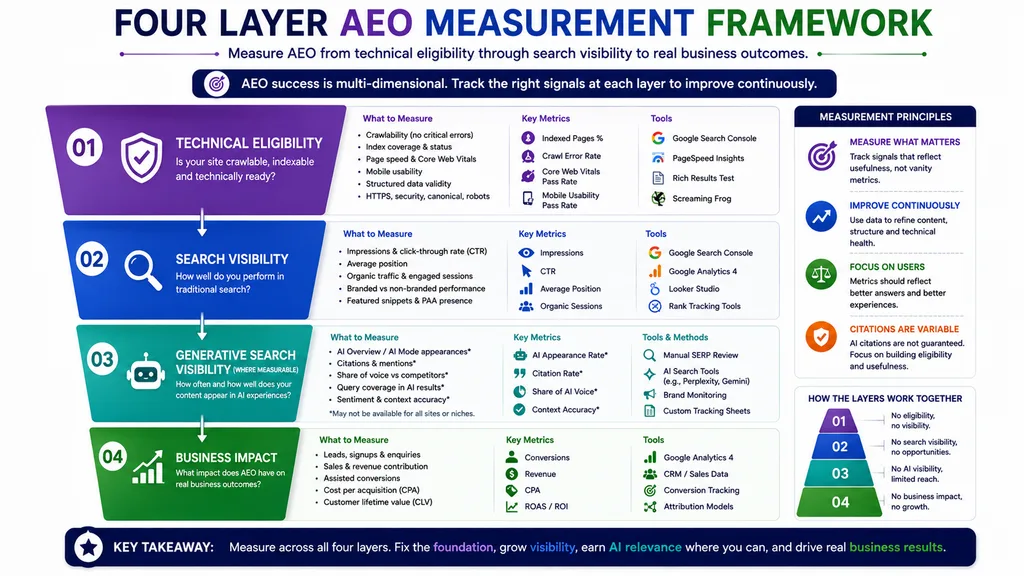
The four-layer AEO measurement model separates discovery, usefulness, trust and business impact so performance problems can be diagnosed at the correct stage.A Repeatable AEO Experiment Framework
AEO recommendations become more useful when they can be tested against documented observations rather than treated as assumptions.
The following framework provides a practical way to evaluate changes to an existing webpage.
It is an experiment methodology, not a claim that the changes will produce a particular ranking, traffic increase, AI citation, or conversion result.
Experiment Objective
The objective is to answer a focused question such as:
Does improving the answer structure, evidence, entity clarity, and information gain of an existing page correspond with measurable changes in relevant search visibility, engagement, generative discovery, or business outcomes?
The wording matters.
The experiment should investigate an outcome rather than assume one.
Step 1. Select an Appropriate Test Page
Choose an existing page that:
- has a clear primary search intent,
- has been published long enough to provide a useful baseline where possible,
- receives at least some measurable search activity where possible,
- is not undergoing a major redesign,
- and can be improved without changing its fundamental purpose.
Avoid selecting a page that is simultaneously affected by major migrations, URL changes, extensive backlink campaigns, or other large interventions if your objective is to understand the relationship between content changes and subsequent performance.
Step 2. Define the Hypothesis
Write the hypothesis before making changes.
For example:
If an existing informational page is improved through clearer answer-first sections, stronger evidence, better entity relationships, useful original information, and improved internal linking, relevant search and user-performance indicators may improve over the subsequent observation period.
This is a testable hypothesis.
It is not:
“AEO will increase traffic by 50%.”
Do not specify a guaranteed outcome unless you have evidence that justifies such a prediction.
Step 3. Record the Baseline
Before editing the page, record the current state.
A baseline record could include:
| Baseline Field | What to Record |
|---|---|
| Page URL | Exact test URL |
| Baseline date | Date measurements were recorded |
| Primary intent | Main user task |
| Main queries | Relevant Search Console queries |
| Impressions | Current search impressions |
| Clicks | Current organic clicks |
| CTR | Search click-through rate |
| Position | Average position where useful |
| Conversions | Relevant page or assisted actions where measurable |
| Internal links | Important incoming and outgoing links |
| Content structure | Existing H1, H2 and important H3 structure |
| Evidence | Important claims and current supporting sources |
| Original assets | Screenshots, diagrams, tools, data or other original material |
| Structured data | Relevant markup currently generated |
| Generative visibility | Observable mentions, citations, or referrals where reliably measurable |
Save genuine screenshots or exports where useful.
Do not recreate historical data later with AI-generated examples.
Step 4. Document the Existing Page
Create a simple record of the page before optimization.
Document:
- title,
- meta description,
- primary heading,
- major section headings,
- important direct answers,
- key internal links,
- relevant external sources,
- structured data,
- important images,
- conversion elements,
- and the last significant update date where known.
This creates an audit trail.
If you later publish the experiment as a case study, readers should be able to understand what actually changed.
Step 5. Apply a Defined Optimization Set
Instead of vaguely recording:
“We optimized the page for AEO,”
document the individual changes.
For example:
Change 1 — Search intent
Clarified the page’s dominant user task.
Change 2 — Answer structure
Moved important answers closer to their corresponding headings.
Change 3 — Information gain
Added a genuinely useful original framework, example, calculation, screenshot, comparison, or first-hand observation.
Change 4 — Evidence
Added or improved sources for important factual claims.
Change 5 — Entity clarity.
Clarified important organizations, products, people, concepts, or relationships.
Change 6 — Page structure
Improved heading hierarchy and removed unnecessary repetition.
Change 7 — Internal linking
Added contextual links to relevant supporting resources.
Change 8 — Structured data
Corrected or added applicable markup only where it accurately represented visible content.
Change 9 — Technical issues.
Corrected relevant indexing, canonical, accessibility, image, or page-level technical problems if discovered.
Change 10 — Conversion path
Improved the next action where appropriate to the page’s intent.
The exact changes should depend on the page.
Do not force all ten changes into every experiment.
Step 6. Record the Publication Date
Record the exact date the optimized version becomes live.
If additional changes are made later, record those dates separately.
This is particularly important because otherwise several rounds of optimization can become mixed during analysis.
Step 7. Use an Appropriate Observation Period
Avoid concluding immediately after publication.
The appropriate observation period depends on factors such as:
- existing traffic volume,
- query demand,
- crawl frequency,
- seasonality,
- website authority,
- scale of the changes,
- and the metrics being evaluated.
Rather than claiming that every AEO experiment requires a universal number of days, establish review checkpoints appropriate to the page.
For example, you may record:
Initial review → Early observation
Second review → Intermediate observation
Later review → Longer-term comparison
The objective is to observe a pattern rather than celebrate a one-day fluctuation.
Step 8. Compare Equivalent Data
Where possible, compare periods that are reasonably meaningful.
Consider:
- day-of-week effects,
- seasonality,
- unusual news events,
- promotional campaigns,
- website outages,
- major algorithmic or search-interface changes,
- and significant changes elsewhere on the website.
For low-volume pages, percentage changes can be particularly misleading.
For example:
Moving from two clicks to four clicks is a 100% increase, but the sample remains extremely small.
Always provide the underlying numbers when reporting percentage changes.
Step 9. Measure More Than Rankings
Review the experiment across the measurement layers defined earlier in this guide.
Search Eligibility and Discovery
Did relevant:
- impressions,
- queries,
- clicks,
- or other search visibility indicators change?
Content Usefulness and Engagement
Did visitors interact with the resource in ways that are meaningful for its purpose?
Trust, Evidence and Generative Discovery
Were there observable changes in:
- source quality,
- content verifiability,
- relevant mentions,
- citations,
- or generative referral traffic
where these can genuinely be observed?
Conversion and Business Impact
Did the page contribute to:
- qualified enquiries,
- registrations,
- sales,
- downloads,
- supporting-page visits,
- or another defined outcome?
This prevents the experiment from being judged solely by one keyword position or one observed AI citation.
Step 10. Record Confounding Factors
A performance change does not prove that the optimization caused it.
Document other developments that may have affected the page during the test period.
Examples include:
- new backlinks,
- competitor changes,
- seasonal demand,
- paid advertising,
- social promotion,
- website redesigns,
- technical fixes,
- internal-link changes elsewhere on the site,
- new content published within the topic cluster,
- and major search-system changes.
You may not be able to eliminate every confounding variable.
The important requirement is to acknowledge them.
Step 11. Classify the Result Carefully
At the end of the observation period, classify the result without exaggerating certainty.
A practical classification could be:
Positive observation
Relevant metrics improved after the documented changes.
Mixed observation
Some metrics improved while others remained stable or declined.
Neutral observation
No meaningful change was observed.
Negative observation
Relevant performance declined during the observation period.
Inconclusive
The available data, sample size, observation period, or confounding factors do not support a useful conclusion.
Notice that these are observations, not automatic statements of causation.
Step 12. Publish Results Transparently
If the experiment later becomes a case study, report:
- what page was tested,
- why it was selected,
- the hypothesis,
- baseline data,
- exact changes,
- dates,
- observation period,
- resulting metrics,
- limitations,
- and potential confounding factors.
Do not publish only the most favorable metric.
For example, avoid:
“Our AEO strategy increased visibility by 300%.”
If the underlying data simply changed from one observed mention to four.
Provide the actual numbers and context.
AEO Experiment Record Template
Use a record like this for each test:
| Experiment Field | Record |
|---|---|
| Test page | |
| Primary intent | |
| Hypothesis | |
| Baseline date | |
| Optimization date | |
| Changes made | |
| Initial review date | |
| Longer-term review date | |
| Search observations | |
| Engagement observations | |
| Generative visibility observations | |
| Conversion observations | |
| Confounding factors | |
| Limitations | |
| Final classification | Positive / Mixed / Neutral / Negative / Inconclusive |
| Next action |
Turn the Experiment Into Genuine Information Gain
Once you have completed a real experiment, the findings can become original information for this article.
For example, you could later add a section such as:
AEO Experiment Update — [Month and Year]
and disclose:
- the page tested,
- the baseline,
- what was changed,
- what happened,
- what did not change,
- and what you learned.
A neutral or negative result can still be useful.
Original research does not require a dramatic success story.
It requires an honest methodology and transparent reporting.
Final Experiment Rule
The objective of an AEO experiment is not to prove that AEO works.
The objective is to determine:
what changed, what was observed, what can reasonably be concluded, and what should be tested next.
That distinction turns an optimization claim into a repeatable learning process.
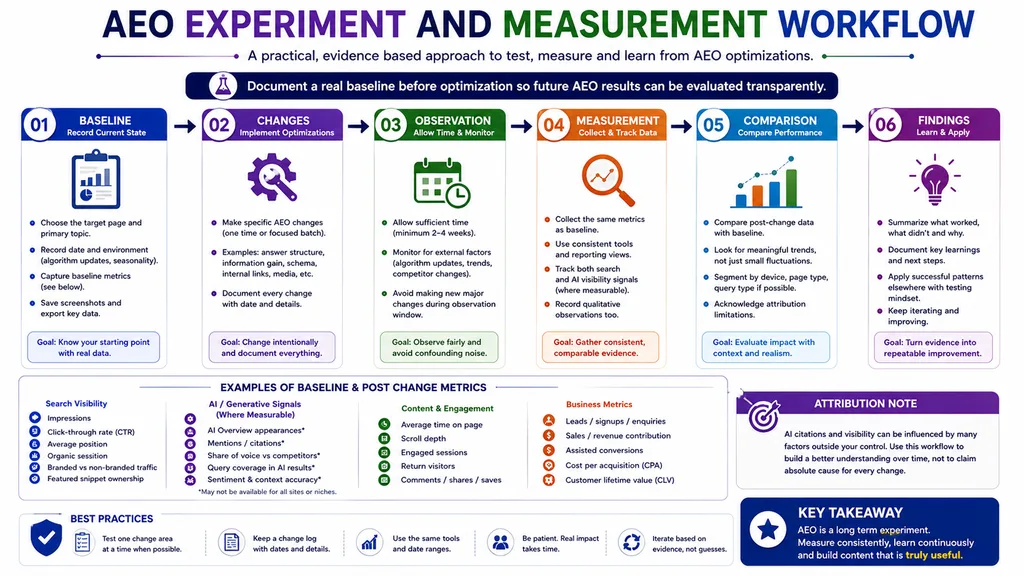
AEO Implementation Checklist
Use this checklist after completing the main optimization process.
It is designed as a final quality-control review rather than a substitute for the detailed steps explained earlier in this guide.
1. Baseline and Page Purpose
Before making major changes, confirm:
- The page has one clearly defined primary purpose.
- The dominant search intent has been identified.
- The intended audience is clear.
- Relevant baseline search data has been recorded where available.
- Existing conversions or business actions have been documented where relevant.
- Important existing headings, links, schema, and page elements have been recorded before major changes.
- Any observable generative-search baseline has been documented only where it can be measured reliably.
2. Search Intent and Content Ownership
Check:
- The page solves a distinct user task.
- Keyword variations representing substantially the same intent have not been unnecessarily split across multiple pages.
- Existing site content has been checked for search-intent overlap.
- The page has a clear role within the broader topic cluster.
- Supporting topics that deserve separate pages have been identified rather than forced into this page.
- The page does not unnecessarily compete with another primary URL on the same website.
3. Answer-First Structure
For important sections, verify:
- Descriptive headings clearly communicate the question or topic.
- The essential answer appears early when a direct answer is appropriate.
- Supporting explanation follows the answer.
- Important limitations or qualifications are included where necessary.
- Evidence appears reasonably close to the claims it supports.
- Examples clarify the answer rather than merely increase length.
- The next useful action is clear where appropriate.
4. Entity Clarity
Check whether:
- Important people, organizations, products, services, tools, concepts, and locations are unambiguous.
- Acronyms are introduced clearly where necessary.
- Important relationships between entities are explained naturally.
- Brand, author, and publisher information is consistent.
- Internal links reinforce useful topical relationships.
- External references identify authoritative sources where appropriate.
- Visible content and structured data describe entities consistently.
5. Information Gain
Ask:
- Does this page provide something meaningfully useful beyond a generic summary?
- Have unnecessary repetitions of competing content been removed?
- Are original frameworks, examples, calculations, screenshots, diagrams, templates, observations, or analyses included where genuinely useful?
- Are first-hand observations clearly distinguished from external facts?
- Are manufacturer, platform, or third-party claims identified appropriately?
- Is every original claim based on genuine evidence rather than invented experience?
- Would the page remain useful if word count were not considered an optimization objective?
6. Technical Search Eligibility
Verify:
- The intended URL returns the appropriate HTTP status.
- The page is crawlable where it is intended to be public.
- No unintended
noindexdirective is present. - The canonical URL is appropriate.
- The page is internally discoverable.
- Relevant sitemap handling is correct.
- Important content is available in the rendered page.
- Mobile usability has been reviewed.
- Images are appropriately optimized.
- HTTPS and basic page security are functioning correctly.
- Relevant Search Console inspection has been completed where necessary.
7. Page and Heading Structure
Review:
- The page has one clear H1.
- H2 sections represent major subtopics.
- H3 and H4 headings are used hierarchically rather than decoratively.
- Heading text is descriptive.
- Long sections are broken into useful logical units.
- Numbered lists are used for sequences.
- Bullet lists are used for grouped information.
- Tables are used when comparison or structured data genuinely benefits the reader.
- Important information is not available only inside an image.
- The table of contents matches the final heading structure.
- All TOC anchor links work after heading changes.
8. Structured Data
Check:
- The actual page type has been identified before adding schema.
- Existing theme or plugin-generated structured data has been inspected.
- Duplicate or conflicting markup has been avoided.
- Article or BlogPosting markup accurately describes the article where applicable.
- Author information refers to a real author.
- Publisher information is accurate.
- Publication and modification dates are accurate.
- Breadcrumb markup reflects the real site hierarchy where used.
- Other structured data is used only when it genuinely applies.
- Structured data matches visible page content.
- The final markup has been validated.
- No schema implementation is described as a guaranteed AI citation or ranking technique.
9. Evidence and Trust
Verify:
- Important factual claims can be traced to appropriate evidence.
- Primary sources are preferred where practical and relevant.
- Statistics include appropriate sourcing and context.
- Time-sensitive claims have been checked for freshness.
- Facts, interpretations, observations, and recommendations are distinguishable.
- First-hand experience is claimed only when it genuinely exists.
- Screenshots are authentic and appropriately contextualized.
- No client results, traffic data, revenue, credentials, awards, or experiments have been fabricated.
- Author information is accurate.
- Publisher information is transparent.
- Relevant disclosures are included where necessary.
10. Internal Linking and Topic Architecture
Confirm:
- Important supporting resources receive contextual internal links.
- Anchor text describes the destination naturally.
- Internal links are useful to the reader rather than inserted only for keywords.
- The page links upward or sideways within its topic cluster where appropriate.
- Relevant supporting pages link back to the primary resource where useful.
- Broken internal links have been checked.
- No unnecessary near-duplicate article has been created for a minor keyword variation.
11. AEO and Generative Search Claims
Check:
- The article does not promise guaranteed AI citations.
- It does not promise guaranteed Google AI Overview inclusion.
- It does not claim that structured data guarantees generative visibility.
- It does not present unsupported AI-oriented files or techniques as universal ranking requirements.
- It does not manufacture authority signals.
- It does not use keyword or entity stuffing.
- It does not imply that AEO replaces foundational SEO.
- Recommendations remain focused on usefulness, accessibility, evidence, originality, and user intent.
12. Conversion Path
For commercially relevant pages, verify:
- The next action matches the visitor’s intent.
- Informational sections are not overwhelmed by aggressive sales messaging.
- Relevant services or products are introduced contextually.
- Calls to action accurately describe what happens next.
- Forms and conversion elements work correctly.
- Important trust information is accessible.
- Conversion tracking works where applicable.
13. Pre-Publish Quality Control
Before publishing or updating the page:
- Read the title and introduction together.
- Read only the headings to confirm that the article tells a logical story.
- Check for repeated sections.
- Remove unsupported claims.
- Verify important dates and facts.
- Test internal and external links.
- Review image filenames, alt text, captions, and placement.
- Check the page on mobile.
- Review the final table of contents.
- Check structured data.
- Proofread the final version.
- Record the publication or optimization date.
14. Post-Publish Measurement
After publication:
- Confirm that the intended page can be accessed normally.
- Verify indexing status where appropriate.
- Record when major changes were published.
- Monitor relevant Search Console queries.
- Monitor impressions, clicks, and CTR in context.
- Review whether query coverage matches the intended search intent.
- Monitor meaningful website actions.
- Track relevant conversions where applicable.
- Record observable generative mentions, citations, or referrals only where they can be measured reliably.
- Document major external or site-wide changes that could affect performance.
- Avoid concluding from very small samples or short-term fluctuations.
15. Periodic Content Review
AEO optimization does not end when the page is published.
Periodically review:
- factual accuracy,
- outdated claims,
- broken links,
- stale screenshots,
- changed products or services,
- outdated statistics,
- search-intent changes,
- content overlap,
- internal-link opportunities,
- structured-data accuracy,
- conversion paths,
- and significant performance changes.
Update the page when doing so makes the resource more accurate, useful, or complete—not merely to change the publication date.
Final AEO Quality Check
Before considering the page complete, answer these questions:
Is the page technically accessible and eligible for the search experience it targets?
Does it satisfy one clear primary user intent?
Can readers find important answers without unnecessary effort?
Does the page contribute meaningful information beyond a generic summary?
Are important claims supported and verifiable?
Are authors, publishers, entities, and sources represented accurately?
Does the page fit logically within the website’s topic architecture?
Does structured data accurately describe the visible content?
Are search and generative visibility treated as measurable outcomes rather than guaranteed results?
Is there a clear method for evaluating performance after publication?
If any answer is no, identify the relevant section of the workflow and fix that issue before adding more optimization tactics.
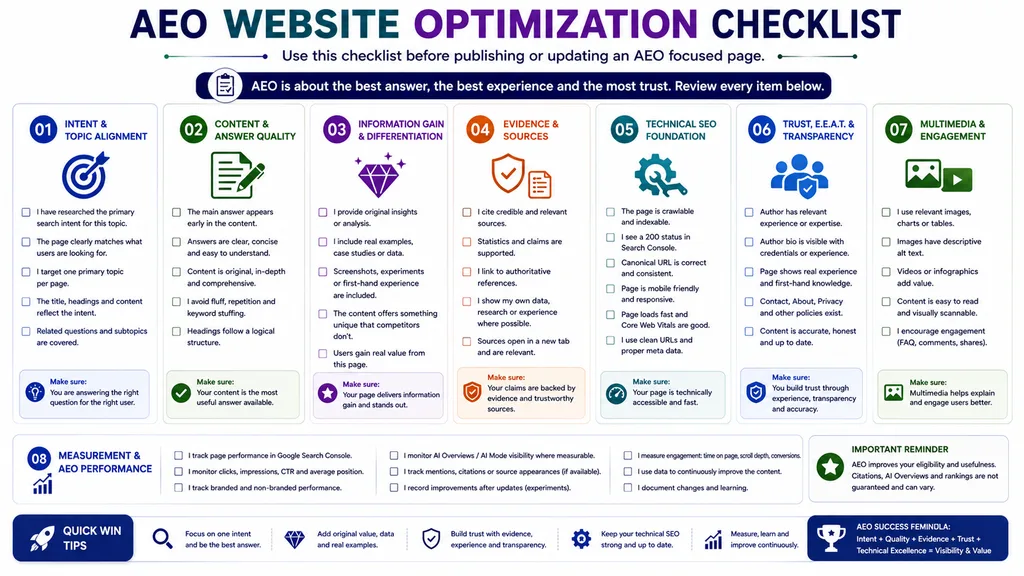
Frequently Asked Questions
How do you use AEO in digital marketing?
Use AEO by first identifying the user’s search intent, then structuring the page around clear answers, useful supporting information, accurate entities, original information, technical search eligibility, appropriate structured data, reliable evidence, internal links, and measurable outcomes.
AEO works best as part of a broader SEO and content strategy rather than as a separate shortcut for AI visibility.
What is the first step when implementing AEO?
Start with a baseline audit.
Record the page’s current search performance, primary purpose, important queries, content structure, internal links, technical status, and relevant conversions before making major changes.
This gives you a reference point for evaluating what happens after optimization.
Does AEO replace traditional SEO?
No.
AEO depends on many of the same foundations required for sustainable organic search visibility, including crawlability, indexability, useful content, search-intent alignment, internal linking, clear site architecture, and trustworthy information.
AEO adds emphasis to making answers, entities, evidence, and information relationships easier to understand and use.
How should content be structured for AEO?
For questions that benefit from a direct response, a useful structure is:
Question or descriptive heading → direct answer → explanation → evidence → example → next action
The complete page should also maintain a logical H1-H2-H3 hierarchy and one clear primary purpose.
Do not divide content into artificially small sections simply because of an assumed AI-preferred content length.
How long should an AEO answer be?
There is no universal word count that makes an answer AEO-optimized.
Use the shortest answer that accurately addresses the question, then provide the context, evidence, qualifications, examples, or instructions the reader needs.
A simple factual question may require only a short response, while a complex decision may require substantial explanation.
Does schema markup improve AEO?
Accurate structured data can help machines understand certain information about a page and its entities, but schema should describe content that genuinely exists on the page.
It should not be treated as a guarantee of higher rankings, Google AI Overview inclusion, AI citations, or generative-search visibility.
Use only structured data that accurately applies to the page and validate the final implementation.
Should every article have FAQ schema for AEO?
No.
An article can contain useful questions and answers without automatically requiring FAQ structured data.
Structured data should be selected according to the actual page content, applicable requirements, and the search platform’s current documentation.
Do not add FAQ markup merely because an article has an FAQ section.
How important is original information for AEO?
Original information can make a resource more useful and distinctive.
Depending on the topic, this may include genuine first-hand experience, original screenshots, documented experiments, calculations, frameworks, templates, comparison methods, data, or expert analysis.
Originality should provide additional value rather than simply make the article longer.
Can AI-generated content be used for AEO?
AI can assist with research organization, outlining, editing, summarization, ideation, and other parts of the content workflow.
However, the final resource should still be accurate, useful, appropriately sourced, and reviewed for unsupported claims, repetition, factual errors, and generic information.
Do not use AI to fabricate experience, credentials, sources, screenshots, case studies, statistics, or results.
How do you measure AEO performance?
Measure AEO across multiple layers rather than relying on one metric.
Useful observations may include:
- relevant search impressions,
- queries,
- organic clicks,
- CTR in context,
- meaningful website interactions,
- conversions,
- content quality and freshness,
- and observable generative mentions, citations, or referrals where they can be measured reliably.
Compare results with a documented baseline whenever possible.
How long does AEO take to show results?
There is no universal AEO timeline.
The observation period can vary according to factors such as existing search visibility, crawl frequency, competition, search demand, website authority, content quality, technical condition, and the scale of the changes.
Avoid promising rankings, traffic, citations, or conversions within a fixed number of days.
Does AEO guarantee visibility in Google AI Overviews or AI Mode?
No.
Improving technical eligibility, usefulness, evidence, originality, entity clarity, and content structure can strengthen the underlying resource, but it does not guarantee selection or inclusion in a particular generative search experience.
Treat visibility as an outcome to observe rather than something that can be guaranteed.
What is the difference between AEO and GEO?
AEO and GEO overlap substantially, but they emphasize somewhat different optimization questions.
AEO generally focuses on making information easier to understand and use in answer-oriented search experiences, while GEO is commonly discussed in relation to how brands, entities, and content are represented or discovered across generative AI experiences.
Both should build on strong SEO, useful content, evidence, technical accessibility, and clear entity relationships.
A dedicated comparison is more appropriate when a detailed AEO-versus-GEO analysis is required.
Can AEO cause keyword cannibalization?
AEO itself does not require multiple pages for minor keyword variations.
Cannibalization risk increases when several URLs substantially satisfy the same search intent.
Before publishing another AEO article, compare its:
- dominant intent,
- user task,
- audience,
- page purpose,
- and expected outcome
with existing content.
When several keywords represent the same task, consider consolidating them into one stronger primary resource.
What is the most important rule for sustainable AEO?
Optimize the underlying resource rather than trying to manipulate a particular answer engine.
A sustainable AEO process should make content:
accessible, useful, clear, distinctive, attributable, verifiable, and measurable.
If an optimization technique does not improve the resource or solve a genuine technical problem, question whether it is necessary.
Recommended Internal Resources for Further Reading
- AEO Basics 2026: Proven Answer Engine Optimization Guide for Beginners
Learn the fundamentals of Answer Engine Optimization, including search intent, answer-first content, information gain, technical SEO, structured data, and AEO measurement. - Google Search Console Guide 2026
Learn how to monitor search queries, impressions, clicks, CTR, indexing, page performance, and other metrics used to establish and evaluate an AEO baseline. - Website Planning Checklist
Use this practical planning framework to define website goals, page purpose, content requirements, site architecture, and customer journeys. - Types of Websites Explained: 18 Powerful Examples & Uses
Understand how different types of websites serve different audiences, search intents, business objectives, and conversion paths. - Website Maintenance Guide 2026–2027
Learn how regular technical checks, content updates, security monitoring, link maintenance, and performance reviews help keep a website accurate and reliable. - Complete Domain Name Guide
Learn how to choose, register, protect, and manage a professional domain name while avoiding common ownership and renewal problems. - Website Features Checklist
Review important website features and functionality when planning a professional, user-focused website. - Website Launch Checklist
Follow a structured pre-launch process covering website functionality, SEO, usability, content, and technical checks. - Professional Website Security Guide
Explore website security practices covering secure access, malware protection, backups, monitoring, and ongoing website protection. - Complete SSL Certificate Guide
Understand SSL certificates, HTTPS, website encryption, installation, migration, and common configuration issues.
Authoritative External Resources and References
- Google Search Central – Latest Search Documentation Updates
Review Google’s latest Search documentation updates, including guidance related to generative AI features, AI Overviews, AI Mode, structured data, and evolving search optimization practices. - Google Search Console – Performance Report
Use Google Search Console’s Performance report to monitor search impressions, clicks, queries, CTR, pages, and other search-performance data when establishing and measuring an AEO baseline. - Google Search Console – Performance Report Queries and Data
Understand how Google Search Console reports queries and other performance dimensions, including important limitations affecting query-level data. - Google Search Console – Performance Measurement
Learn how Google defines and reports impressions, clicks, click-through rate, and other Search performance information. - Google Search Console – Performance Report Use Cases
Learn how to identify top-performing content, evaluate queries, analyze pages, and use Search Console performance information to improve search strategy. - Google Search Console – Advanced Performance Filtering
Learn how to segment and compare Search Console performance data using queries, pages, countries, devices, dates, and other dimensions. - Schema.org – Structured Data Vocabulary
Explore the shared Schema.org vocabulary used to describe entities, relationships, properties, and structured information on webpages. - Schema.org – Getting Started
Learn the fundamentals of adding structured information to web content using Schema.org vocabulary and supported markup formats. - Schema.org – Official Documentation
Access Schema.org documentation covering schema types, properties, data models, vocabulary documentation, extensions, and implementation resources.
1 Comment