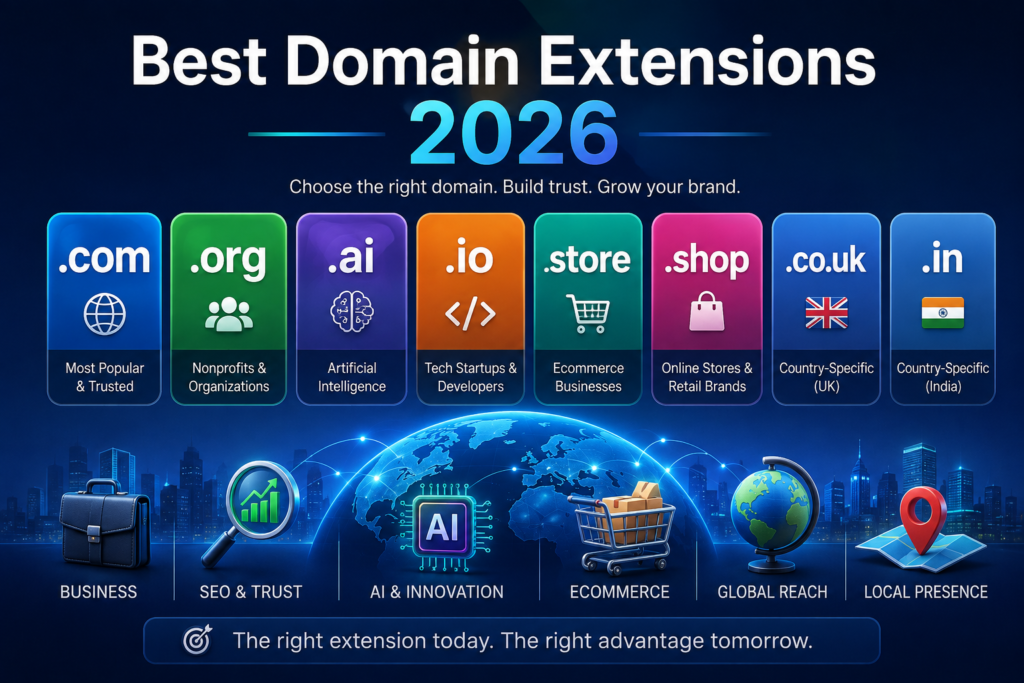
Table of Contents
Target Audience: Business owners, startups, website owners, ecommerce brands, SaaS companies, developers, marketers, agencies, and entrepreneurs.
Last Updated: 11th August 2026
Choosing the right domain extension is one of the earliest decisions you make when building a website, but its impact can last for years.
A domain extension is the ending of your domain name, such as .com, .org, .net, .ai, .io, .store, .shopor a country-code extension such as .ca, .uk, .au, or .pk.
At first, the decision may seem simple. Find an available name, choose an extension, register it, and start building.
In practice, the decision deserves more attention.
Your domain extension can influence how people interpret your brand, whether your website appears local or international, how easily customers remember your web address, how your email addresses look, how much the domain costs to maintain, and whether the domain still fits your company after it grows.
For many businesses, .com remains the strongest all-purpose option in 2026 because it is widely recognized and provides excellent long-term flexibility.
However, .com is not automatically the best choice for every website.
A nonprofit organization may be better represented by .org.
An artificial intelligence startup may benefit from the immediate category association of .ai.
A developer platform may find .dev or .io more natural.
An ecommerce company may create a memorable brand using .store or .shop.
A business serving customers almost entirely within one country may benefit from an appropriate country-code top-level domain.
There is also an important SEO distinction to understand from the beginning.
Choosing a specific generic domain extension does not automatically improve your website’s Google rankings.
The strongest domain decision therefore combines branding, audience expectations, geography, memorability, cost, legal considerations, technical requirements, and future business plans.
This comprehensive guide compares the best domain extensions in 2026, explains their advantages and limitations, examines their relationship with SEO, and provides a practical framework for choosing the right TLD for your business.
Quick Answer: What Is the Best Domain Extension in 2026?
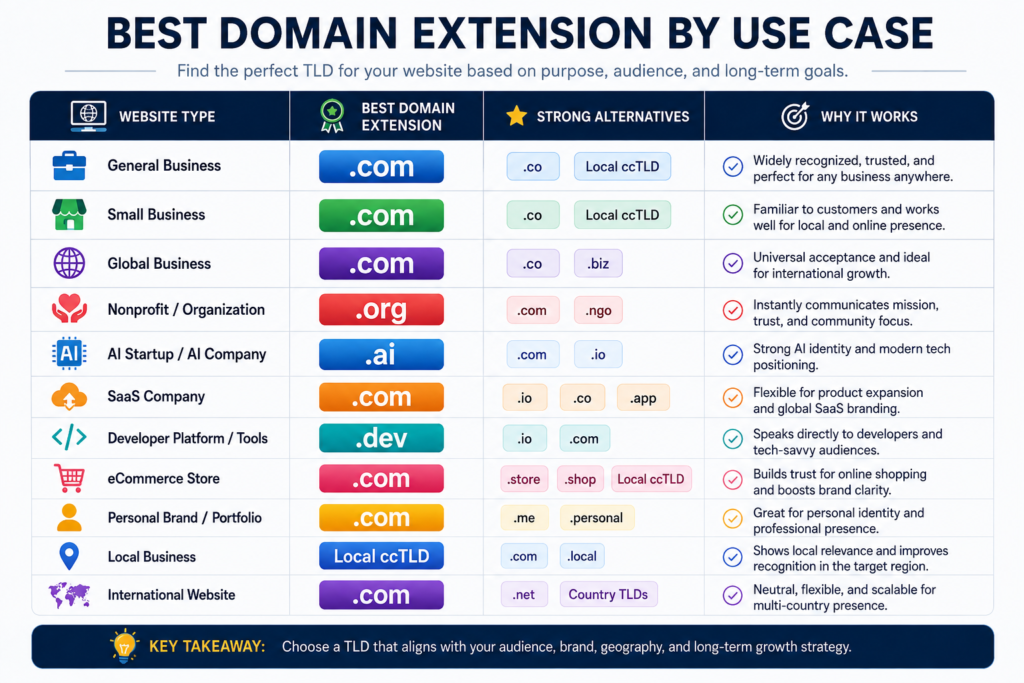
For most commercial websites, .com is the best overall domain extension in 2026 because it combines broad recognition, international usability, familiarity, and long-term brand flexibility.
However, the best TLD depends on the purpose of the website.
| Website Type | Recommended Extension | Strong Alternatives | Primary Reason |
|---|---|---|---|
| General Business | .com | .co, local ccTLD | Recognition and flexibility |
| Small Business | .com or local ccTLD | .co | Customer familiarity |
| Global Business | .com | .co | International positioning |
| Nonprofit | .org | .com | Organizational identity |
| AI Startup | .com or .ai | .io, .co | Broad brand vs AI positioning |
| SaaS Company | .com | .io, .co, .app | Product flexibility |
| Developer Platform | .dev or .io | .com | Technical audience relevance |
| Ecommerce Store | .com | .store, .shop, ccTLD | Commerce and brand clarity |
| Personal Brand | .com or .me | Relevant niche TLD | Personal identity |
| Local Business | ccTLD or .com | Industry TLD | Geographic relevance |
| International Website | .com or another suitable gTLD | Multi-country architecture | Global scalability |
The practical rule is straightforward:
Choose the extension that best aligns with your users, brand, geographic market, and long-term business strategy rather than selecting a TLD because you expect an automatic SEO ranking advantage.
Key Takeaways
Before exploring each extension in detail, these are the most important conclusions:
.comremains the strongest general-purpose option for many businesses..orgis particularly appropriate for nonprofits, associations, communities, and mission-driven organizations..aioffers powerful category positioning for artificial intelligence businesses..ioremains popular with SaaS companies, developers, and technology startups..appCan work well for applications and software products..devIs highly relevant to developer-focused websites and tools..storeand.shopcan create immediate ecommerce positioning.- Country-code domains can provide meaningful geographic signals for websites focused on particular countries.
- New generic TLDs are not automatically disadvantaged in Google Search.
- Keywords contained in a domain extension should not be treated as automatic ranking signals.
- First-year domain pricing can be misleading. Renewal pricing matters.
- Domain security depends on registrar security, DNS management, HTTPS, account protection, and related controls rather than the TLD alone.
- A short and memorable alternative extension can sometimes be better than a complicated one.
.com. - The best domain should support the company you plan to build, not only the website you operate today.
What Is a Domain Extension?
A domain extension is the final part of a domain name appearing after the last dot.
For example:
example.com
Here, .com is the domain extension.
Similarly:
example.org
uses .org.
example.ai
uses .ai.
example.pk
uses .pk.
The technical term for a domain extension is a Top-Level Domain, commonly abbreviated as TLD.
Domain Extension Examples
Common examples include:
.com.org.net.co.ai.io.app.dev.store.shop.tech.me.agency
Country-specific examples include:
.us.uk.ca.au.pk.de.fr.jp
Why Domain Extensions Matter
A domain extension serves a technical function within the Domain Name System, but users can also interpret it as part of your brand.
For example:
.orgis commonly associated with organizations..aiis strongly associated with artificial intelligence..devsuggests development..storesuggests ecommerce..agencysuggests a service agency..pkcommunicates a connection with Pakistan..cacommunicates a connection with Canada.
The extension can therefore affect how quickly a visitor understands your website.
That makes choosing a TLD both a technical decision and a branding decision.
Domain Registry vs Domain Registrar vs Registrant
Understanding the domain ecosystem helps you make better registration and security decisions.
What Is a Domain Registry?
A domain registry operates the authoritative infrastructure and database associated with a particular top-level domain.
Registry policies can influence matters such as:
- Eligibility
- Reserved names
- Premium names
- Registration periods
- Renewal rules
- Technical requirements
- Transfer procedures
Different extensions can therefore operate under different policies.
What Is a Domain Registrar?
A domain registrar is a company through which customers register domain names.
Registrars commonly provide services such as:
- Domain registration
- DNS management
- Domain transfers
- Renewal management
- Registration privacy services
- Hosting
- SSL or TLS-related services
The registrar provides the customer-facing relationship, while the registry operates the relevant TLD infrastructure.
What Is a Domain Registrant?
The registrant is the person or organization that registers the domain and holds the registration rights subject to the applicable agreements and policies.
A business should maintain direct control over important domain assets, including:
- Registrar login
- Recovery email
- Multi-factor authentication
- Billing information
- DNS configuration
- Renewal settings
- Administrative contacts
For a business website, the domain should be treated as a critical digital asset.
Types of Domain Extensions
Not all TLDs belong to the same category.
Understanding the major categories makes it easier to select the right extension.
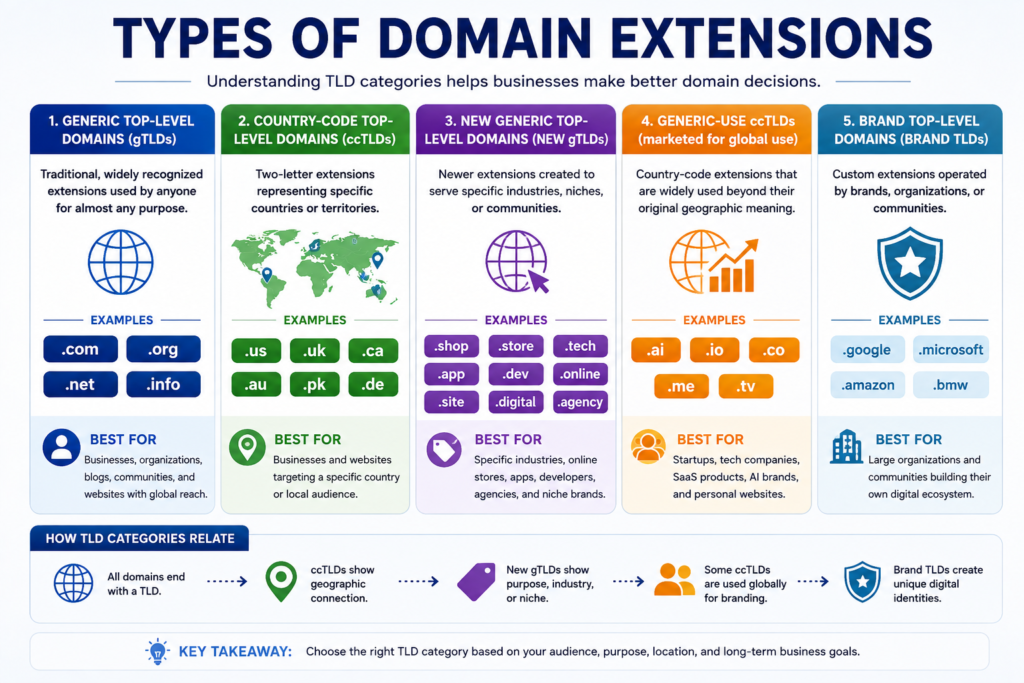
Generic Top-Level Domains (gTLDs)
Generic Top-Level Domains are commonly known as gTLDs.
Traditional examples include:
.com.org.net
These extensions are widely used and generally suitable for websites targeting audiences beyond one specific country.
They can work well for:
- Businesses
- Ecommerce websites
- SaaS platforms
- International brands
- Blogs
- Communities
- Organizations
New Generic Top-Level Domains
The domain ecosystem now contains many newer generic extensions.
Examples include:
.store.shop.tech.agency.cloud.app.dev.online.site.digital
These extensions can create useful branding opportunities.
For example:
example.store
immediately communicates a retail context.
example.agency
communicates a service-business context.
example.dev
communicates a developer-oriented context.
However, descriptive meaning should not be confused with an automatic search ranking advantage.
Country-Code Top-Level Domains (ccTLDs)
Country-Code Top-Level Domains are commonly abbreviated as ccTLDs.
Examples include:
.pk.ca.au.uk.de.fr.jp
They are associated with countries or territories.
A ccTLD can be particularly useful when a website is strongly focused on one geographic market.
Generic-Use Country-Code Domains
Some extensions are technically country-code domains but have become widely used for broader branding purposes.
Important examples include:
.ai.co.io.me.tv
Their popular meanings can differ from their original geographic associations.
For example, .ai is now strongly associated with artificial intelligence, while .io is common in the technology sector.
Sponsored and Restricted TLDs
Some extensions are intended for particular communities, industries, institutions, or eligible registrants.
Registration requirements may include:
- Geographic presence
- Professional eligibility
- Institutional status
- Supporting documentation
- Specific organizational requirements
Always verify the current official registry rules before committing a brand to a restricted extension.
Brand TLDs
Large organizations may apply to operate their own top-level domain through the appropriate ICANN process.
This is fundamentally different from registering a normal domain.
Registering:
example.com
means obtaining a domain under .com.
Operating:
.example
would involve registry-level responsibilities.
For ordinary businesses and website owners, traditional domain registration remains the relevant process.
How to Choose the Best Domain Extension
Choosing the right TLD requires more than checking which domain is available.
A professional evaluation should consider the following factors.
1. Understand Your Target Audience
Start with the people who will use the website.
Ask:
- Where do they live?
- What language do they speak?
- Are they businesses or consumers?
- Are they technical or nontechnical?
- Do they recognize the extension?
- Will they understand it when they hear it?
A .dev domain may be completely natural to a software developer.
It may be less intuitive to customers looking for a local accountant.
2. Evaluate Brand Recognition
The complete domain should be easy to:
- Read
- Spell
- Say
- Remember
- Type
- Share
The strongest extension is not useful if the complete domain becomes confusing.
3. Consider Geographic Targeting
Determine whether your business is:
- Local
- National
- Multi-country
- International
- Global
A country-focused website may benefit from a ccTLD.
A company expecting worldwide expansion may prefer a generic domain.
4. Evaluate Industry Relevance
Industry-specific extensions can create immediate context.
Examples include:
.aifor artificial intelligence.devfor developers.storefor ecommerce.agencyfor agencies.techfor technology
However, niche relevance should be balanced against long-term flexibility.
5. Compare the Actual Domain Names
Do not compare extensions in isolation.
Compare the full domains.
For example:
bright.co
may be easier to remember than:
bright-online-business-solutions-company.com
The second option has .com, but that does not automatically make the complete domain stronger.
6. Consider Long-Term Business Growth
Ask whether the extension will still make sense if your business expands.
A company may begin as an agency and later add:
- SaaS
- Hosting
- Training
- Consulting
- Digital products
A .agency domain could eventually feel restrictive.
Similarly, an AI startup could expand beyond AI-specific products.
Think several years ahead.
7. Test Email Usability
Imagine your domain in an email address:
contact@brand.com
contact@brand.ai
contact@brand.agency
Ask whether customers can:
- Understand it
- Type it correctly
- Remember it
- Distinguish it from similar addresses
Email usability is an important but frequently overlooked part of domain selection.
8. Check Domain Renewal Costs
Never evaluate a domain solely by its introductory registration price.
Check:
- Initial registration cost
- Standard renewal cost
- Premium renewal pricing
- Transfer cost
- Privacy-related fees where applicable
- Taxes
- Currency conversion
Calculate the approximate cost of ownership over several years.
9. Verify Registry Restrictions
Before registration, check whether the extension has:
- Residency requirements
- Business requirements
- Documentation requirements
- Professional restrictions
- Local presence requirements
Rules can vary by registry and extension.
10. Consider Brand Protection
Registering additional domains can sometimes reduce:
- Customer confusion
- Impersonation
- Brand abuse
- Typographical mistakes
However, defensive registration should be targeted.
Most businesses do not need dozens of extensions.
Best Domain Extensions Compared
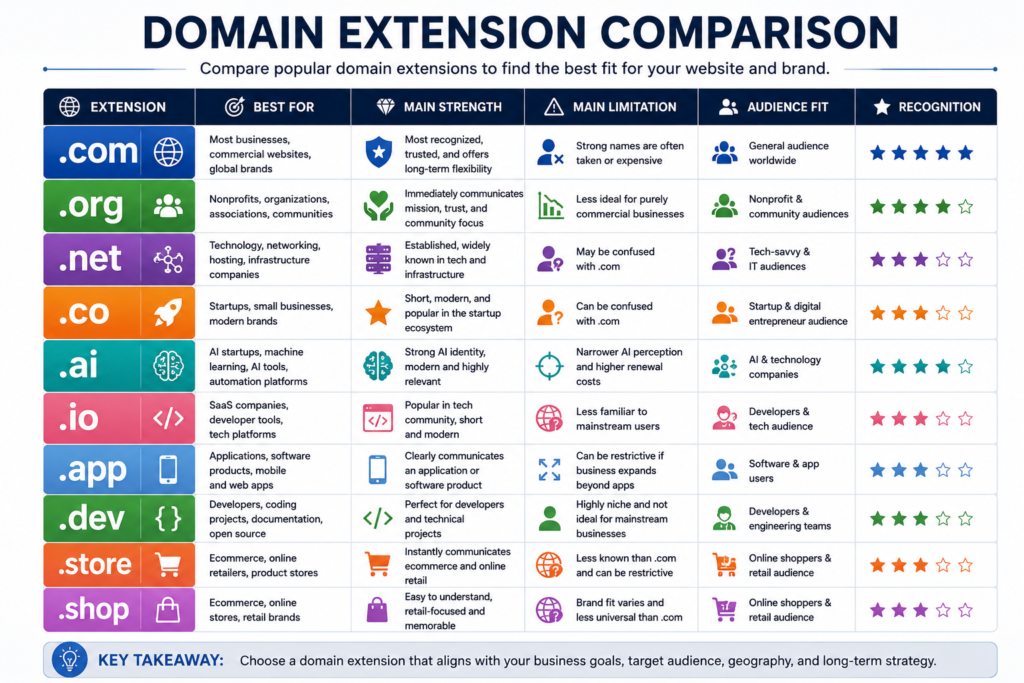
The following table provides a high-level comparison of major TLD choices.
| Extension | Best For | Main Strength | Main Limitation |
|---|---|---|---|
.com | Most businesses | Recognition and flexibility | Strong names may be unavailable |
.org | Nonprofits and organizations | Mission-oriented familiarity | Less commercial positioning |
.net | Technology and infrastructure | Established recognition | Possible .com confusion |
.co | Startups | Short and modern | Possible .com confusion |
.ai | AI companies | Strong AI identity | Can narrow perceived scope |
.io | SaaS and developers | Technology association | Less familiar outside tech |
.app | Applications | Clear product meaning | Narrow positioning |
.dev | Developer tools | Strong developer identity | Highly specialized |
.store | Ecommerce | Immediate commerce meaning | Less familiar than .com |
.shop | Retail | Clear shopping meaning | Brand fit varies |
.tech | Technology companies | Category clarity | Can become restrictive |
.me | Personal brands | Personal identity | Less suitable for many companies |
.agency | Agencies | Immediate service identity | Can limit future positioning |
| ccTLD | Country-focused websites | Geographic relevance | Can create a national perception |
Best Domain Extensions in 2026
Now consider the major extensions individually.
1. .com: Best Overall Domain Extension
For many businesses, .com remains the strongest general-purpose domain extension.
Its main advantage is not a guaranteed SEO benefit.
Its advantage is widespread familiarity.
.com can work effectively for:
- Businesses
- Ecommerce stores
- SaaS platforms
- Startups
- Agencies
- Blogs
- Media brands
- Professional services
- International companies
Advantages of .com
Key benefits include:
- Broad recognition
- International familiarity
- Strong commercial identity
- Long-term flexibility
- Professional email appearance
- Suitability across industries
- Easy expansion into new markets
A company can begin with one service and expand significantly without making .com feel outdated.
Disadvantages of .com
The primary challenge is availability.
Many short and desirable .com domains have already been registered.
Businesses may therefore face:
- Expensive premium domains
- Longer names
- Additional words
- Hyphens
- Awkward abbreviations
Do not destroy a good brand merely to obtain .com.
Who Should Use .com?
.com is particularly suitable for:
- International businesses
- Commercial websites
- Ecommerce companies
- Professional service providers
- SaaS companies
- Brands with broad expansion plans
When Should You Avoid .com?
Avoid forcing .com when the available name becomes:
- Excessively long
- Difficult to spell
- Confusing
- Legally risky
- Unreasonably expensive
A cleaner alternative can sometimes be the stronger strategic choice.
2. .org: Best Domain Extension for Nonprofits
.org has strong recognition among organizations and mission-driven initiatives.
It is particularly suitable for:
- Nonprofits
- Charities
- Associations
- Communities
- Public-interest projects
- Open-source organizations
- Educational initiatives
Advantages of .org
.org Can communicate:
- Organizational identity
- Community orientation
- Mission-driven positioning
- Familiarity
Disadvantages of .org
A purely commercial company may create the wrong expectation by using it. .org.
The issue is not technical SEO.
It is positioning.
Who Should Use .org?
Consider .org when the organization exists primarily around:
- Public benefit
- Membership
- Community
- Advocacy
- Education
- Nonprofit activity
.org vs .com
Choose .org when organizational identity is central.
Choose .com when the website represents a conventional commercial business.
Neither extension should be selected because of an assumed automatic Google ranking advantage.
3. .net: Established Alternative to .com
.net remains an established domain extension.
It can work particularly well for:
- Hosting companies
- Networking businesses
- Infrastructure providers
- Technology companies
- Software services
Is .net Still a Good Domain Extension?
Yes.
A strong .net domain can be perfectly professional.
The key issue is customer confusion.
If another company owns the matching .comusers may accidentally visit that website.
Advantages of .net
- Long-established extension
- Familiar to many internet users
- Strong fit for technical businesses
- More availability than
.comin some cases
Disadvantages of .net
- Users may assume
.com - Less universal commercial recognition than
.com - Can create leakage when the matching
.comis an active competitor
.net vs .com
Choose .com when both names are equally strong and reasonably available.
Choose .net when it creates a significantly better brand and the matching .com does not create serious confusion.
4. .co: Strong .com Alternative for Startups
.co is widely used by startups and digital businesses.
It can be suitable for:
- Startups
- SaaS businesses
- Technology companies
- Agencies
- Online services
- Modern brands
Advantages of .co
- Short
- Clean
- Modern
- Widely understood in startup circles
- Useful when
.comis unavailable
Disadvantages of .co
The largest issue is potential .com confusion.
A customer hearing:
brand.co
may later type:
brand.com
.co vs .com
If both are available and equally strong, .com will usually be the safer general-purpose choice.
If .com requires a long or awkward name while .co preserves a strong brand, .co deserves serious consideration.
Always investigate the matching. .com.
5. .ai: Best Domain Extension for AI Companies
.ai has become one of the most important technology-oriented domain extensions.
It is particularly relevant for:
- AI startups
- Generative AI platforms
- AI SaaS products
- Machine learning companies
- AI agents
- AI assistants
- Automation platforms
- AI developer tools
Why .ai Is Popular
The letters “AI” have immediate category meaning.
A domain such as:
brand.ai
can communicate artificial intelligence before a visitor even opens the website.
That can provide valuable branding efficiency.
Advantages of .ai
- Strong AI association
- Short
- Modern
- Memorable for technology audiences
- Excellent category positioning
Disadvantages of .ai
Potential limitations include:
- Renewal cost considerations
- Narrower category perception
- Less familiarity among some mainstream audiences
- Possible future mismatch if the company moves far beyond AI
Is .ai Good for SEO?
Yes, a .ai website can rank normally.
The extension should primarily be selected for branding and positioning rather than an assumed ranking advantage.
.ai vs .com
Choose .ai when:
- AI is central to the company.
- The
.aicreates a much stronger name. - Your target audience understands the extension.
- AI will remain a major part of the brand.
Choose .com when:
- You want maximum category flexibility.
- The company may expand significantly beyond AI.
- The
.comname is strong and affordable.
6. .io: Popular Domain Extension for SaaS and Developers
.io has become familiar within technology and developer communities.
It is frequently used by:
- SaaS companies
- Developer tools
- API platforms
- Infrastructure products
- Technology startups
- Open-source projects
Advantages of .io
- Strong recognition among technical audiences
- Short
- Modern
- Good availability for some brands
- Suitable for developer-focused products
Disadvantages of .io
- Less familiar to mainstream consumers
- Can be more niche than
.com - Renewal pricing should be checked
- May require explanation outside technology circles
Is .io Good for SEO?
A .io website can rank normally.
The reason to choose .io is primarily audience and branding fit.
.io vs .com
For a developer-focused startup, .io can be completely natural.
For a mainstream consumer company, .com may be easier for customers to recognize.
7. .app: Best Domain Extension for Applications
.app is particularly relevant when a website represents an application.
It can work for:
- Mobile apps
- Web apps
- Productivity tools
- Software products
- Consumer applications
Advantages of .app
- Immediate application context
- Short
- Modern
- Strong software identity
Disadvantages of .app
The extension can become restrictive if the brand evolves beyond an application.
A company that later becomes a broad technology platform may prefer a more flexible identity.
8. .dev: Best Domain Extension for Developer Projects
.dev is highly relevant to developer audiences.
It can work for:
- Developer tools
- API products
- Programming projects
- Documentation
- Developer portfolios
- Engineering communities
Advantages of .dev
- Clear developer identity
- Strong technical positioning
- Memorable within its target audience
Disadvantages of .dev
- Highly specialized
- Less suitable for mainstream consumers
- May restrict broader brand perception
Use .dev when developer relevance is a genuine strength.
9. .store: Strong Domain Extension for Ecommerce
.store Can create immediate ecommerce positioning.
It can work for:
- Online retailers
- Clothing stores
- Electronics stores
- Beauty stores
- Digital product stores
- Direct-to-consumer brands
Advantages of .store
- Immediate ecommerce meaning
- Potential for short brand combinations
- Easy category recognition
- Useful alternative when
.comis unavailable
Disadvantages of .store
- Less universally familiar than
.com - Renewal costs should be checked
- Can restrict the brand if the company expands beyond commerce
Is .store Good for SEO?
Yes, .store can rank normally.
However, the word “store” in the TLD should not be treated as an automatic keyword-ranking advantage.
10. .shop: Ecommerce-Focused Domain Extension
.shop also provides immediate retail meaning.
Advantages of .shop
- Easy to understand
- Clear shopping intent
- Suitable for ecommerce
- Can create memorable domain combinations
Disadvantages of .shop
- Less universal recognition than
.com - Brand fit varies
- Renewal pricing requires consideration
.shop vs .store
Neither is universally better.
Compare the complete names.
For example:
brand.shop
may sound more natural than:
brand.store
for one company, while the reverse may be true for another.
Choose according to:
- Memorability
- Brand sound
- Customer expectations
- Availability
- Renewal pricing
11. .tech: Domain Extension for Technology Brands
.tech Can provide immediate technology positioning.
It can work for:
- IT companies
- Software companies
- Technology communities
- Digital businesses
- Innovation platforms
Advantages of .tech
- Clear category meaning
- Strong technology association
- Potentially memorable branding
Disadvantages of .tech
The company may eventually outgrow the category.
A business expanding into consulting, media, education, or other sectors may find a broader extension more flexible.
12. .agency: Domain Extension for Agencies
.agency can create a clear identity for:
- Web development agencies
- Marketing agencies
- SEO agencies
- Design agencies
- Advertising agencies
- Creative firms
Advantages of .agency
- Clear service positioning
- Potential for short names
- Easy industry identification
Disadvantages of .agency
It can become restrictive if the company later adds:
- SaaS
- Hosting
- Software
- Products
- Training
- Other business models
A broad .com may provide greater long-term flexibility.
13. .me: Domain Extension for Personal Brands
.me can work particularly well for:
- Personal websites
- Portfolios
- Resume websites
- Creator brands
- Professional profiles
- Personal blogs
Advantages of .me
- Strong personal identity
- Short
- Memorable
- Useful for personal branding
Disadvantages of .me
It may be less appropriate for:
- Large companies
- Ecommerce businesses
- Corporate websites
- Organizations
The extension works best when the individual is the brand.
Best Domain Extensions by Website Type
The best TLD becomes easier to identify when the website’s purpose is clear.
Best Domain Extension for Business
For most general businesses, .com remains the strongest starting point.
Good alternatives include:
- Relevant ccTLD
.co.net- Appropriate industry-specific TLD
The decision should prioritize:
- Brand clarity
- Customer trust
- Market geography
- Long-term flexibility
Best Domain Extension for Small Business
Small businesses should prioritize simplicity.
For many small businesses, the strongest choices are:
.com- Relevant local ccTLD
A small business does not need an unusual extension to look modern.
A clean name and professional website are more important.
Best Domain Extension for Local Business
Local businesses often benefit from:
.com- Relevant national ccTLD
Examples include:
- Plumbers
- Electricians
- Contractors
- Clinics
- Salons
- Repair businesses
- Local consultants
Local relevance should be supported by the entire website, not only the domain extension.
Best Domain Extension for Global Business
A global company generally benefits from a geographically neutral extension.
.com is often the strongest option.
A generic TLD can make international expansion simpler than operating from a domain strongly associated with one country.
Best Domain Extension for a Web Development Agency
A web development agency should usually evaluate:
.com- Relevant country ccTLD
.agency.digital
An international agency will generally benefit from .com when a strong name is available.
A locally focused agency can consider its national extension.
Best Domain Extension for a Digital Marketing Agency
Strong candidates include:
.com.agency.digital- Local ccTLD
Remember that the domain will appear in:
- Proposals
- Invoices
- Advertising
- Business cards
- Client referrals
Choose accordingly.
Best Domain Extensions for Startups
Startups often need alternatives because desirable .com domains can be expensive.
Strong options include:
.com.co.io.ai.app.dev
| Startup Type | Strong Choices |
|---|---|
| General Startup | .com, .co |
| AI Startup | .com, .ai, .io |
| SaaS Startup | .com, .io, .co |
| Developer Startup | .dev, .io, .com |
| Consumer App | .app, .com, .co |
| Ecommerce Startup | .com, .store, .shop |
Best Domain Extension for an AI Startup
The strongest choices are usually:
.com.ai.io.co
For an AI-first startup, .ai can provide exceptional category clarity.
For a company expecting broader expansion, .com may provide more flexibility.
Best Domain Extension for an AI Company
The choice often comes down to .com versus .ai.
Use .ai when artificial intelligence is inseparable from the brand.
Use .com when you want the broadest possible corporate identity.
Best Domain Extension for Generative AI
A generative AI platform should consider:
.ai.com.io
A clean .ai can communicate the category immediately.
However, the company should still investigate the matching. .com.
Best Domain Extension for AI SaaS
Strong choices include:
.com.ai.io
The customer profile should influence the choice.
A developer-facing AI infrastructure platform may fit. .io.
A mainstream AI productivity company may benefit more from .ai or .com.
Best Domain Extension for a Software Company
Strong candidates include:
.com.io.app.dev.co
The more diversified the software business is likely to become, the more valuable a flexible extension becomes.
Best Domain Extension for SaaS
For most SaaS companies, .com remains the strongest general option.
Alternatives include:
.io.co.app
A developer-focused SaaS product may comfortably use .io.
A broad enterprise platform may prefer .com.
Best Domain Extension for Developer Tools
Strong choices include:
.dev.io.com
A developer tool benefits from an extension its audience understands immediately.
Best Domain Extension for Ecommerce
Strong ecommerce choices include:
.com.store.shop- Relevant ccTLD
For a global ecommerce brand, .com provides excellent flexibility.
For a short brand where .com is unavailable, .store or .shop can be highly effective.
Best Domain Extension for a Shopify Store
Shopify does not require a specific TLD.
A Shopify store can use:
.com.store.shop- Relevant ccTLD
- Other suitable supported custom domains
Choose according to branding rather than the e-commerce platform.
Best Domain Extension for a WooCommerce Store
WooCommerce also does not require a special extension.
Strong choices remain:
.com.store.shop- Relevant ccTLD
The CMS should not determine the TLD.
Best Domain Extension for an Online Clothing Store
Fashion brands should prioritize:
- Memorability
- Visual simplicity
- Social media compatibility
- International potential
- Brand identity
Strong choices include:
.com.store.shop- Relevant ccTLD
Best Domain Extension for a Blog
.com remains a highly flexible blogging option.
Alternatives include:
.me.blog- Relevant niche extensions
Consider whether the blog may eventually become:
- A media brand
- Consultancy
- E-commerce business
- Newsletter
- Course platform
Future monetization can influence the best choice.
Best Domain Extension for a Portfolio
Strong options include:
.com.me.design- Other relevant creative extensions
The complete name should remain simple.
Best Domain Extension for a Personal Brand
A professional personal brand should generally consider:
.com.me- Local ccTLD
A name-based .com provides broad flexibility, while .me can create a distinctive personal identity.
Best Domain Extension for Professional Services
For professional services, familiar extensions often work best.
Strong choices include:
.com- Relevant local ccTLD
This applies to:
- Consultants
- Lawyers
- Accountants
- Financial professionals
- Healthcare organizations
- Business advisors
Best Domain Extension for a Consulting Business
A consulting business should generally prioritize:
.com- Relevant ccTLD
A specialized extension may work, but .com usually provides better flexibility if the company later expands.
Best Domain Extension for a Law Firm
Law firms depend heavily on trust and professional credibility.
Strong choices include:
.com- Relevant ccTLD
A novelty extension should only be used when it clearly supports the firm’s branding.
Best Domain Extension for an Accounting Firm
Accountants should prioritize:
- Trust
- Professionalism
- Local recognition
- Easy email communication
- Memorability
.com Local ccTLDs are generally strong candidates.
Best Domain Extension for a Real Estate Business
Real estate is frequently location-dependent.
Strong choices include:
.com- Relevant local ccTLD
The domain should align with the geographic market served.
Best Domain Extension for a Restaurant
Restaurants are usually local businesses.
Strong choices include:
.com- Relevant local ccTLD
The domain should be easy to remember after a customer sees it on:
- A sign
- Menu
- Social media profile
- Advertisement
- Business listing
Best Domain Extensions for International SEO
International SEO introduces an additional consideration: geography.
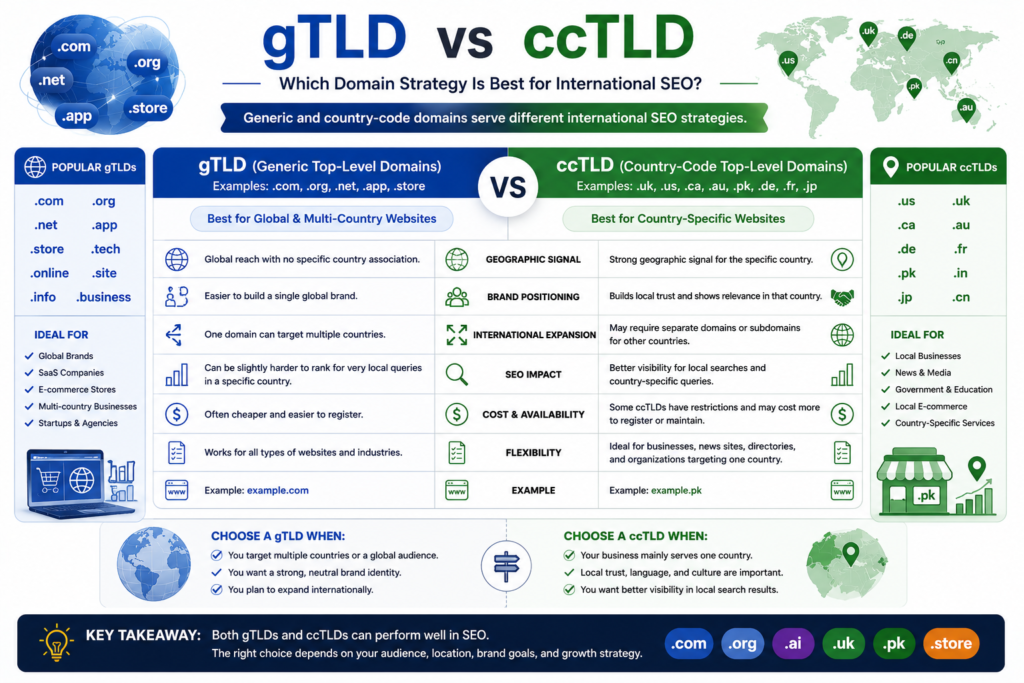
What Is a gTLD?
A generic Top-Level Domain is generally used without a primary country-specific search association.
Examples include:
.com.org.net.store.shop
What Is a ccTLD?
A country-code Top-Level Domain is associated with a country or territory.
Examples include:
.ca.uk.au.pk
gTLD vs ccTLD
| Factor | gTLD | ccTLD |
|---|---|---|
| Global Positioning | Strong | Country-focused |
| Geographic Signal | Generally neutral | Strong for most true ccTLDs |
| International Expansion | Easier | Can require additional architecture |
| Local Recognition | Good | Often excellent |
| Best For | Global brands | National businesses |
Country Domain vs .com
Choose a country domain when:
- Most customers are in one country.
- Products or services are country-specific.
- Pricing is local.
- Regulations are local.
- Local identity matters.
Choose .com when:
- Customers come from multiple countries.
- International expansion is planned.
- You want geographically neutral branding.
- One global domain is operationally preferable.
When Should You Use a ccTLD?
Consider a ccTLD when the business is strongly tied to one country.
Examples include:
- Local ecommerce
- National service businesses
- Country-specific publishers
- Local professional services
When Should You Use a Generic TLD?
Consider a generic TLD when:
- The business targets several countries.
- International expansion is likely.
- The brand should remain geographically neutral.
- The website uses country or language sections under one domain.
Best Domain Extension for Local SEO
A relevant ccTLD can provide geographic context.
However, local SEO also depends on:
- Local content
- Accurate business information
- Google Business Profile
- Reviews
- Relevant links
- Location pages
- Technical SEO
- Search intent
A country domain does not replace local SEO.
Best Domain Extensions by Country
Best Domain Extension for the United States
For US businesses, .com remains a strong general-purpose choice.
It works well for:
- Local companies
- National businesses
- Ecommerce
- SaaS
- Agencies
- Professional services
Best Domain Extension for the United Kingdom
UK businesses can consider:
.co.uk.uk.com
A UK-focused company may prefer a UK-specific identity.
A global company may prefer .com.
Best Domain Extension for Canada
Strong options include:
.ca.com
.ca provides clear Canadian positioning.
.com offers greater international flexibility.
Best Domain Extension for Australia
Strong choices include:
.com.au.au.com
Businesses should check current eligibility and registry requirements before registration.
Best Domain Extension for Pakistan
Pakistan-focused websites can consider:
.pk- Relevant
.pksecond-level domains .com
A Pakistan-only business can benefit from local identity.
A Pakistan-based company serving international customers may prefer .com.
.pk vs .com for Pakistan
Choose .pk when:
- Pakistan is clearly the main market.
- Local identity is strategically valuable.
- Products and services are country-specific.
- International expansion is not a major priority.
Choose .com when:
- The company targets international customers.
- Global expansion is planned.
- The business needs geographically neutral branding.
When Should a Pakistan Business Use .pk?
A .pk domain can make sense for:
- Local ecommerce
- Pakistan-specific information
- Local services
- National organizations
- Businesses primarily serving Pakistani users
When Should a Pakistan Business Use .com?
A .com can be stronger for:
- Export businesses
- International agencies
- SaaS companies
- Global ecommerce
- International consulting
- Technology companies targeting worldwide customers
Do Domain Extensions Affect SEO?
This is one of the most important questions in domain selection.
For generic TLDs, the extension itself should not be treated as an automatic Google ranking advantage.
A .com does not automatically outrank .net.
A .store does not automatically rank better for ecommerce.
A .tech does not automatically rank better for technology.
A .ai does not automatically rank better for artificial intelligence queries.
Website quality remains far more important.
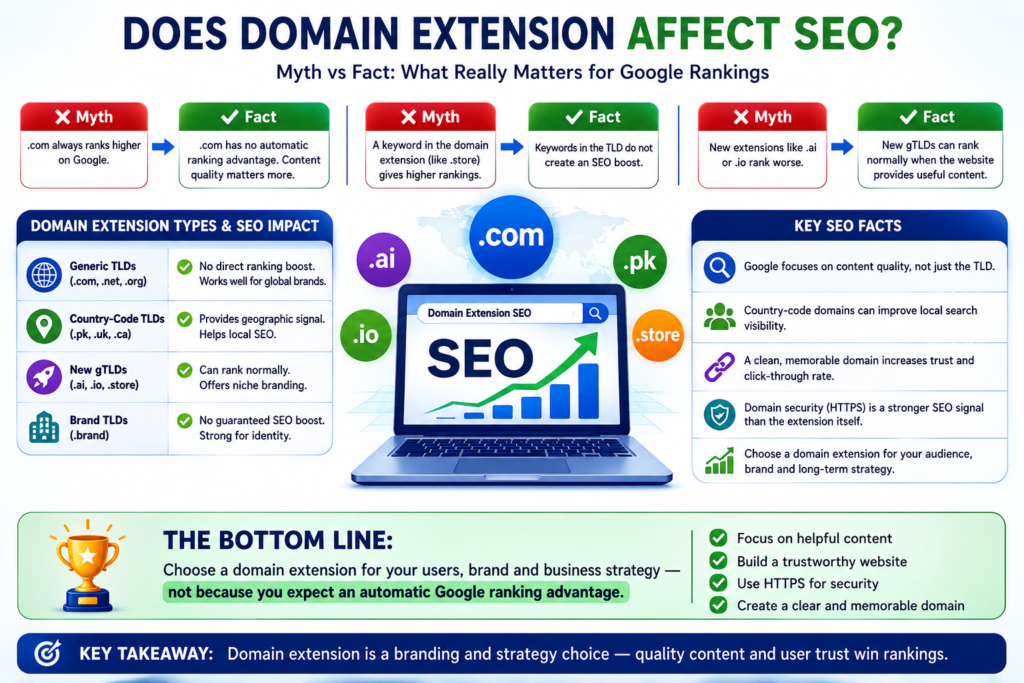
Does .com Rank Better on Google?
Not automatically.
A .com website may rank extremely well because it has:
- Better content
- Strong backlinks
- Topical authority
- Strong brand recognition
- Good technical SEO
- Helpful user experience
Do not confuse correlation with causation.
Does a Keyword in a Domain Extension Help SEO?
A descriptive extension can help users interpret a domain.
For example:
brand.store
Communicates e-commerce.
However, this does not mean the word “store” automatically creates a search ranking advantage.
Are New Domain Extensions Good for SEO?
Yes.
New generic TLDs can rank normally.
Examples include:
.tech.store.agency.cloud.app.dev
The website still needs:
- Useful content
- Crawlability
- Strong architecture
- Relevant links
- Technical quality
- Trust
Is .ai Good for SEO?
Yes.
A .ai website can rank normally.
Its strongest benefit is AI branding.
Is .io Good for SEO?
Yes.
.io can perform normally and is widely recognized within technology communities.
Is .co Good for SEO?
Yes.
.co Can be used for global websites.
Its primary strategic issue is possible .com confusion rather than an inherent SEO problem.
Is .store Good for SEO?
Yes.
.store can rank normally.
Use it when it strengthens ecommerce branding.
Is .shop Good for SEO?
Yes.
.shop can be suitable for ecommerce when the complete domain is memorable and trustworthy.
Do Country-Code Domains Affect SEO?
Country-code domains can provide strong geographic signals.
This can make them strategically useful for country-focused websites.
However, a ccTLD does not create a universal ranking advantage for every query.
Direct SEO Effects vs Indirect Branding Effects
This distinction is essential.
A generic extension may not provide a direct ranking boost, but domain choice can influence:
- Brand recall
- Customer confidence
- Direct navigation
- Email trust
- Word-of-mouth
- Click behavior
- Customer understanding
These are valuable business effects.
They should not be misrepresented as a direct generic-TLD ranking factor.
Domain Extensions and Google AI Overviews
Domain selection is increasingly discussed in relation to AI search.
The same principle applies.
There is no reason to select a generic extension because you expect an automatic advantage in AI-generated search experiences.
Do AI Overviews Prefer Certain Domain Extensions?
There is no established general rule that Google AI Overviews prefer .com, .aior another generic TLD simply because of the extension.
AI-friendly visibility is more closely associated with content qualities such as:
- Clear answers
- Accurate information
- Strong topical relevance
- Logical structure
- Original information
- Reliable sourcing
- Entity clarity
Domain Extensions and Google AI Mode
A strong domain can support branding, but content quality remains central.
Use:
- Descriptive headings
- Direct answers
- Tables
- Comparisons
- Definitions
- FAQs
- Original examples
Domain Extensions and ChatGPT Visibility
A memorable domain can strengthen brand recognition, but the extension itself should not be treated as an automatic ChatGPT visibility factor.
Domain Extensions and Gemini
The same principle applies.
Build a trustworthy website with clear entities and high-quality information rather than relying on TLD selection.
Domain Extensions and Perplexity
Citation-oriented AI systems benefit from accessible, useful, and well-supported information.
The TLD is only one small component of the overall brand.
Domain Extensions and Microsoft Copilot
Focus on:
- Crawlable content
- Strong information architecture
- Accurate facts
- Brand consistency
- Search visibility
rather than attempting to optimize through the extension alone.
Domain Trust and Brand Recognition
Domain trust is contextual.
What Is the Most Trusted Domain Extension?
There is no universal trust score applicable to every audience.
However:
.comhas broad commercial familiarity..orghas strong organizational familiarity.- Local ccTLDs can be highly familiar within their home markets.
.aihas strong recognition within the AI industry..iois familiar to many developers.
Which Domain Extension Looks Most Professional?
Professionalism depends on the business.
For a mainstream company:
.com
may feel most familiar.
For a nonprofit:
.org
may communicate the mission more accurately.
For a local company:
A national ccTLD may be highly professional.
For an AI startup:
.ai
can strengthen category identity.
Which Domain Extension Is Easiest to Remember?
The complete domain matters more than the extension alone.
Compare:
nova.ai
with:
nova-artificial-intelligence-business-solutions.com
The first is likely easier to remember even though the second uses .com.
Does Domain Extension Affect Customer Trust?
It can influence perception.
Customers may feel more comfortable with extensions they recognize.
That makes audience research useful before choosing an unfamiliar TLD.
Domain Extension and Brand Recall
Perform a simple recall test:
- Say the domain aloud.
- Wait several minutes.
- Ask the listener to type it.
- Check whether they remember the extension correctly.
This can reveal practical branding problems.
Domain Extension and Email Trust
Your domain will appear in email addresses.
Test:
hello@brand.com
against:
hello@brand.agency
or:
hello@brand.ai
Choose an address customers can understand and reproduce accurately.
What Should You Do If .com Is Taken?
The absence of your ideal .com does not mean you should choose a poor domain.
Use a structured process.
1. Check Who Owns the .com
Determine whether the domain is:
- Active
- Parked
- Listed for sale
- Used by a competitor
- Used by an unrelated organization
2. Check for Trademark Conflicts
Investigate whether the brand name may create legal problems.
Domain availability does not automatically mean the name is legally safe.
3. Evaluate the Existing .com Website
If the .com belongs to a direct competitor, choosing the same name on another extension may create substantial confusion.
4. Compare Alternative TLDs
Depending on the business, consider:
.co.ai.io.app.dev.store.shop- Relevant ccTLD
5. Compare the Complete Domain Names
A clean alternative may outperform an awkward one .com from a branding perspective.
6. Test Customer Recall
Ask real target users which option they:
- Remember
- Trust
- Understand
- Type correctly
Best Alternatives to .com
| Website Type | Strong Alternative |
|---|---|
| Local Business | Relevant ccTLD |
| Startup | .co |
| AI Company | .ai |
| SaaS | .io or .co |
| Developer Tool | .dev |
| Ecommerce | .store or .shop |
| Nonprofit | .org |
| Personal Brand | .me |
Domain Registration and Renewal Costs
Cost analysis should extend beyond the first year.
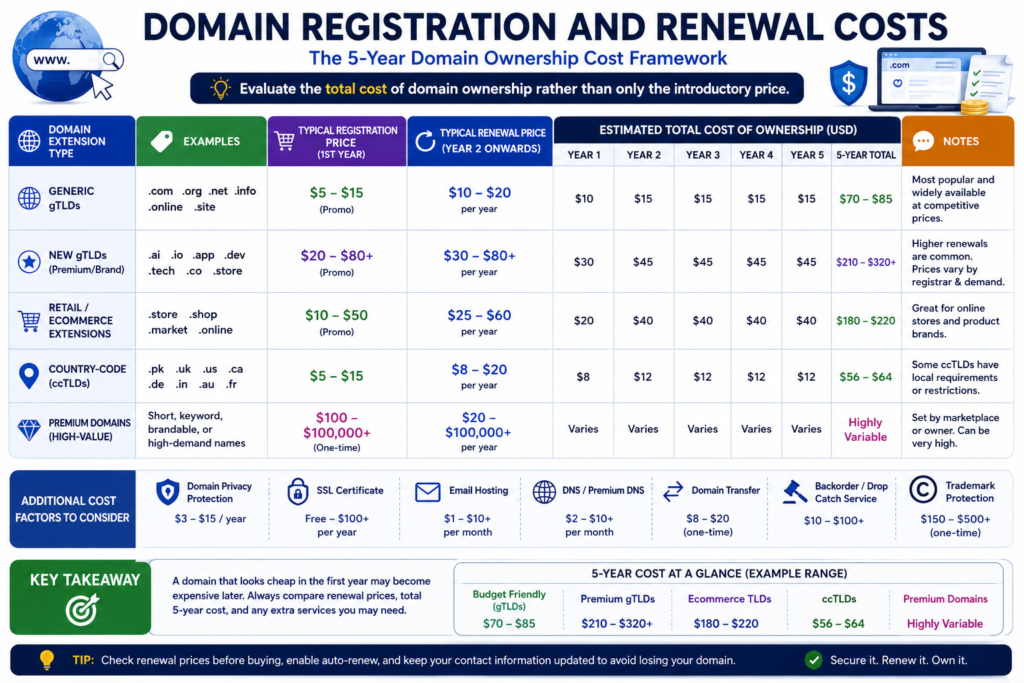
Registration Price vs Renewal Price
A registrar may advertise a low introductory price.
That does not mean future renewals will cost the same amount.
Always check the standard renewal price before purchasing.
How to Calculate Five-Year Domain Cost
Calculate:
- Initial registration
- First renewal
- Second renewal
- Third renewal
- Fourth renewal
- Privacy-related charges where applicable
- Premium renewal charges
- Taxes and other applicable costs
This provides a more realistic ownership estimate.
What Is a Premium Domain?
A premium domain can carry a higher price because of factors such as:
- Short length
- Brandability
- Commercial value
- Keyword value
- Market demand
- Registry classification
Premium Registration vs Premium Renewal
Do not assume a premium domain only costs more during registration.
Check whether premium pricing also applies to renewal.
Domain Transfer Costs
If you expect to move registrars later, investigate:
- Transfer eligibility
- Transfer pricing
- Renewal implications
- Lock periods
- Applicable registry policies
Why Cheap Domain Extensions Can Become Expensive
A very low first-year price can hide a much higher long-term cost.
For a serious business, predictability is more important than saving a small amount during the first year.
Domain Extension Restrictions
Some TLDs are easier to register than others.
Geographic Restrictions
Certain country domains may require a local connection.
Business Eligibility Requirements
Some namespaces may require a registered company or business presence.
Professional Eligibility Requirements
Specialized domains can have professional or institutional eligibility rules.
Registry-Specific Rules
Registries can set policies relating to:
- Reserved names
- Documentation
- Registration periods
- Eligibility
- Transfers
Why You Should Check Registry Policies Before Registration
A domain is a long-term brand asset.
Do not build a brand around an extension until you understand its current rules.
Domain Security and TLD Choice
No domain extension automatically makes a website secure.
Security requires multiple layers.
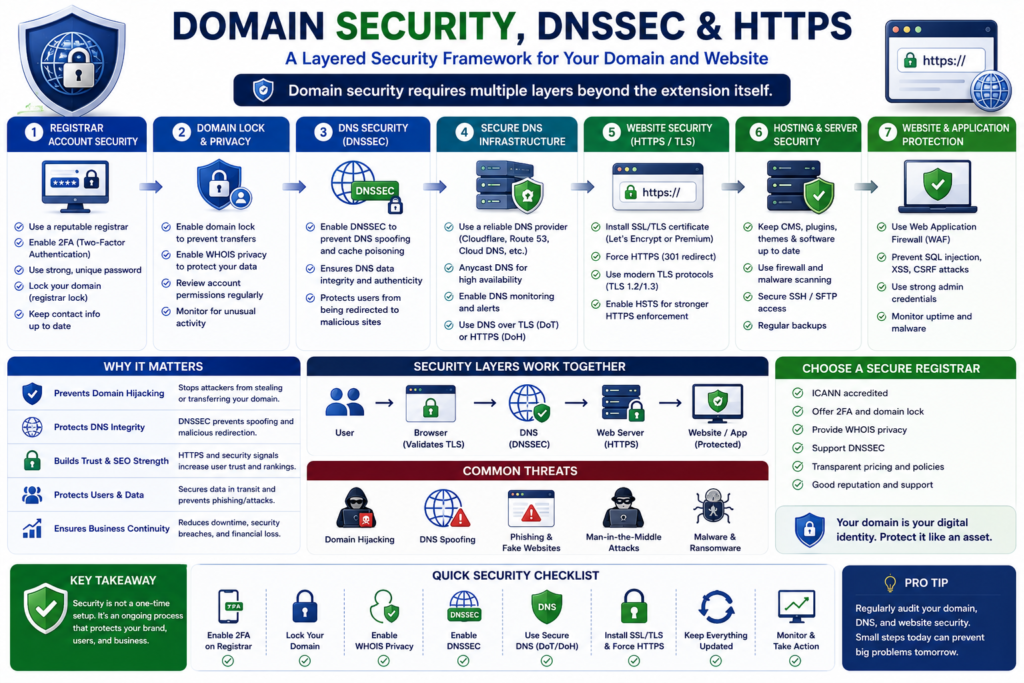
Does a TLD Make a Website Secure?
No.
Security depends on:
- Registrar account protection
- DNS security
- HTTPS
- Hosting security
- Website security
- Access controls
Registrar Account Security
Protect the registrar account using:
- Strong unique password
- Multi-factor authentication
- Secure recovery email
- Restricted administrative access
Domain Transfer Lock
Use available transfer protection features to reduce unauthorized transfer risk.
DNSSEC
DNSSEC can provide cryptographic validation for DNS data and help protect against certain DNS attacks.
It is separate from HTTPS.
HTTPS and TLS
HTTPS protects data transmitted between users and the website.
Every professional website should use a valid TLS certificate.
Domain Privacy
Availability and handling of registration data can vary by:
- Registrar
- Registry
- Jurisdiction
- Registrant type
Account Recovery Protection
Protect the email account used for domain recovery.
An attacker who controls your recovery email may be able to compromise other digital assets.
Should You Buy Multiple Domain Extensions?
Sometimes.
When Defensive Domain Registration Makes Sense
Additional domains can be useful when there is a realistic risk of:
- Impersonation
- Customer confusion
- Typographical errors
- Brand abuse
Which Domain Variations Should You Protect?
Prioritize obvious variants.
For example, a company operating on .ai may eventually consider acquiring the matching .com if the cost and risk justify it.
Should Secondary Domains Have Separate Websites?
Usually not when they represent the same company and the same content.
Creating duplicate sites can complicate:
- SEO
- Branding
- Analytics
- Maintenance
When to Redirect Secondary Domains
A defensive domain can normally redirect to the primary canonical domain.
Why You Should Not Buy Every TLD
Buying dozens of domains creates:
- Renewal costs
- Security obligations
- Administrative work
- Expiration risk
Protect meaningful variants rather than every possible extension.
Changing Domain Extensions
Changing a domain extension is possible, but it should be treated as a complete website migration.
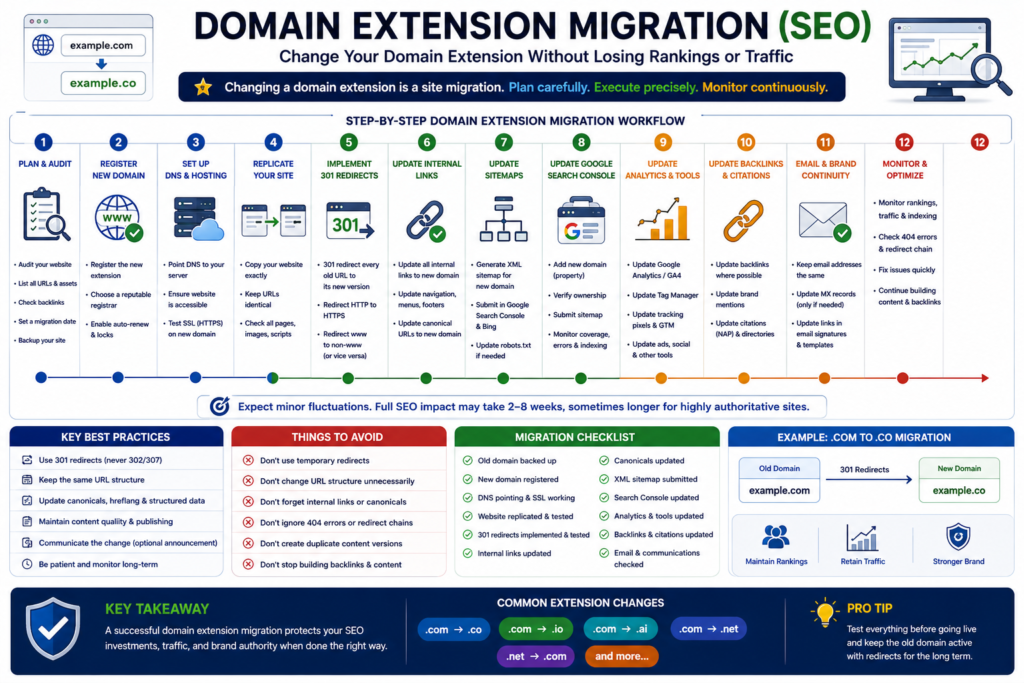
Can You Change a Domain Extension Later?
Yes.
For example:
brand.net
Can migrate to:
brand.com
However, changing domains involves more than changing a WordPress setting.
Reasons to Change a Domain Extension
Possible reasons include:
- Better branding
- Acquisition of the ideal
.com - International expansion
- Rebranding
- Customer confusion
- Company restructuring
Do not migrate solely because you believe another generic TLD will automatically improve rankings.
SEO Risks of Domain Migration
A poorly managed migration can create:
- Broken URLs
- Lost referral traffic
- Indexing delays
- Redirect problems
- Duplicate pages
- Email disruption
- Temporary ranking volatility
Complete Domain Migration Checklist
Before the Migration
- Crawl the existing website.
- Export all important URLs.
- Record current rankings and traffic.
- Map old URLs to new URLs.
- Back up the website.
- Verify the new domain.
- Check DNS configuration.
- Plan email migration.
During the Migration
- Preserve URL paths where practical.
- Implement permanent redirects.
- Update canonical URLs.
- Update internal links.
- Update hreflang.
- Update structured data.
- Update XML sitemaps.
- Update robots-related configurations where necessary.
After the Migration
- Verify the new Search Console property.
- Submit updated sitemaps.
- Monitor indexing.
- Check redirects.
- Check 404 errors.
- Monitor traffic.
- Update social profiles.
- Update advertising.
- Update business listings.
- Update important external links where practical.
How Long Should You Keep the Old Domain?
For an important business migration, retaining the old domain long-term is generally prudent because:
- Old links may continue to exist.
- Customers may use old bookmarks.
- Old email addresses may still receive messages.
- The old brand may remain familiar.
Do not allow a valuable former business domain to expire casually.
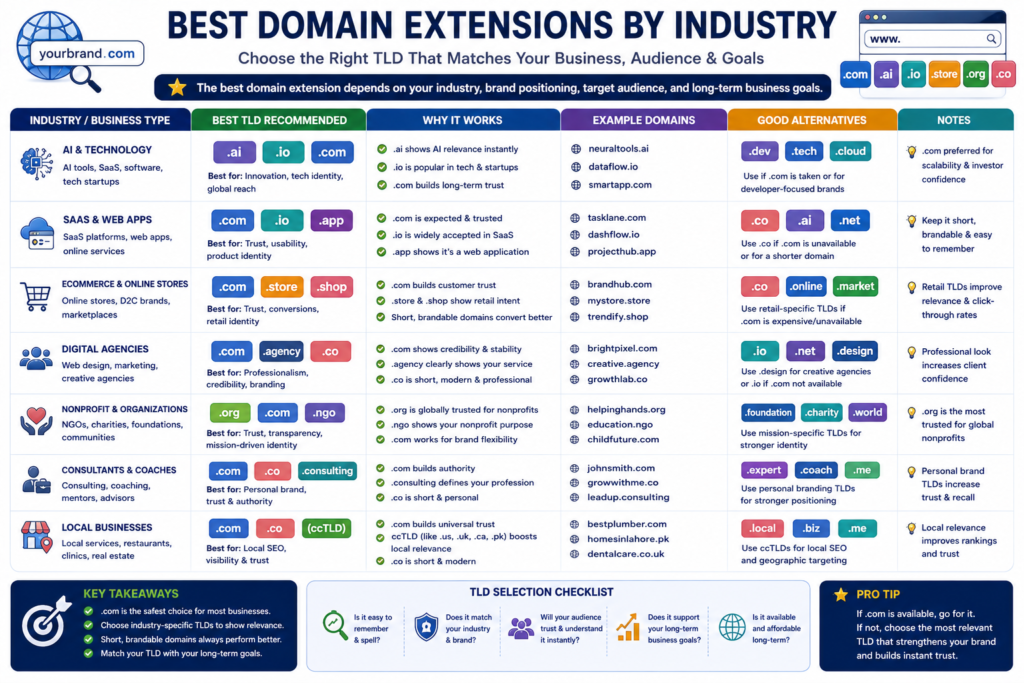
Best Domain Extensions by Industry
Different industries have different branding requirements.
| Industry | Strong Domain Options | Main Consideration |
|---|---|---|
| Website Development | .com, ccTLD, .agency | Professional flexibility |
| Digital Marketing | .com, .agency, .digital | Service identity |
| Artificial Intelligence | .com, .ai, .io | AI positioning |
| SaaS | .com, .io, .co | Technology and flexibility |
| Software Development | .com, .io, .app | Product scope |
| Developer Tools | .dev, .io, .com | Technical audience |
| Ecommerce | .com, .store, .shop | Commerce identity |
| Nonprofit | .org | Organizational trust |
| Consulting | .com, ccTLD | Professional positioning |
| Accounting | .com, ccTLD | Trust |
| Legal Services | .com, ccTLD | Credibility |
| Real Estate | .com, ccTLD | Geographic relevance |
| Restaurants | .com, ccTLD | Local recall |
| Personal Portfolio | .com, .me | Personal identity |
| Creative Professional | .com, .me, relevant niche TLD | Brandability |
Best Domain Extensions by Business Goal
Best for Global Recognition
Recommended: .com
Its broad familiarity makes it a strong choice for global commercial branding.
Best for Local Targeting
Recommended: Relevant ccTLD
Use when one country is clearly central to the business.
Best for AI Branding
Recommended: .ai
Use when AI is genuinely central to the product and company identity.
Best for Developer Audiences
Recommended: .dev or .io
Both are familiar within technology communities.
Best for Ecommerce
Recommended: .com, .store, or .shop
Choose according to brand quality and market reach.
Best for Nonprofits
Recommended: .org
It aligns well with common user expectations.
Best for Personal Branding
Recommended: .com or .me
Choose according to availability and desired positioning.
Best for Long-Term Flexibility
Recommended: .com
A broad generic identity reduces the chance that the company will outgrow its extension.
.com vs Other Popular Domain Extensions
.com vs .net
Choose .com for broader commercial familiarity.
Choose .net when it provides a stronger available name and fits a technical business.
.com vs .org
Choose .com for conventional commercial activity.
Choose .org for organizational and nonprofit identity.
.com vs .co
Choose .com when available and strong.
Choose .co when it preserves a much cleaner brand and .com confusion is manageable.
.com vs .ai
Choose .com for broad flexibility.
Choose .ai for strong artificial intelligence positioning.
.com vs .io
Choose .com for mainstream recognition.
Choose .io for developer and technology audiences when it strengthens the brand.
.com vs .store
Choose .com for broad business flexibility.
Choose .store when the website is clearly ecommerce-focused, and the resulting name is stronger.
.com vs Country-Code Domains
Choose .com for global positioning.
Choose a ccTLD when national relevance is strategically more important.
Technology Domain Extension Comparison
.com vs .ai vs .io vs .co
| Factor | .com | .ai | .io | .co |
|---|---|---|---|---|
| General Recognition | Excellent | Growing | Strong in Tech | Strong |
| AI Identity | Neutral | Excellent | Good | Neutral |
| Developer Identity | Good | Strong | Excellent | Good |
| Startup Fit | Excellent | Excellent for AI | Excellent | Excellent |
| Long-Term Flexibility | Excellent | Good | Good | Excellent |
| Main Risk | Availability | Narrow category | Niche recognition | .com confusion |
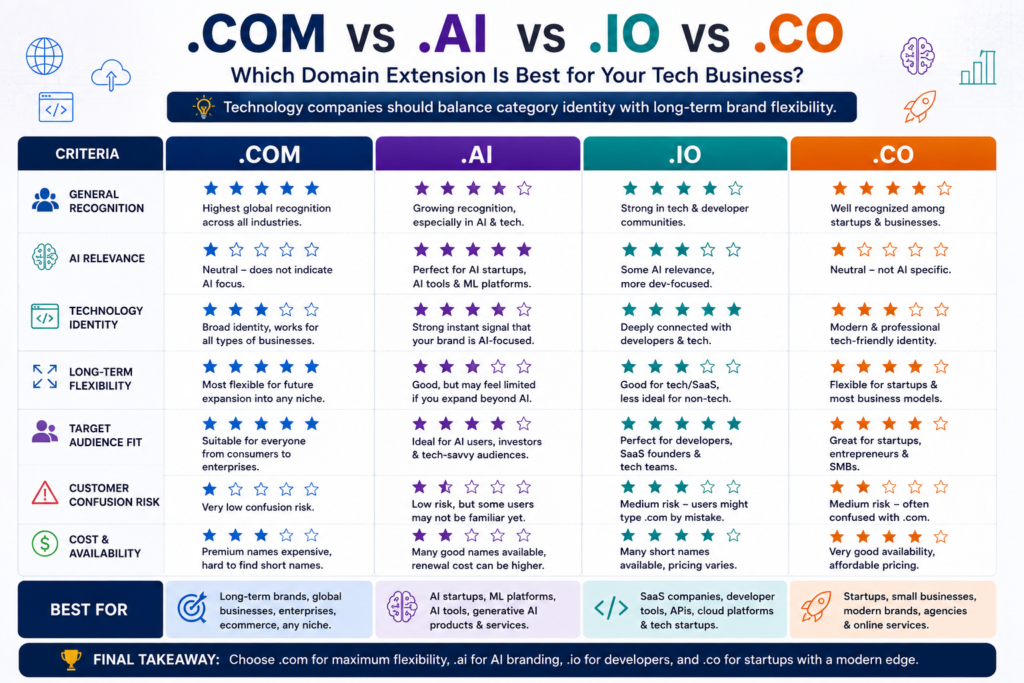
Which Is Best for an AI Startup?
If AI is central to the company, .ai can be an excellent choice.
If broad long-term expansion is expected, .com may be stronger.
Which Is Best for SaaS?
.com provides broad flexibility.
.io can be highly suitable for technical SaaS.
.co can work well when it preserves a clean startup brand.
Which Is Best for Developer Tools?
.dev and .io are especially relevant.
.com remains an excellent choice when available.
Ecommerce Domain Extension Comparison
.com vs .store
.com provides greater general recognition.
.store provides immediate ecommerce meaning.
Choose the domain that creates the stronger complete brand.
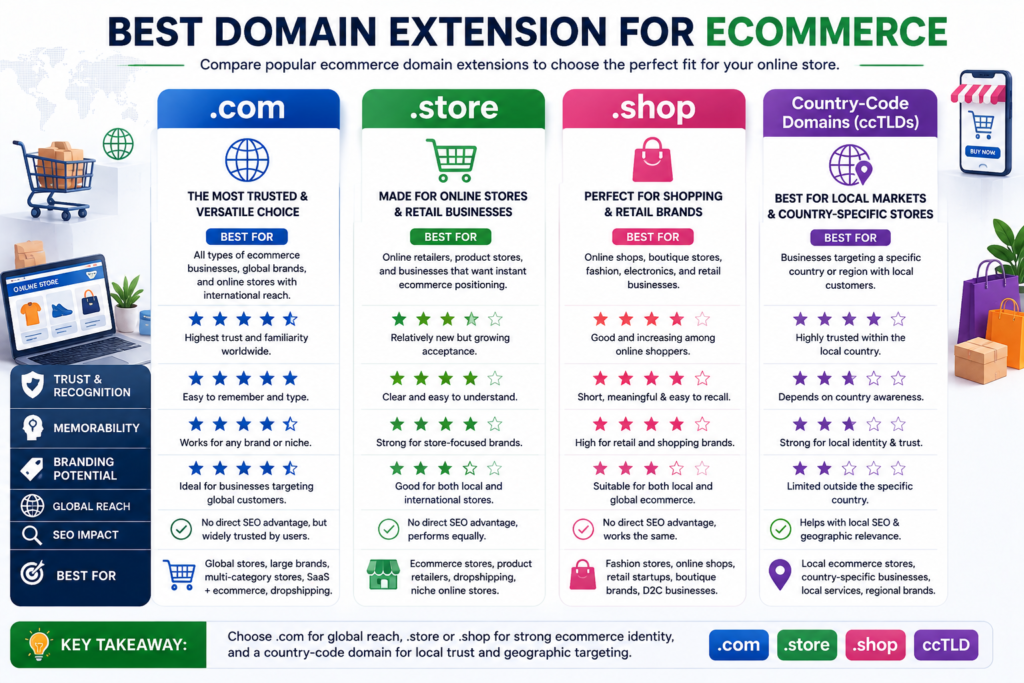
.com vs .shop
.com Provides broad flexibility.
.shop Can clearly communicate online retail.
.store vs .shop
Both communicate e-commerce.
The decision should be based on:
- Brand sound
- Memorability
- Availability
- Renewal cost
- Customer preference
Country Domain vs .com for Ecommerce
A country-specific ecommerce business may benefit from a local ccTLD.
An international store will often find it .com easier to scale.
Domain Extension Decision Matrix
Use this matrix as a practical starting point.
| Question | If Yes | Direction |
|---|---|---|
| Is the business global? | Yes | Consider .com |
| Is one country the primary market? | Yes | Consider ccTLD |
| Is AI central to the brand? | Yes | Consider .ai |
| Is the audience primarily developers? | Yes | Consider .dev or .io |
| Is the site purely ecommerce? | Yes | Compare .com, .store, .shop |
| Is the organization nonprofit? | Yes | Consider .org |
| Is this a personal brand? | Yes | Compare .com and .me |
Is a strong .com available? | Yes | Usually prioritize it |
Is the .com awkward or unaffordable? | Yes | Compare alternatives |
| Will the company expand categories? | Yes | Prefer flexibility |
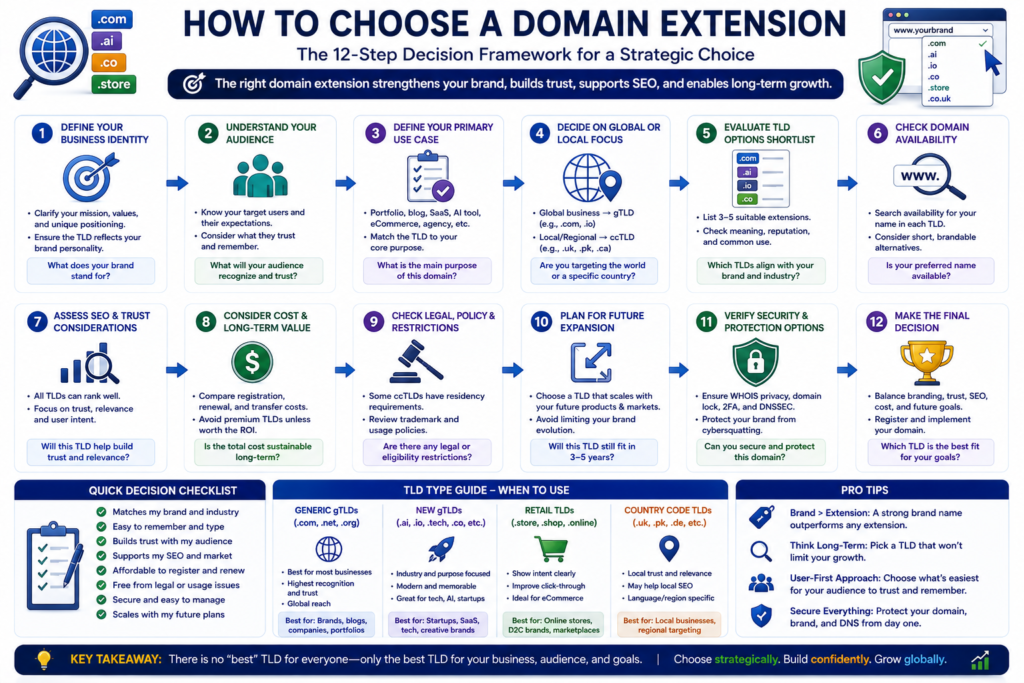
How to Choose a Domain Extension: 12-Step Framework
Step 1: Define Your Target Audience
Document:
- Country
- Language
- Customer type
- Technical familiarity
- Purchase behavior
Step 2: Define Your Website Type
Determine whether the website is:
- Business
- Ecommerce
- SaaS
- AI product
- Blog
- Portfolio
- Nonprofit
- Local service
Step 3: Determine Your Geographic Market
Classify the business as:
- Local
- National
- Multi-country
- Global
Step 4: Check the .com
Always investigate whether a strong .com is available.
Step 5: Check the Relevant ccTLD
If one country matters significantly, investigate the appropriate national extension.
Step 6: Compare Industry-Specific Extensions
Examples:
- AI:
.ai - Development:
.dev - Ecommerce:
.store - Agency:
.agency
Step 7: Compare Complete Domain Names
Do not compare only the endings.
Compare the complete domains.
Step 8: Perform the Spoken Domain Test
Say the domain to someone without showing it.
Can they type it correctly?
Step 9: Perform the Email Test
Write:
hello@yourdomain
Does it remain clear and professional?
Step 10: Calculate Long-Term Costs
Check several years of expected ownership rather than only the first year.
Step 11: Check Legal and Registry Requirements
Investigate:
- Trademark conflicts
- Registry restrictions
- Local presence requirements
- Reserved names
Step 12: Choose One Primary Domain
Once selected, build the brand consistently around one canonical domain.
Domain Extension Decision Scorecard
Score each candidate from 1 to 5.
Memorability
Can customers remember the complete domain?
Customer Trust
Does the extension feel appropriate to the audience?
Brand Quality
Does the complete domain sound like a strong brand?
Geographic Fit
Does it align with the target market?
Long-Term Flexibility
Will the domain remain suitable after expansion?
Industry Relevance
Does the extension communicate useful category information?
Email Usability
Can customers type the email address correctly?
Renewal Cost
Is long-term ownership financially reasonable?
Customer Confusion Risk
Could customers accidentally visit another extension?
A domain scoring consistently well across these factors is generally stronger than one selected only because its TLD is fashionable.
Practical Domain Extension Examples
Realistic scenarios demonstrate why there is no universal answer.
Scenario 1: International Consulting Company
Situation
A consulting business currently serves US customers but wants to expand internationally.
Its exact .com is available.
A niche consulting extension is also available.
Recommended Domain Strategy
Use the .com as the primary domain.
Why This Choice Works
The company may later expand into:
- Training
- Research
- Software
- Digital products
- Advisory services
A broad .com supports that growth without requiring a future rebrand.
Scenario 2: AI SaaS Startup
Situation
An AI startup has a short and memorable .ai available.
The matching .com is listed at a price far beyond the startup’s current budget.
AI will remain central to the product.
Recommended Domain Strategy
The .ai can be an excellent primary domain.
Risks to Check
Before registering, evaluate:
- Renewal cost
- Trademark conflicts
- Matching
.comactivity - Social handles
- Long-term company direction
Do not select .ai because of an assumed SEO advantage.
Select it because it strengthens the brand.
Scenario 3: Pakistan-Only Ecommerce Business
Situation
An ecommerce business:
- Sells only in Pakistan
- Prices products in PKR
- Ships domestically
- Has no immediate international plans
.pk vs .com Decision
A .pk domain can provide strong local positioning.
A .com remains an option if international expansion is expected.
Expansion Considerations
If the company later plans to sell globally, a generic domain can reduce the need for a future domain migration.
Scenario 4: Web Development Agency
Situation
A web agency can obtain:
brand.agency
but it’s available .com requires several extra words.
.agency vs .com
The shorter .agency may be easier to remember.
Long-Term Branding Considerations
Before choosing it, consider whether the company may later offer:
- Hosting
- Software
- SaaS
- Courses
- Digital products
If so, a broader brand may be more flexible.
Scenario 5: Migrating from .net to .com
Situation
An established company operates on .net.
It later acquires its ideal. .com.
Customers frequently type the .com version.
Potential Benefits
Migrating could improve:
- Brand clarity
- Customer recall
- Email usability
SEO Migration Requirements
The company should:
- Map URLs
- Implement permanent redirects
- Update internal links
- Update canonical URLs
- Submit updated sitemaps
- Monitor Search Console
- Preserve the old domain
The move should be justified by business value rather than an assumed .com ranking boost.
Scenario 6: .com vs .store for Ecommerce
Situation
An ecommerce business must choose between:
brand-online-shopping-company.com
and:
brand.store
Recommended Evaluation
The shorter .store may provide better branding.
Customer Recall Test
Ask potential customers:
- Which domain looks more trustworthy?
- Which one is easier to remember?
- Which one can they type after hearing it once?
Real user feedback can make the decision clearer.
Common Domain Extension Mistakes
Mistake 1: Assuming .com Automatically Ranks Higher
.com .com is valuable for recognition and flexibility.
Do not misrepresent those advantages as an automatic Google ranking bonus.
Mistake 2: Choosing an Awkward .com
A long, confusing .com can damage memorability.
Compare clean alternatives.
Mistake 3: Ignoring the Matching .com
Before using .co, .net, .aior another extension, investigate the matching .com.
Mistake 4: Ignoring Renewal Pricing
Always calculate long-term cost.
Mistake 5: Choosing an Overly Narrow TLD
A niche extension can become restrictive as the company grows.
Mistake 6: Treating Keyword TLDs as SEO Shortcuts
A descriptive extension can help users understand a website.
It does not replace high-quality SEO.
Mistake 7: Ignoring Geographic Strategy
Use ccTLDs deliberately rather than accidentally restricting a global brand.
Mistake 8: Confusing TLD Choice With Website Security
Security requires:
- HTTPS
- DNS security
- Registrar protection
- Secure hosting
- Strong authentication
Mistake 9: Buying Too Many Defensive Domains
Protect realistic risks rather than every possible variation.
Mistake 10: Migrating Without an SEO Plan
A domain migration should be treated as a technical project.
Best Domain Extension Checklist
Branding Checklist
- [ ] The domain is easy to spell.
- [ ] The domain is easy to pronounce.
- [ ] The complete name is memorable.
- [ ] The extension fits the brand.
- [ ] The domain works well in email.
- [ ] The name supports future growth.
SEO Checklist
- [ ] The TLD is not being selected for an assumed generic ranking bonus.
- [ ] Geographic targeting has been considered.
- [ ] One canonical primary domain will be used.
- [ ] Migration requirements are understood if replacing an existing domain.
- [ ] International architecture has been considered.
Geographic Checklist
- [ ] Primary market is defined.
- [ ] International expansion plans are documented.
- [ ] Relevant ccTLD has been evaluated.
- [ ] Global alternatives have been evaluated.
Cost Checklist
- [ ] Registration price is known.
- [ ] Renewal price is known.
- [ ] Premium status is known.
- [ ] Transfer cost has been checked.
- [ ] Long-term ownership cost is acceptable.
Security Checklist
- [ ] Multi-factor authentication is enabled where available.
- [ ] Registrar lock is enabled where appropriate.
- [ ] Recovery email is secure.
- [ ] HTTPS is planned.
- [ ] DNS security has been considered.
Legal and Trademark Checklist
- [ ] Trademark conflicts have been investigated.
- [ ] Similar businesses have been checked.
- [ ] Registry eligibility has been verified.
- [ ] Restricted-name rules have been reviewed where relevant.
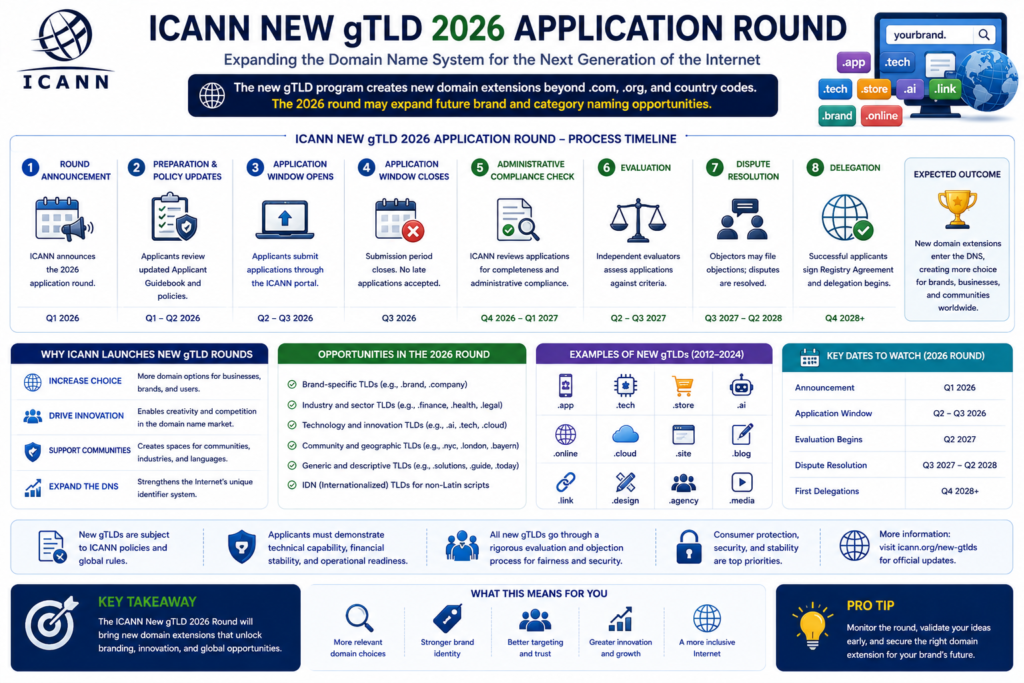
ICANN 2026 New gTLD Application Round
The domain ecosystem continues to evolve.
The new gTLD program is particularly relevant to organizations interested in operating new top-level domains.
What Is the New gTLD Program?
The program allows eligible applicants to seek the right to operate a new generic top-level domain.
This is fundamentally different from ordinary domain registration.
How Is a New gTLD Different From Registering a Domain?
Registering:
brand.com
means obtaining a second-level domain under .com.
Applying to operate:
.brand
involves becoming responsible for a top-level domain at the registry level.
Brand TLD Opportunities
Large organizations may consider brand-specific extensions as part of:
- Digital identity
- Security
- Customer experience
- Corporate infrastructure
Community and Geographic TLDs
New applications can also involve strings associated with communities, categories, or geographic concepts, subject to applicable program rules.
What the 2026 Round Means for Businesses
Most small businesses do not need their own TLD.
However, broader expansion of the TLD ecosystem could lead to:
- More naming options
- Greater acceptance of alternative extensions
- More brand TLDs
- New industry-specific possibilities
- More complex domain strategy
Future Domain Extension Trends for 2027 and Beyond
Domain strategy will continue evolving.
Continued Growth of .ai
As artificial intelligence businesses expand, demand for strong .ai domains is likely to remain significant.
Companies will continue comparing:
.ai
against:
.com
for flagship brands.
AI Agent Domain Branding
Growth in AI agents and autonomous software may increase demand for domain names associated with:
- AI agents
- Agentic AI
- AI assistants
- AI automation
- AI SaaS
Increased Industry-Specific TLD Adoption
Users are increasingly exposed to extensions such as:
.store.shop.app.dev.tech
Greater familiarity may reduce the assumption that every professional website must end in .com.
Brand TLD Expansion
Large organizations may continue exploring proprietary top-level domains as part of long-term digital-brand strategy.
Greater Focus on Short, Memorable Domains
As premium .com names become harder to obtain, businesses may increasingly compare:
- Short alternative TLDs
- Longer
.comdomains - Brand modifications
- Country-code domains
The quality of the complete domain will become increasingly important.
Increased Importance of Renewal-Cost Analysis
Businesses will need to evaluate total ownership costs carefully, especially when considering premium or less conventional extensions.
Featured Snippet Opportunities
The article can target concise answer formats for important queries.
What Is a Domain Extension?
A domain extension is the top-level portion of a domain name appearing after the final dot, such as .com, .org, .ai, or .pk.
What Is the Best Domain Extension?
For most businesses, .com is the strongest general-purpose domain extension because of its broad recognition and flexibility. However, the best extension depends on the website’s purpose, audience, geography, and long-term brand strategy.
Which Domain Extension Is Best for SEO?
No generic domain extension provides a universal Google ranking advantage. Choose a TLD based on users, branding, geographic strategy, and long-term business requirements.
What Is a gTLD?
A gTLD is a generic top-level domain, such as .com, .org, .net, .store, or .shop.
What Is a ccTLD?
A ccTLD is a country-code top-level domain associated with a country or territory, such as .ca, .uk, .au, or .pk.
What Is the Difference Between gTLD and ccTLD?
A gTLD is generally geographically neutral, while a ccTLD is associated with a particular country or territory and can provide a strong geographic signal.
Does .com Rank Better?
.com Does not receive a universal automatic ranking advantage simply because it is .com.
Is .ai Good for SEO?
Yes. .ai Websites can rank normally. Its primary advantage is artificial intelligence branding rather than an automatic SEO boost.
What Should You Use If .com Is Taken?
Compare clean alternatives such as .co, .ai, .io, .store, .shop, .dev, or a relevant ccTLD after checking trademarks and the risk of customer confusion.
Frequently Asked Questions
What Are the Best Domain Extensions in 2026?
The strongest options include .com, .org, .net, .co, .ai, .io, .app, .dev, .store, .shopand relevant country-code extensions. The right choice depends on the website’s audience, business model, geography, and branding requirements.
Which Domain Extension Is Best for SEO?
There is no generic TLD that receives a universal Google ranking advantage. A suitable ccTLD can provide geographic signals, while the overall quality of the website remains more important.
Does .com Rank Better on Google?
Not automatically. .com is highly familiar and can be excellent for branding, but its extension alone does not guarantee better rankings.
Is .ai Good for SEO?
Yes. .ai Websites can rank normally. Choose .ai primarily when it improves AI-related brand positioning.
Is .io Good for SEO?
Yes. .io can rank normally and is especially familiar to developer and technology audiences.
Is .co Good for SEO?
Yes. .co Can be a valid business domain. The main concern is possible confusion with .com.
Is .store Good for SEO?
Yes. .store Can rank normally. Its main benefit is clear ecommerce branding.
Is .shop Good for SEO?
Yes. .shop can be an appropriate ecommerce extension when it creates a memorable and trustworthy brand.
Is .net Good for Business?
Yes. .net remains an established extension and can work particularly well for technology, networking, hosting, and infrastructure companies.
Is .org Good for Business?
It can be used, but .org is strongly associated with organizations and nonprofit activity. A conventional commercial business should consider whether that matches its identity.
Which Domain Extension Is Most Trusted?
Trust depends on audience and context. .com has broad commercial familiarity, .org is strongly associated with organizations, and national ccTLDs can have high familiarity within their local markets.
Which Domain Extension Looks Most Professional?
.com is broadly recognized for commercial websites. A local ccTLD can be highly professional in its home market, while specialized extensions can be professional when they accurately match the industry.
What Should I Use If .com Is Taken?
Investigate the .com owner and trademark situation, then compare .co, .ai, .io, .store, .shop, .app, .dev, or a relevant ccTLD.
Is .co Better Than a Long .com?
It can be. A short and memorable .co may provide stronger branding than a long and awkward .com, provided customer confusion with the matching .com is manageable.
Are New Domain Extensions Bad for SEO?
No. New generic TLDs can rank normally when the website provides useful content and strong technical implementation.
Do Keywords in TLDs Help Rankings?
A descriptive TLD can help users understand the website, but it should not be treated as an automatic ranking advantage.
What Is a Country-Code Domain?
A country-code domain is a TLD associated with a particular country or territory, such as .ca, .au, .uk, or .pk.
Should a Local Business Use a ccTLD?
It can be an excellent choice when the business primarily serves one country. A company expecting international expansion may prefer a generic TLD.
Can I Change Domain Extensions Later?
Yes, but the change should be managed as a complete website migration with redirects, updated internal links, canonical URLs, sitemaps, Search Console monitoring, and email continuity.
Should I Buy Multiple Domain Extensions?
Buy additional domains when they provide meaningful brand protection or reduce genuine customer confusion. Purchasing every available extension is generally unnecessary.
Does a Domain Extension Make a Website Secure?
No. Website and domain security depend on registrar protection, DNS security, HTTPS, hosting security, account security, and other technical controls.
Is .org Only for Nonprofits?
.org is strongly associated with nonprofit and organizational use. Current registration rules should always be checked with the applicable registry and registrar.
Should I Choose the Cheapest Domain Extension?
No. Consider renewal cost, brand quality, customer trust, restrictions, and long-term suitability rather than only the first-year price.
Can a .store Domain Rank on Google?
Yes. A .store domain can rank normally when the website satisfies search intent and demonstrates strong overall SEO quality.
Is .ai Better Than .com for AI Startups?
.ai can provide stronger AI category positioning, while .com provides broader long-term flexibility. The correct choice depends on the company’s business model and growth plans.
Is .io Better Than .com for SaaS?
Not universally. .io is highly familiar within technology markets, while .com has broader recognition. Choose according to your customers and long-term positioning.
What Is the Best Domain Extension for Ecommerce?
.com remains the strongest general-purpose ecommerce option. .store, .shop, and relevant country-code extensions can be excellent alternatives.
What Is the Best Domain Extension for a Blog?
.com is highly flexible. .me, .blogand relevant niche extensions can also work when they improve the brand.
What Is the Best Domain Extension for a Portfolio?
.com and .me are strong general choices. Creative professionals can also evaluate relevant industry-specific extensions.
What Is the Best Domain Extension for an Agency?
.com Generally provides the greatest flexibility. .agency, .digital, and relevant country-code domains can also create strong branding.
Recommended Internal Links
Internal links should be added contextually rather than collected only at the end of the article.
Recommended supporting resources include:
- Complete Domain Name Guide
- How to Choose a Domain Name
- How to Build a Website
- Website Planning Checklist
- Types of Websites Explained
- Website Development Cost Guide
- Website Launch Checklist
- Technical SEO Guide
- Google Search Console Guide
- Website Security Guide
- Website Mistakes to Avoid
- On-Page SEO Services
- Website Development Services
- Ecommerce Website Development
- Shopify Guide for Beginners
Recommended Internal References
- Professional Website Development & SEO Services
- Complete Domain Name Guide in 2026: Everything You Need to Know Before Registering a Domain
- How to Build a Website 2027: Proven Steps to Online Success
- Technical SEO Guide 2026: Complete Enterprise SEO Handbook
- Complete Google Search Console Guide 2026–2027: Powerful SEO Tips for Higher Rankings
- Website Mistakes to Avoid: 25 Costly Problems Hurting Your Traffic, Trust, and Sales
Recommended Authoritative External Sources
Technical claims should be supported by primary and authoritative sources wherever possible.
- Google Search Central. Official Google documentation for SEO, crawling, indexing, ranking, search appearance, and website optimization.
- Google Search Essentials. Official requirements and best practices covering technical eligibility, spam policies, and people-first search optimization.
- Google Documentation for International and Multilingual Websites. Official guidance for localized website versions, language and regional targeting, and
hreflangimplementation. - Google Search Ranking Systems Guide. Google’s official explanation of the automated systems and signals used to rank relevant and useful search results.
- Google Structured Data Documentation. Official guidance for implementing structured data and making website content eligible for supported rich-result features.
- ICANN New gTLD Program. Authoritative information about generic top-level domains and the expansion of the Domain Name System.
- ICANN 2026 New gTLD Program Updates. Particularly relevant to your article’s ICANN 2026 New gTLD Application Round section. ICANN’s current program page records that the 2026 application window opened on April 30, 2026.
- IANA Root Zone Database. The authoritative database for checking TLD classifications, delegation details, and the organizations responsible for individual top-level domains.
- IANA .AI Delegation Record. Useful for the
.aisection. IANA officially classifies.aias a country-code top-level domain and lists the Government of Anguilla as its ccTLD manager. - IANA .IO Delegation Record. Useful for the
.iosection and for accurately explaining its technical classification as a country-code top-level domain. - IANA .PK Delegation Record. Recommended for your Best Domain Extension for Pakistan section. IANA identifies
.pkas Pakistan’s ccTLD and lists PKNIC as its manager. - IANA Root Zone Management. Useful for explaining how top-level domains, DNS root-zone delegation, TLD managers, and authoritative domain records work.
Recommended Schema Markup
Structured data should accurately describe the real content of the page.
Article or BlogPosting Schema
Recommended fields can include:
- Headline
- Author
- Date published
- Date modified
- Publisher
- Featured image
- Description
All values should match visible page information.
BreadcrumbList Schema
Breadcrumb markup can help represent the site’s hierarchy.
The visible breadcrumb and structured data should remain consistent.
Organization Schema
Use accurate organization information on the appropriate site-level pages.
Do not fabricate organizational details.
FAQPage Schema
FAQ structured data should only be used when:
- The visible content qualifies.
- The markup accurately represents that content.
- Current search-engine requirements are satisfied.
Do not assume FAQ markup guarantees a rich result.
QAPage Schema
A normal publisher-written FAQ section should not automatically be marked as QAPage.
Product and Review Schema
Do not add Product or Review markup merely to obtain additional SERP features.
Use them only when the page genuinely qualifies.
E.E.A.T. Publication Requirements
Strong E.E.A.T. presentation requires genuine transparency.
Author Information
Display the real author name.
Where relevant, provide an author page explaining genuine expertise.
Professional Experience
State experience only when it is accurate and verifiable.
Do not invent years of experience.
Editorial Review
If another person reviews the article, provide the real reviewer information.
Do not create fictional reviewers.
Fact-Checking
Technical claims about:
- Google Search
- TLD classification
- International targeting
- Domain registries
- DNS
- ICANN programs
should be checked against appropriate primary sources.
Source Verification
Prioritize:
- Google Search Central
- ICANN
- IANA
- Official registry documentation
AI Usage Disclosure
If AI materially assisted the content and disclosure is appropriate under your editorial policy, explain accurately:
- How AI was used
- What human review occurred
- How factual claims were verified
Never manufacture human review that did not occur.
Final Domain Extension Recommendations
The following summary provides a practical decision framework.
Choose .com if
Choose .com when:
- You want broad international recognition.
- A strong domain is available.
- The business may expand into multiple categories.
- Long-term flexibility is important.
Choose .org if
Choose .org when:
- You operate a nonprofit.
- You represent an association.
- Community or mission-driven identity is central.
Choose .ai If
Choose .ai when:
- Artificial intelligence is central to the company.
- AI category recognition strengthens the brand.
- The domain is memorable.
- Long-term pricing is acceptable.
Choose .io If
Choose .io when:
- Your audience is technical.
- You operate SaaS or developer products.
- The extension feels natural to customers.
Choose .dev If
Choose .dev when:
- Developers are the primary audience.
- The website represents a developer product, project, documentation platform, or tool.
Choose .store or . shop If
Choose .store or .shop when:
- Ecommerce is central to the brand.
- The extension creates a cleaner name than available alternatives.
- Customers understand the extension.
- Renewal costs are acceptable.
Choose a ccTLD if
Choose a relevant country-code extension when:
- One country is clearly the primary market.
- Local identity is strategically important.
- Geographic relevance outweighs global neutrality.
Choose .co if
Choose .co when:
.comis unavailable..copreserves a significantly stronger brand.- The matching
.comdoes not create unacceptable confusion.
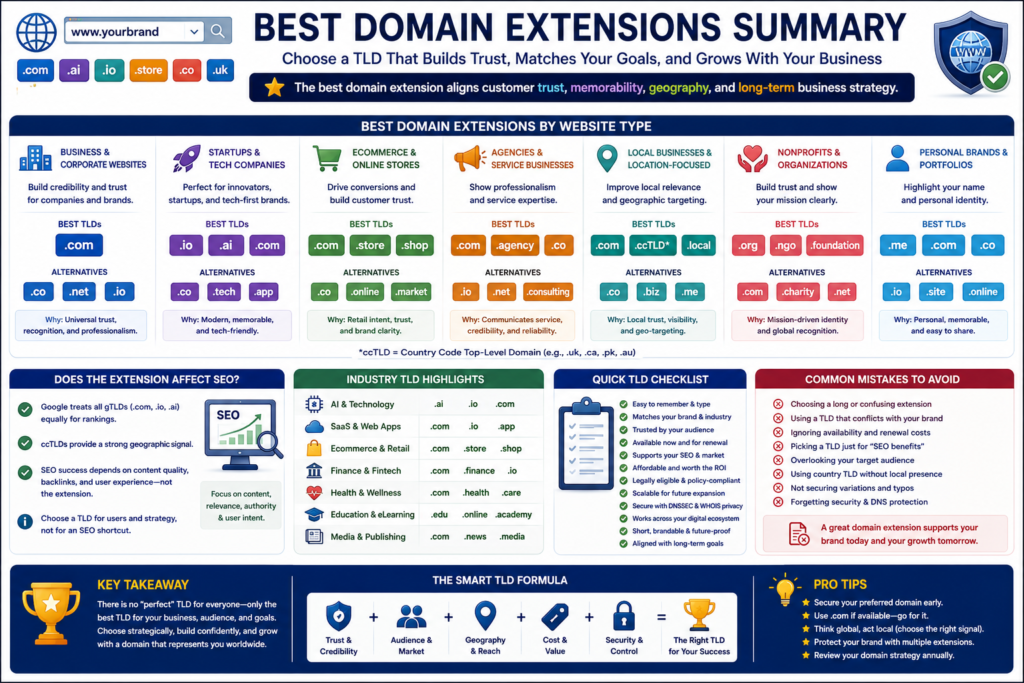
Conclusion: Which Domain Extension Should You Choose?
The best domain extensions in 2026 cannot be reduced to a universal ranking list.
For most commercial websites, .com remains the strongest all-purpose option because it combines broad recognition, familiarity, and long-term flexibility.
But the right answer changes according to the website.
Choose .org when nonprofit or organizational identity matters.
Consider .ai when artificial intelligence is fundamental to the company.
Consider .io or .dev for developer-focused technology products.
Consider .store or .shop when ecommerce meaning creates a cleaner and more memorable brand.
Consider an appropriate country-code domain when one national market is central to the business.
Consider .co when it preserves an excellent brand and the risk of .com confusion is manageable.
Most importantly, do not select a generic TLD because you expect the extension itself to produce higher Google rankings.
Instead, evaluate the complete domain according to:
- Audience
- Brand recognition
- Memorability
- Geographic strategy
- Long-term flexibility
- Email usability
- Trademark risk
- Registry requirements
- Registration and renewal costs
- Security
- Customer confusion
The strongest domain is not necessarily the one using the most familiar extension.
It is the domain that your customers can understand, trust, remember, type correctly, and continue associating with your brand for years to come.
A carefully selected domain gives your website a durable foundation.
High-quality content, strong technical SEO, helpful user experience, authoritative information, reliable security, and consistent brand development are what turn that foundation into long-term organic growth.